Caliper vernier brass
1344×768 · AVIF · CC BY 4.0
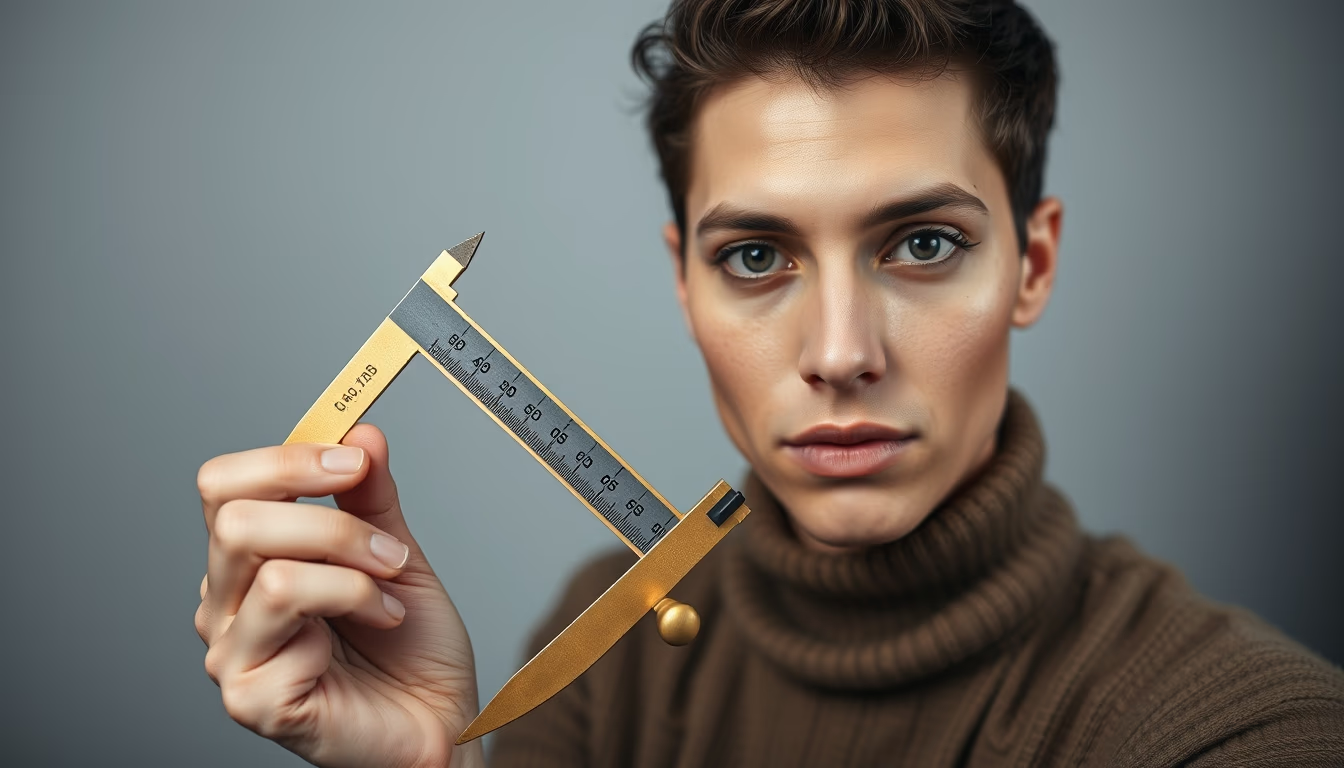
Brass vernier caliper: precision measuring tool for internal, external, and depth measurements, used in mechanics and engineering since the 17th century.
About this subject
The vernier caliper is a high-precision measuring instrument invented by the French mathematician Pierre Vernier in 1631. It operates on two scales: a fixed main scale and a sliding vernier scale (nônio) that enables finer readings, typically with a resolution of 0.05 mm or 0.001 inch. These instruments are used to measure internal and external diameters as well as depths of mechanical parts, making them essential in machining workshops, metrology labs, and engineering fields.
Brass models were common in the 17th to 19th centuries, before stainless steel became prevalent. Brass offered good corrosion resistance, ease of machining, and an aesthetic finish valued in antique tools. Many antique brass vernier calipers are now collectible items, especially those with hand-engraved scales and polished surfaces. Production of brass calipers declined in the 20th century due to cost and the development of more durable metal alloys.
Though digital calipers have made measurements faster, the mechanical vernier is still appreciated for its reliability and independence from batteries. In environments where electronic interference is a concern or simple calibration is needed, it remains a standard tool. Maintenance of these antique instruments requires care: they should be cleaned with a soft cloth and stored in a case to prevent damage to the scale and vernier.
Interestingly, the term "vernier" is sometimes used loosely to describe any caliper, but technically only those with a movable vernier scale are true vernier calipers. Despite being nearly 400 years old, the concept of amplifying readings via an auxiliary scale has inspired other precision instruments like micrometers and goniometers.
Frequently Asked Questions
How does the vernier scale work on a caliper?
The vernier scale is a movable scale that allows reading fractions of the smallest division on the main scale. It has slightly smaller divisions than the fixed scale, creating a displacement that reveals the measurement value when one of its marks aligns with a mark on the main scale. For example, a 50-division vernier spanning 49 mm enables readings of 0.02 mm.
What is the typical accuracy of a vernier caliper?
A common vernier caliper has an accuracy of 0.05 mm (0.002 inch). More refined models with a 50-division vernier achieve 0.02 mm (0.001 inch). Accuracy also depends on the quality of the scales and the operator's skill.
Why was brass used in antique precision instruments?
Brass was preferred for its corrosion resistance, ease of machining, and dimensional stability. It was easier to engrave than steel, did not rust, and had a pleasant weight. Many scientific and navigational instruments from the 18th and 19th centuries were made of brass.
Direct URL
https://pub-c7d6a6ea828543ac903a74a341ccb2e1.r2.dev/imagens/caliper-vernier-brass-studio-editorial-portrait-fresh17.avifHow to credit
Include a visible link back to UtilizAí. Copy one of the snippets below:
<a href="https://xn--utiliza-eza.com/en/midia/imagens/caliper-vernier-brass-studio-editorial-portrait-fresh17">Caliper vernier brass</a> by <a href="https://xn--utiliza-eza.com">UtilizAí</a>, licensed under <a href="https://creativecommons.org/licenses/by/4.0/">CC BY 4.0</a>.
[Caliper vernier brass](https://xn--utiliza-eza.com/en/midia/imagens/caliper-vernier-brass-studio-editorial-portrait-fresh17) by [UtilizAí](https://xn--utiliza-eza.com), CC BY 4.0
License: CC-BY-4.0