Bubble chamber tracks
1344×768 · AVIF · CC BY 4.0
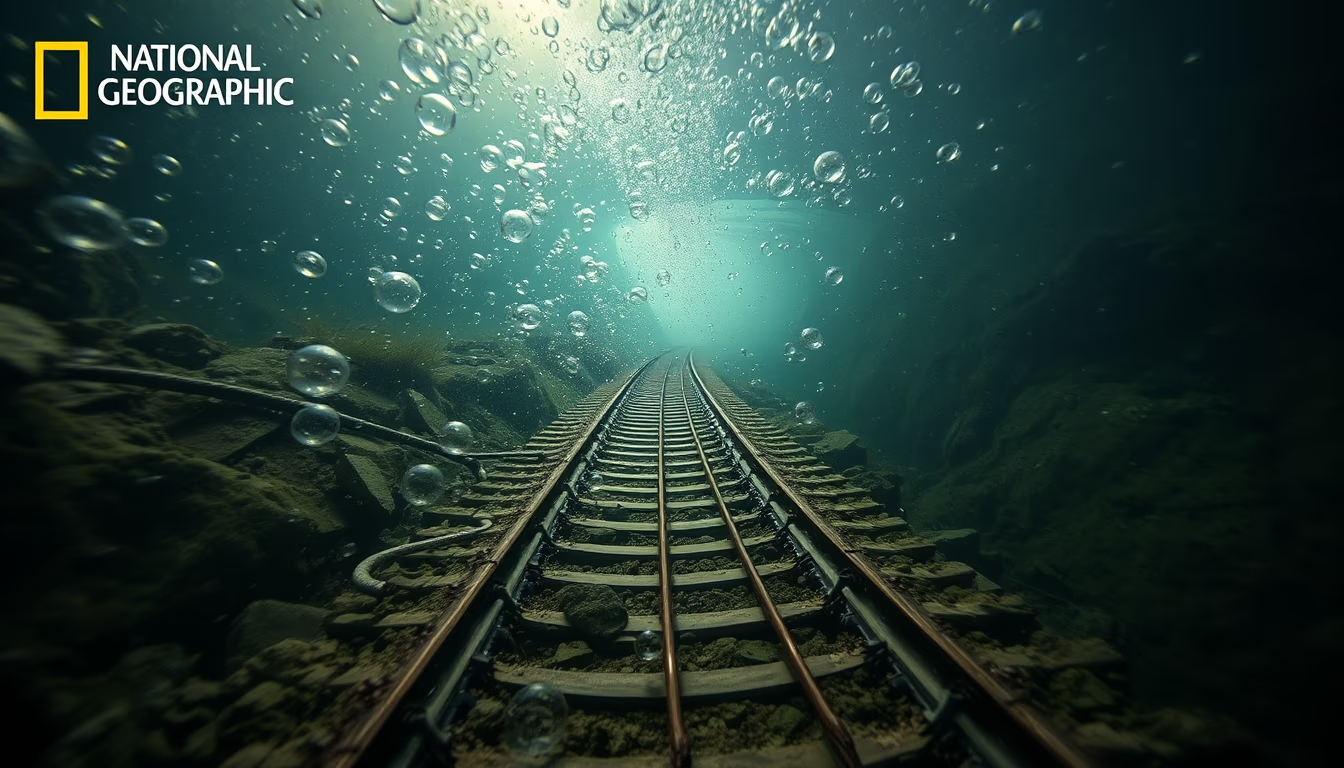
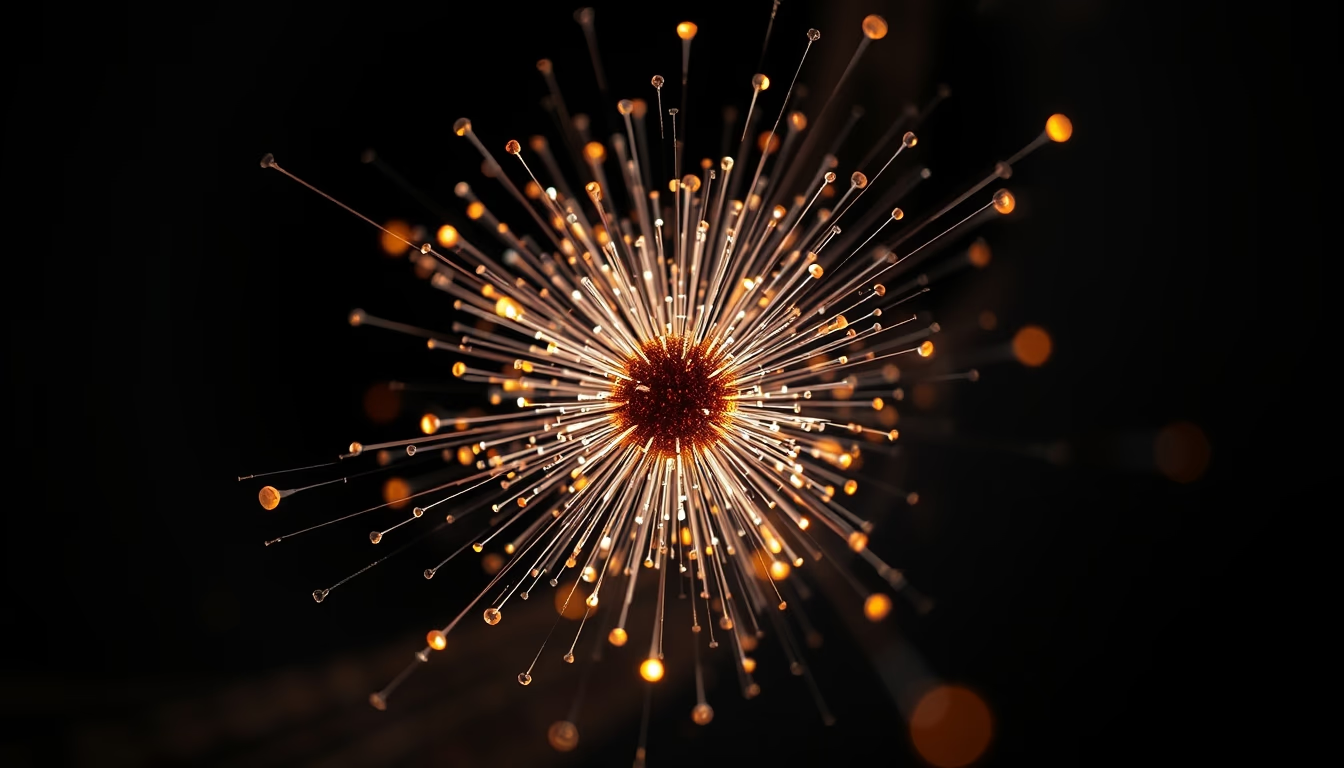
Tracks of subatomic particles in bubble chambers reveal fundamental discoveries of modern physics, such as antimatter and quarks.
About this subject
A bubble chamber is a particle detector that records the passage of subatomic particles through trails of bubbles in a superheated liquid, typically liquid hydrogen or a mixture of liquefied gases. Invented by Donald A. Glaser in 1952, for which he received the Nobel Prize in Physics in 1960, the bubble chamber revolutionized particle physics by enabling direct visualization of particle interactions and decays. In operation, the liquid is kept under pressure just above its boiling point; when a piston rapidly reduces the pressure, the liquid becomes superheated. A charged particle traversing the liquid ionizes molecules along its path, creating vapor nuclei that form bubbles. These bubbles grow and are photographed, generating three-dimensional images of the trajectories. Applied magnetic fields curve the tracks, allowing determination of charge-to-mass ratio and particle energy.
The bubble chamber was instrumental in major discoveries, such as the antiproton (1955) and the antineutron (1956) at the Bevatron, confirming the existence of antimatter. In the 1960s and 1970s, experiments with bubble chambers at accelerators like CERN and Fermilab led to the identification of numerous particles, including strange baryons and resonances, contributing to the development of the Standard Model. One notable collaboration was Gargamelle, a huge bubble chamber filled with propane and freon at CERN, which in 1973 discovered weak neutral currents, crucial evidence for the W and Z bosons.
Despite its great success, bubble chambers were gradually replaced by faster electronic detectors with higher data acquisition rates from the 1980s onward. However, their legacy endures: images of helical tracks and interaction vertices are icons of experimental physics. Today, modern image analysis techniques and digital repositories allow physicists to revisit historical data for new discoveries, and the aesthetics of bubble chamber photographs inspire art and science exhibitions.
Interestingly, the bubble chamber principle is analogous to that of the cloud chamber, invented by C.T.R. Wilson in 1911, which uses supersaturated vapor to visualize particles. Both techniques rely on droplet or bubble nucleation along the ionizing track. The bubble chamber stands out for its higher density (up to 1000 times that of gas), enabling clearer recording of higher-energy particles.
Frequently Asked Questions
What is a bubble chamber?
A bubble chamber is a particle detector that records trails of bubbles produced by subatomic particles as they pass through a superheated liquid, such as liquid hydrogen. It allows visualization of particle interactions and decays.
What major discoveries were made with bubble chambers?
Bubble chambers were crucial for discovering the antiproton and antineutron (antimatter), as well as many other particles like strange baryons. They also revealed weak neutral currents, confirming the existence of W and Z bosons.
Why did bubble chambers fall out of use?
Bubble chambers were gradually replaced by faster electronic detectors, such as wire chambers and spark chambers, which offered higher data collection rates and less dead time, making them more suitable for high-event-rate experiments.
Direct URL
https://pub-c7d6a6ea828543ac903a74a341ccb2e1.r2.dev/imagens/bubble-chamber-tracks-national-geographic-style-p4.avifHow to credit
Include a visible link back to UtilizAí. Copy one of the snippets below:
<a href="https://xn--utiliza-eza.com/en/midia/imagens/bubble-chamber-tracks-national-geographic-style-p4">Bubble chamber tracks</a> by <a href="https://xn--utiliza-eza.com">UtilizAí</a>, licensed under <a href="https://creativecommons.org/licenses/by/4.0/">CC BY 4.0</a>.
[Bubble chamber tracks](https://xn--utiliza-eza.com/en/midia/imagens/bubble-chamber-tracks-national-geographic-style-p4) by [UtilizAí](https://xn--utiliza-eza.com), CC BY 4.0
License: CC-BY-4.0