Bubble chamber tracks
1344×768 · AVIF · CC BY 4.0
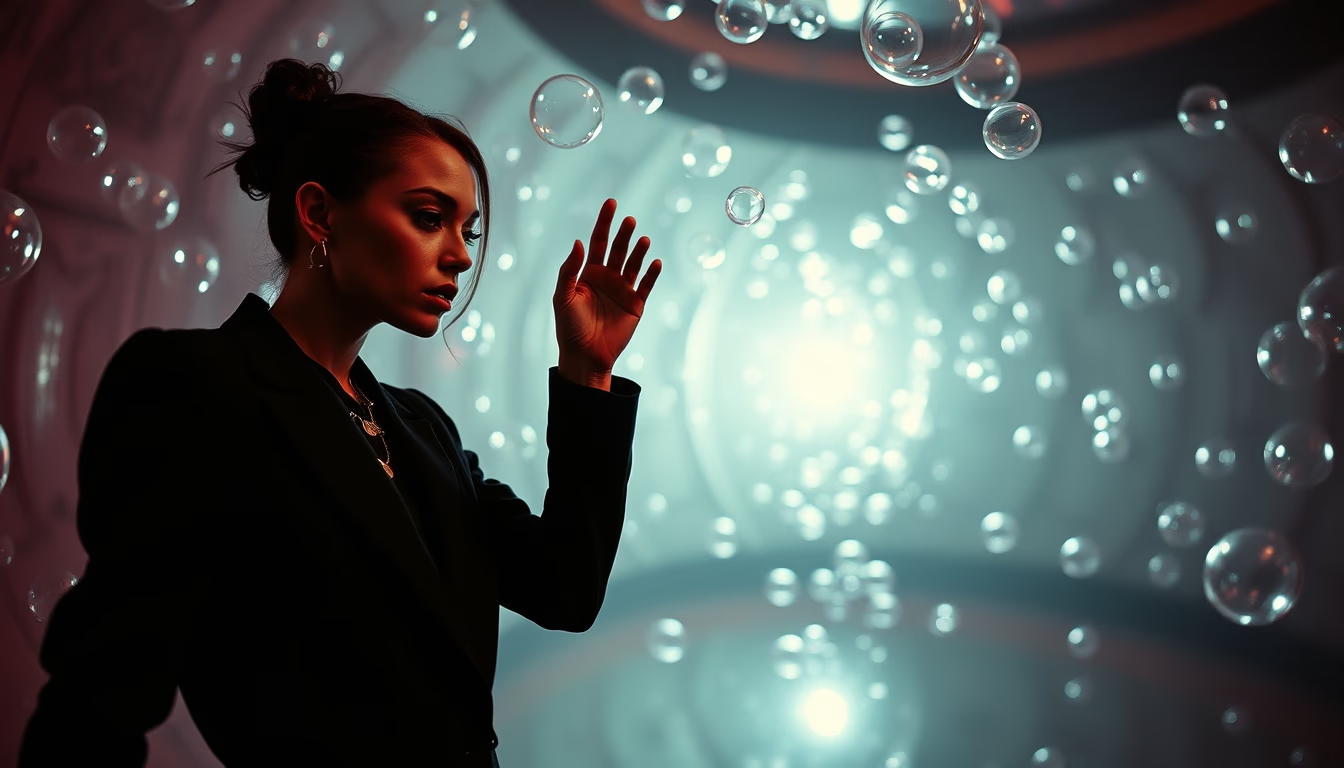
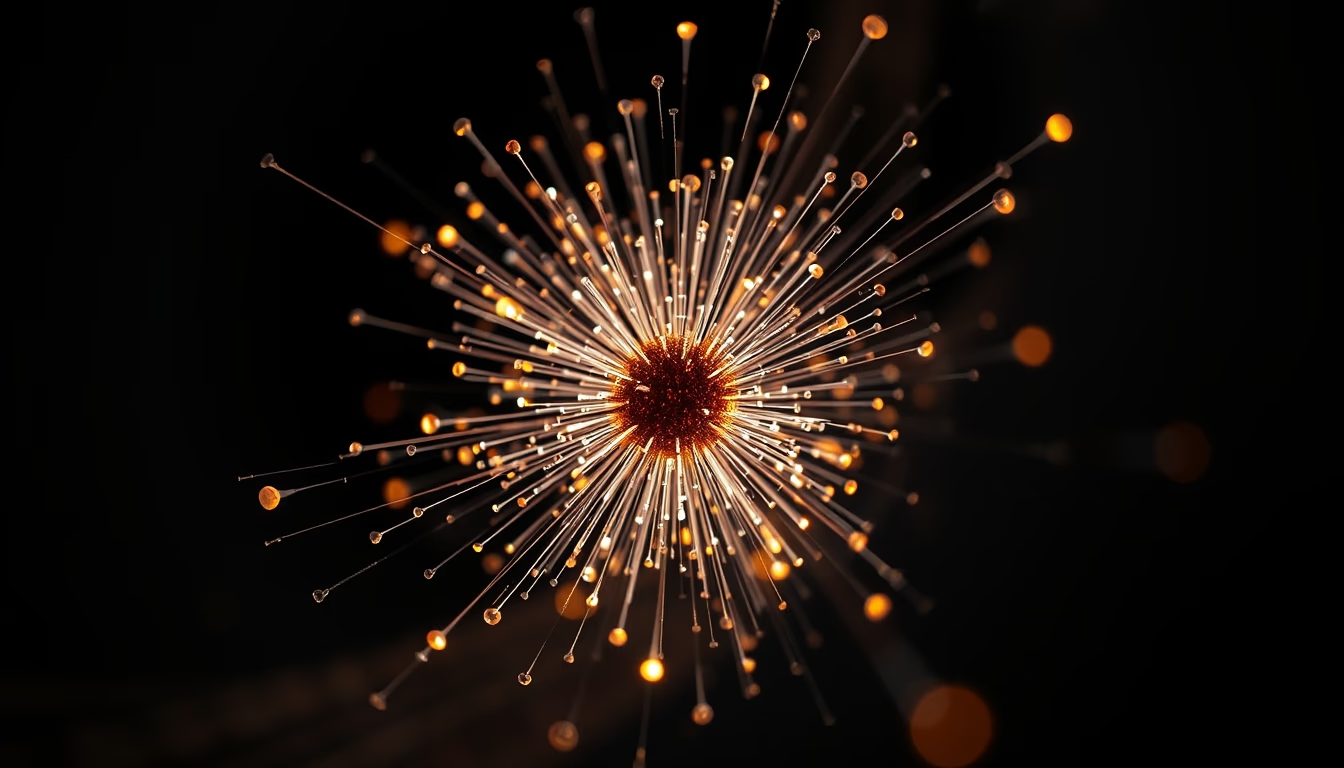
Bubble chamber tracks reveal the paths of subatomic particles in a superheated liquid, a technique that revolutionized particle physics in the 1950s.
About this subject
The bubble chamber was invented by American physicist Donald A. Glaser in 1952, a feat that earned him the Nobel Prize in Physics in 1960. The principle is deceptively simple: a container holds a liquid, such as liquid hydrogen, kept under pressure just above its boiling point. When a charged particle passes through the liquid, it deposits energy along its path, causing the liquid to boil locally and form a visible trail of bubbles. These bubbles are photographed and analyzed to determine the particle's energy, mass, and charge.
The bubble chamber became a central tool in high-energy physics experiments, particularly at accelerators like the Bevatron in Berkeley and CERN in Europe. With it, scientists discovered several particles, including the omega-minus, which confirmed the quark theory. Unlike nuclear emulsions, which recorded tracks passively, the bubble chamber allowed real-time observation and selective triggering for rare events.
Although largely replaced by modern electronic detectors such as wire chambers and silicon detectors, the bubble chamber left an undeniable aesthetic legacy. The images of spiraling and branching tracks, from electrons, pions, and kaons, are often associated with the beauty of particle physics. In recent years, these images have inspired art and fashion projects, exploring the contrast between apparent chaos and the underlying order of natural laws, a concept that resonates with high-fashion aesthetics.
Frequently Asked Questions
What is a bubble chamber?
A bubble chamber is a particle detector that uses a superheated liquid to visualize the trajectories of subatomic particles. When a charged particle passes through the liquid, it causes bubbles to form along its path, which are photographed for analysis.
Who invented the bubble chamber?
American physicist Donald A. Glaser invented the bubble chamber in 1952, for which he received the Nobel Prize in Physics in 1960.
Which famous particles were discovered using bubble chambers?
Among the most notable discoveries is the omega-minus meson (Ω⁻), which confirmed the existence of the strange quark and validated Gell-Mann's eightfold way model.
Direct URL
https://pub-c7d6a6ea828543ac903a74a341ccb2e1.r2.dev/imagens/bubble-chamber-tracks-high-fashion-editorial-p5.avifHow to credit
Include a visible link back to UtilizAí. Copy one of the snippets below:
<a href="https://xn--utiliza-eza.com/en/midia/imagens/bubble-chamber-tracks-high-fashion-editorial-p5">Bubble chamber tracks</a> by <a href="https://xn--utiliza-eza.com">UtilizAí</a>, licensed under <a href="https://creativecommons.org/licenses/by/4.0/">CC BY 4.0</a>.
[Bubble chamber tracks](https://xn--utiliza-eza.com/en/midia/imagens/bubble-chamber-tracks-high-fashion-editorial-p5) by [UtilizAí](https://xn--utiliza-eza.com), CC BY 4.0
License: CC-BY-4.0