Bubble chamber tracks
1344×768 · AVIF · CC BY 4.0
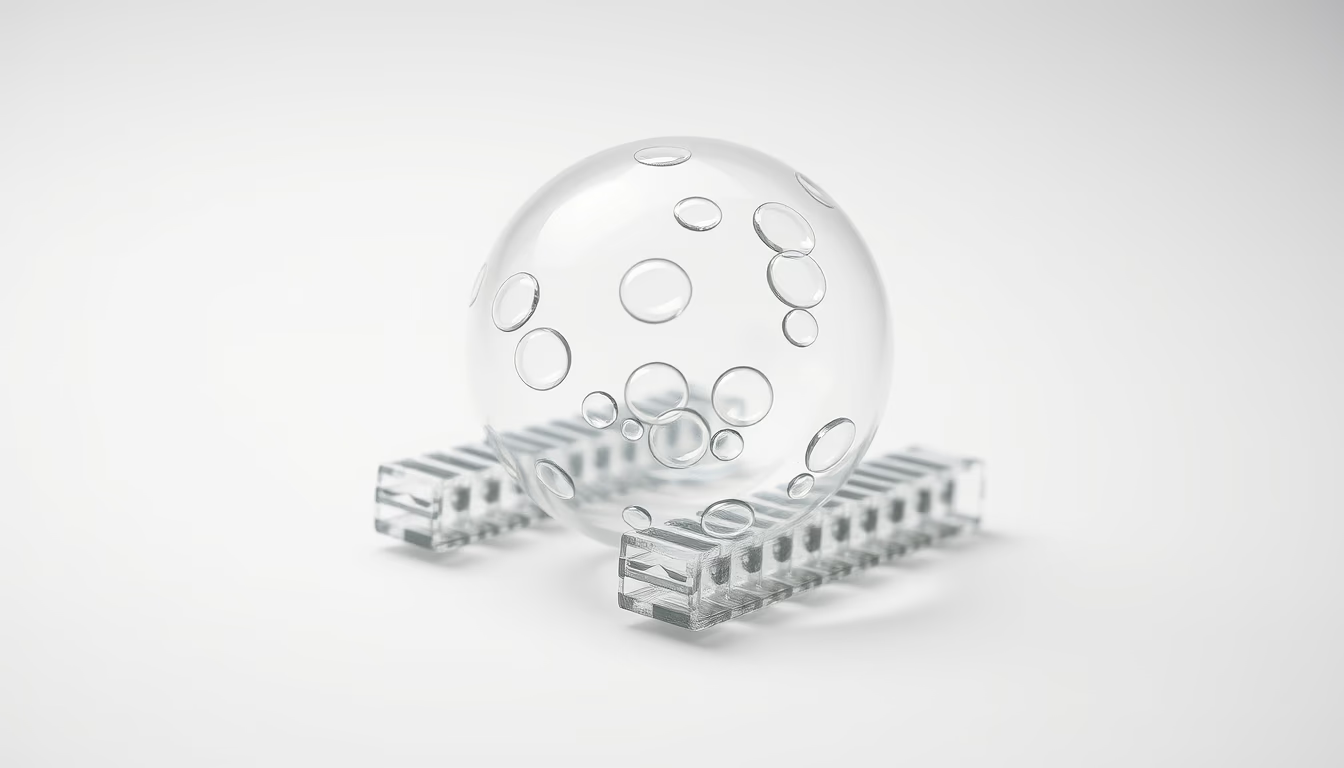
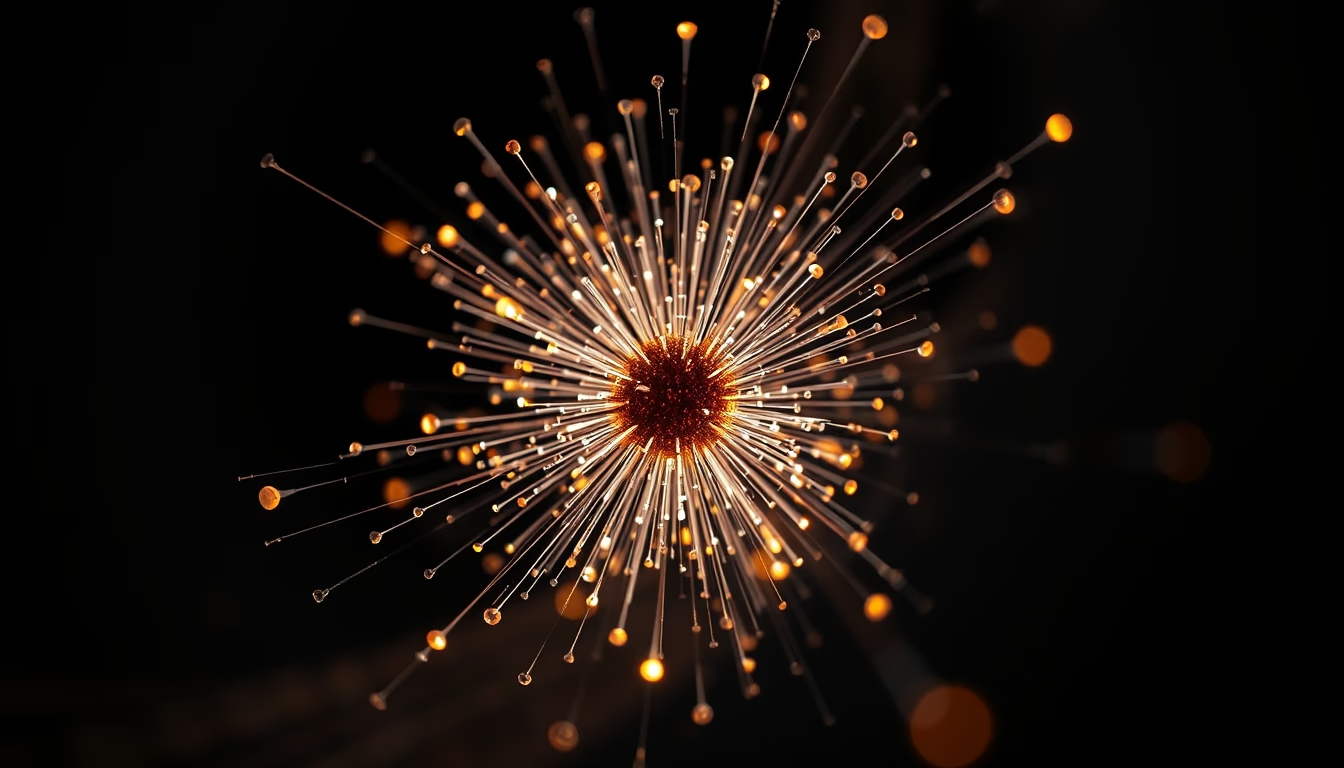
Bubble chamber tracks are visual records of subatomic particles in motion, revealing curved trajectories influenced by magnetic fields.
About this subject
The bubble chamber is a particle detector invented by American physicist Donald Glaser in 1952, work that earned him the Nobel Prize in Physics in 1960. The device consists of a container filled with a superheated liquid, usually hydrogen or deuterium, kept in a state of unstable equilibrium. When a charged particle traverses the liquid, it ionizes molecules along its path, creating vapor nuclei that expand into visible bubbles. These bubbles are photographed immediately after the particle passes, generating the iconic spiral track images.
The shape and curvature of the tracks provide crucial information about the particles. In an applied magnetic field, charged particles follow curved paths, with the radius of curvature determined by the particle's charge-to-mass ratio. Heavier particles, like protons, curve less, while lighter ones, like electrons, form tight spirals. Neutral particles, such as neutrons and photons, leave no direct tracks, but their presence can be inferred from secondary interactions, like the sudden emergence of an electron-positron pair from a gamma ray.
Bubble chambers were fundamental to particle physics from the 1950s to the 1970s. Among their most notable contributions was the discovery of the omega-minus particle at Brookhaven National Laboratory in 1964, confirming the quark theory. They were also used in neutrino experiments at CERN and in the US, leading to the observation of weak neutral currents. Although replaced by faster electronic detectors from the 1970s onward, bubble chamber images remain iconic symbols of the heroic era of experimental physics.
Today, bubble chamber photographs are often used in science outreach and textbooks. They intuitively illustrate abstract concepts like momentum, charge, and particle interactions. The aesthetic beauty of these images has also turned them into art, exhibited in science museums worldwide. While rarely operational now, some chambers have been preserved for historical or educational purposes, such as the CERN 80 cm bubble chamber on display at the Science Museum in London.
Frequently Asked Questions
What is a bubble chamber?
It is a particle detector that records the passage of charged particles through a superheated liquid, forming bubbles along their trajectories.
How do bubble chamber tracks help identify particles?
The curvature of tracks in a magnetic field reveals the charge-to-mass ratio, allowing identification. The radius of curvature and bubble density also provide information about speed and energy.
Who invented the bubble chamber?
It was invented by American physicist Donald Glaser in 1952, for which he received the Nobel Prize in Physics in 1960.
Direct URL
https://pub-c7d6a6ea828543ac903a74a341ccb2e1.r2.dev/imagens/bubble-chamber-tracks-commercial-product-photography-p2.avifHow to credit
Include a visible link back to UtilizAí. Copy one of the snippets below:
<a href="https://xn--utiliza-eza.com/en/midia/imagens/bubble-chamber-tracks-commercial-product-photography-p2">Bubble chamber tracks</a> by <a href="https://xn--utiliza-eza.com">UtilizAí</a>, licensed under <a href="https://creativecommons.org/licenses/by/4.0/">CC BY 4.0</a>.
[Bubble chamber tracks](https://xn--utiliza-eza.com/en/midia/imagens/bubble-chamber-tracks-commercial-product-photography-p2) by [UtilizAí](https://xn--utiliza-eza.com), CC BY 4.0
License: CC-BY-4.0