Bubble chamber tracks
1344×768 · AVIF · CC BY 4.0
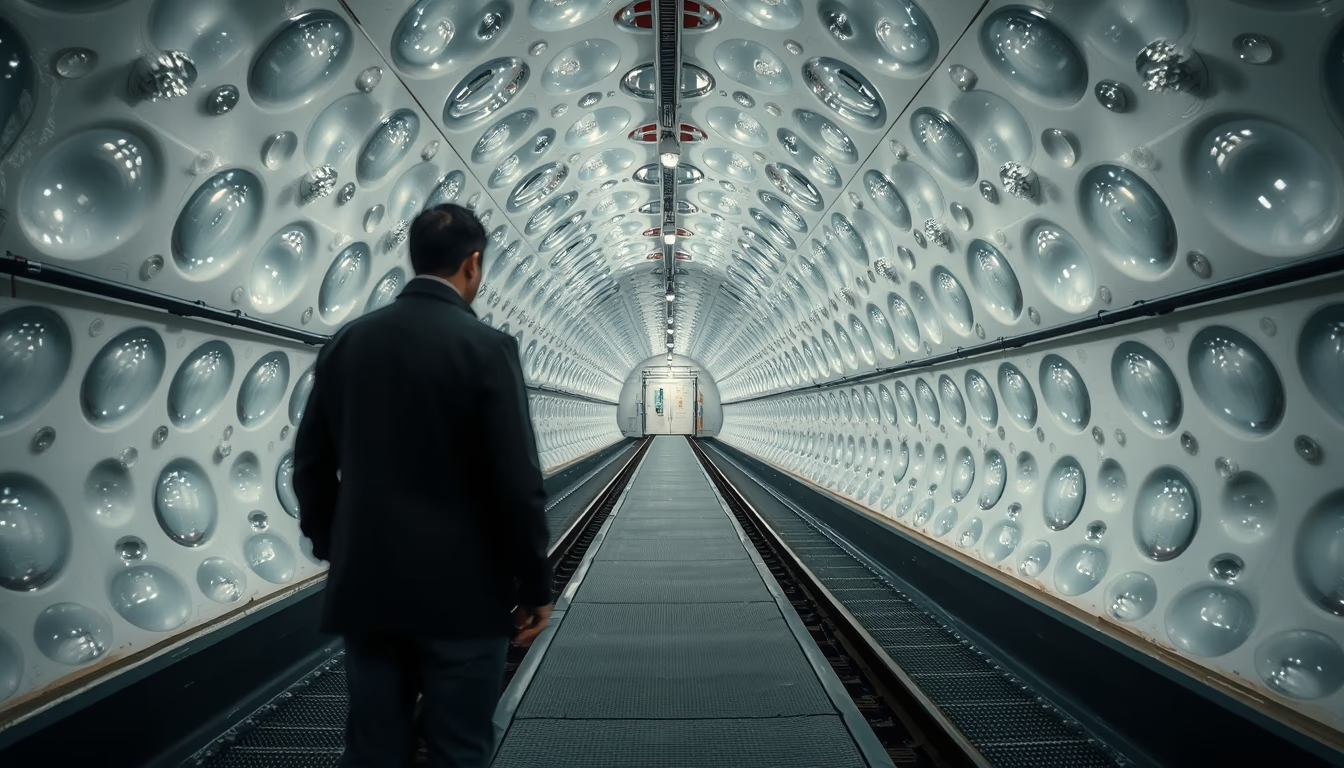
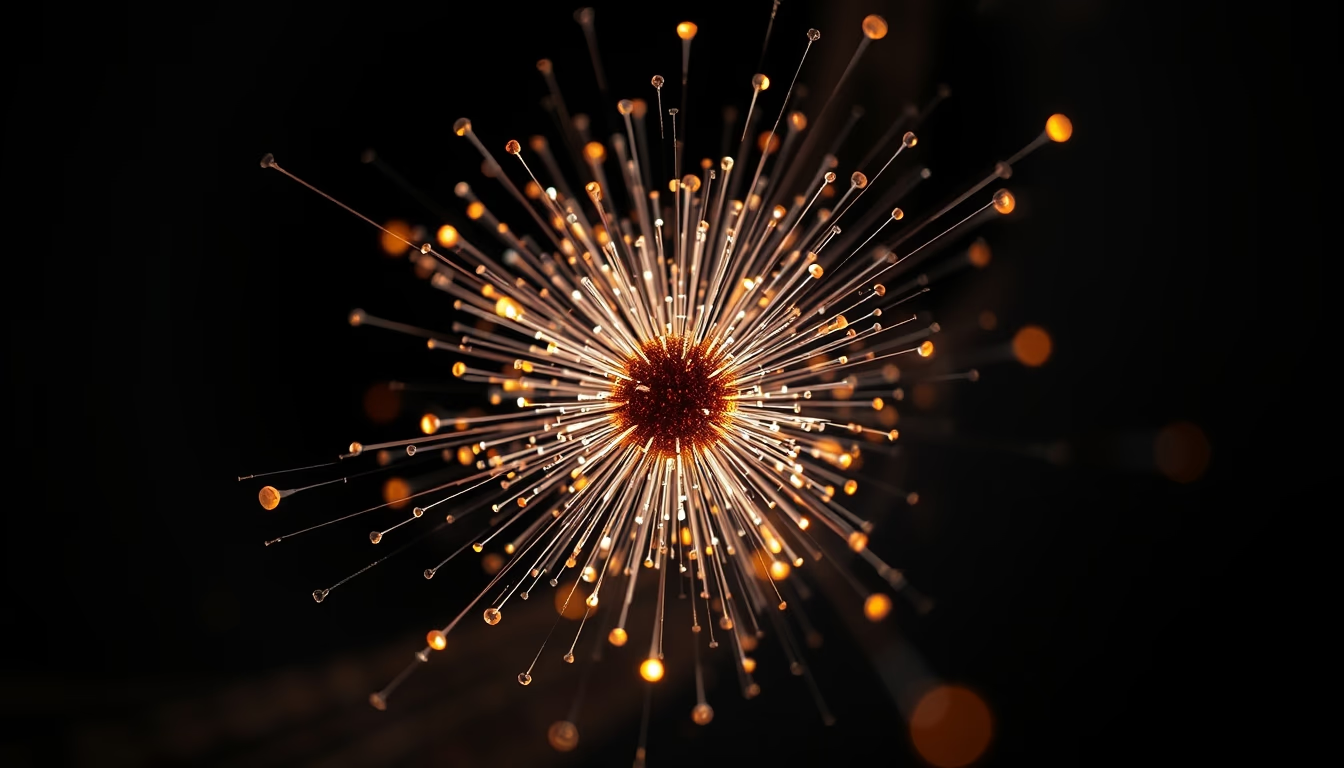
Bubble chamber tracks are visual records of subatomic particles, revealing collisions and decays in high-energy physics experiments.
About this subject
Bubble chambers were invented by Donald Glaser in 1952, a breakthrough that earned him the Nobel Prize in Physics in 1960. The principle is straightforward: a superheated liquid (usually liquid hydrogen) is kept just below its boiling point. When a charged particle traverses the liquid, it ionizes the medium, creating vapor nuclei that grow into bubbles along the track. These bubbles are photographed, producing the iconic images of spiral and straight trajectories.
Each track tells a story. Particles like electrons, positrons, protons, and mesons leave distinctive patterns; their curvature in a magnetic field indicates charge and momentum. Bubble density along the track reveals particle speed. In experiments at CERN, chambers like Gargamelle (a 12-cubic-meter monster filled with freon) helped discover weak neutral currents in 1973, a key confirmation of the electroweak unification.
The historical importance of bubble chambers is immense. Before modern electronic detectors, they were the primary tool for visualizing particle interactions. The 2-meter bubble chamber at SLAC produced millions of photographs analyzed manually by scientists. Although largely replaced by detectors like time projection chambers (TPCs), bubble chamber images remain valuable educational tools and icons of 20th-century experimental physics.
A curiosity: track analysis relied on specialized human scanners who spent hours poring over photographs. Today, machine learning algorithms can perform this task, yet the original images endure as both scientific and artistic records of humanity's quest to understand matter.
Frequently Asked Questions
How does a bubble chamber work?
A bubble chamber contains a superheated liquid, such as liquid hydrogen, kept just above its boiling point. When a charged particle passes through, it ionizes the medium, creating tiny bubbles along its path. These bubbles are photographed, forming visible tracks.
What do bubble chamber tracks reveal about particles?
The curvature of tracks in a magnetic field indicates the particle's electric charge and momentum. The bubble density along the track reveals its speed. Different particles produce characteristic patterns, allowing identification.
Are bubble chambers still used today?
They are no longer widely used for cutting-edge experiments, having been replaced by faster and more versatile electronic detectors like time projection chambers. However, they remain important for educational and historical purposes.
Direct URL
https://pub-c7d6a6ea828543ac903a74a341ccb2e1.r2.dev/imagens/bubble-chamber-tracks-architectural-photography-p6.avifHow to credit
Include a visible link back to UtilizAí. Copy one of the snippets below:
<a href="https://xn--utiliza-eza.com/en/midia/imagens/bubble-chamber-tracks-architectural-photography-p6">Bubble chamber tracks</a> by <a href="https://xn--utiliza-eza.com">UtilizAí</a>, licensed under <a href="https://creativecommons.org/licenses/by/4.0/">CC BY 4.0</a>.
[Bubble chamber tracks](https://xn--utiliza-eza.com/en/midia/imagens/bubble-chamber-tracks-architectural-photography-p6) by [UtilizAí](https://xn--utiliza-eza.com), CC BY 4.0
License: CC-BY-4.0