Brazilian Bitcoin miner inspecting industrial mining rigs
1344×768 · AVIF · CC BY 4.0
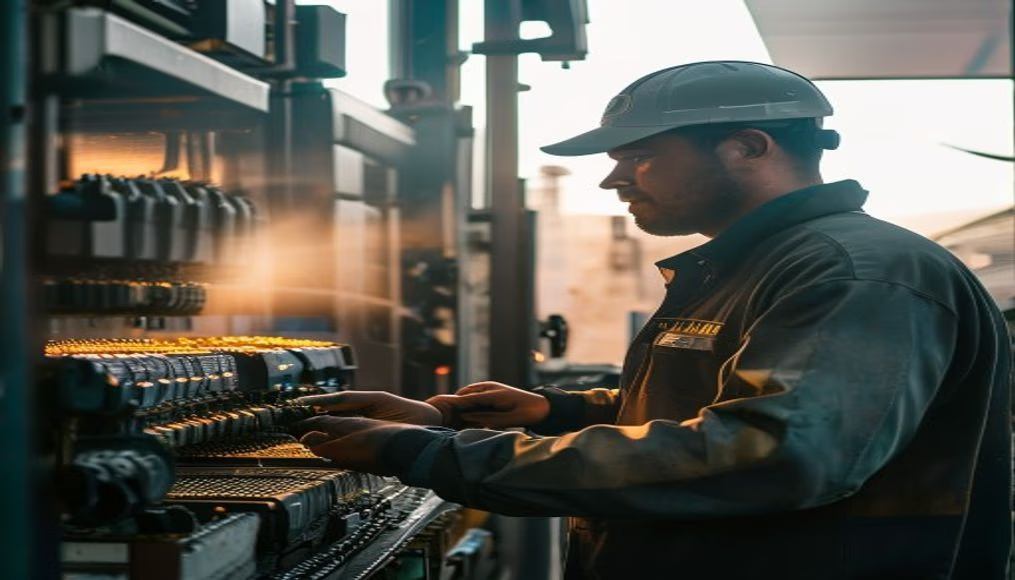
Brazilian Bitcoin miner inspects industrial mining rigs on an overcast day, highlighting the infrastructure behind the cryptocurrency.
About this subject
Bitcoin mining is the process that validates transactions and adds new blocks to the blockchain. In Brazil, this activity has grown significantly with the installation of large mining farms, especially in regions with low-cost electricity, such as the South and Southeast. The industrial rigs shown in the image are composed of hundreds of ASICs (application-specific integrated circuits), machines optimized exclusively for calculating SHA-256 hashes. Each unit consumes about 3,000 to 3,500 watts, making the electricity bill the main operational cost.
The miner in the photo performs a routine inspection, checking component temperatures and fan efficiency. In industrial environments, ambient temperature is strictly controlled to prevent overheating, as ASICs operate 24/7. Preventive maintenance is crucial to maximize hashrate and avoid downtime that reduces profitability. In Brazil, the National Electric Energy Agency (ANEEL) classifies these operations as high-voltage consumers, requiring special contracts with distributors.
Interestingly, Bitcoin mining in Brazil faces regulatory challenges. In 2023, the Central Bank issued rules on crypto asset declaration, but the activity still lacks specific legislation. Despite this, the country stands out in Latin America for its use of renewable sources, such as hydroelectric plants, to power rigs. It is estimated that over 70% of energy used in Brazilian mining comes from clean sources, contrasting with the global average of about 50%.
The inspection shown in the image reflects the routine of professionals who monitor hundreds of machines simultaneously. With the recent drop in block reward (halving in 2024), operational efficiency has become even more important. Brazilian miners seek innovations such as liquid immersion cooling to reduce costs, but most still use forced air systems, like those visible in the scene.
Frequently Asked Questions
What is an ASIC and why is it used in mining?
ASIC is a chip designed exclusively to compute SHA-256 hashes, Bitcoin's algorithm. It is much more efficient than CPUs or GPUs, consuming less energy per hash.
What is the energy cost for mining Bitcoin in Brazil?
Costs vary by region, but on average, each ASIC consumes 3,250 watts. With industrial rates around $0.10/kWh, monthly spending per machine can exceed $300.
Is Bitcoin mining legal in Brazil?
Yes, there is no prohibition. However, the Federal Revenue requires income declaration, and the Central Bank regulates crypto asset services.
Direct URL
https://pub-c7d6a6ea828543ac903a74a341ccb2e1.r2.dev/imagens/brazilian-bitcoin-miner-inspecting-industrial-mining-rigs-editorial-overcast-daytime-6.avifHow to credit
Include a visible link back to UtilizAí. Copy one of the snippets below:
<a href="https://xn--utiliza-eza.com/en/midia/imagens/brazilian-bitcoin-miner-inspecting-industrial-mining-rigs-editorial-overcast-daytime-6">Brazilian Bitcoin miner inspecting industrial mining rigs</a> by <a href="https://xn--utiliza-eza.com">UtilizAí</a>, licensed under <a href="https://creativecommons.org/licenses/by/4.0/">CC BY 4.0</a>.
[Brazilian Bitcoin miner inspecting industrial mining rigs](https://xn--utiliza-eza.com/en/midia/imagens/brazilian-bitcoin-miner-inspecting-industrial-mining-rigs-editorial-overcast-daytime-6) by [UtilizAí](https://xn--utiliza-eza.com), CC BY 4.0
License: CC-BY-4.0