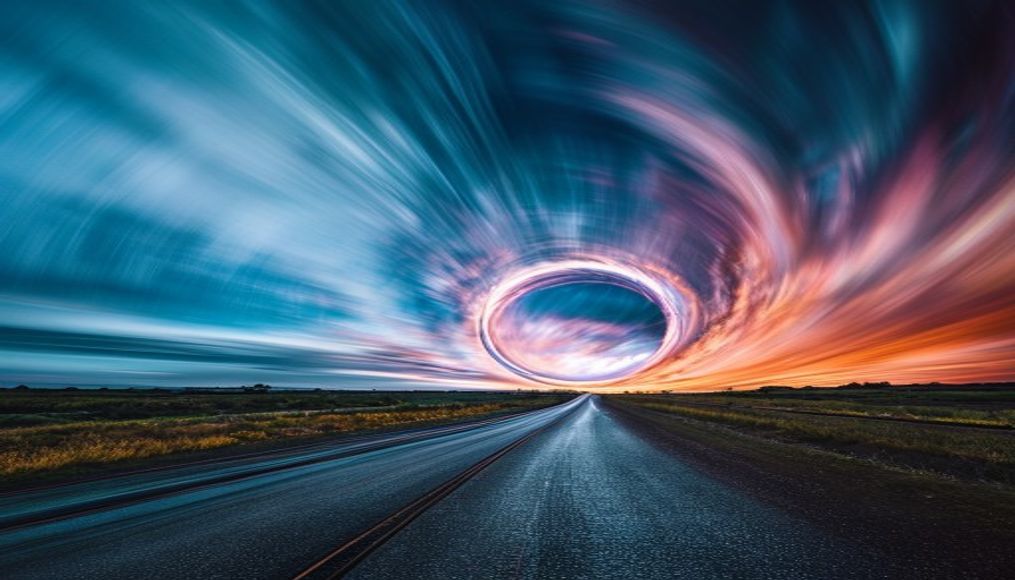
Black hole event horizon
1344×768 · AVIF · CC BY 4.0

The event horizon of a black hole is the boundary beyond which nothing, not even light, can escape.
About this subject
At the center of a black hole, infinite density forms a singularity where the laws of physics as we know them break down. The event horizon is the point of no return: once crossed, any object or radiation is inexorably pulled inward. To a distant observer, time appears to freeze at this boundary due to the immense curvature of spacetime. The most massive black holes, supermassive ones, reside at the centers of galaxies, with masses equivalent to millions or billions of suns. Sagittarius A, at the center of the Milky Way, has about 4 million solar masses, and its event horizon would span approximately 44 million kilometers. A stellar-mass black hole, formed from the collapse of a massive star, can have an event horizon only a few kilometers in radius. In 2019, the Event Horizon Telescope (EHT) produced the first direct image of a black hole: M87, with 6.5 billion solar masses, revealing a bright ring around a dark shadow, the silhouette of the event horizon. This image confirmed predictions of Einstein's General Relativity. Ongoing studies aim to understand the dynamics of relativistic jets and the possible connection to information that appears to be lost in these cosmic objects.
Frequently Asked Questions
What happens if someone crosses the event horizon?
Upon crossing the event horizon, a person would be stretched in a process called spaghettification due to extreme tidal forces. Inside, no signals can be sent outward; any communication is impossible.
Do all black holes have the same event horizon size?
No. The radius of the event horizon is proportional to the black hole's mass. Supermassive black holes can have horizons larger than the solar system, while stellar-mass black holes are only a few dozen kilometers across.
How did scientists photograph the event horizon if it is dark?
The EHT image shows the shadow of the event horizon against the glowing gas around it. The black hole itself emits no light, but superheated material in the accretion disk radiates, highlighting the dark outline.
Direct URL
https://pub-c7d6a6ea828543ac903a74a341ccb2e1.r2.dev/imagens/black-hole-event-horizon-studio-still-life-p0.avifHow to credit
Include a visible link back to UtilizAí. Copy one of the snippets below:
<a href="https://xn--utiliza-eza.com/en/midia/imagens/black-hole-event-horizon-studio-still-life-p0">Black hole event horizon</a> by <a href="https://xn--utiliza-eza.com">UtilizAí</a>, licensed under <a href="https://creativecommons.org/licenses/by/4.0/">CC BY 4.0</a>.
[Black hole event horizon](https://xn--utiliza-eza.com/en/midia/imagens/black-hole-event-horizon-studio-still-life-p0) by [UtilizAí](https://xn--utiliza-eza.com), CC BY 4.0
License: CC-BY-4.0