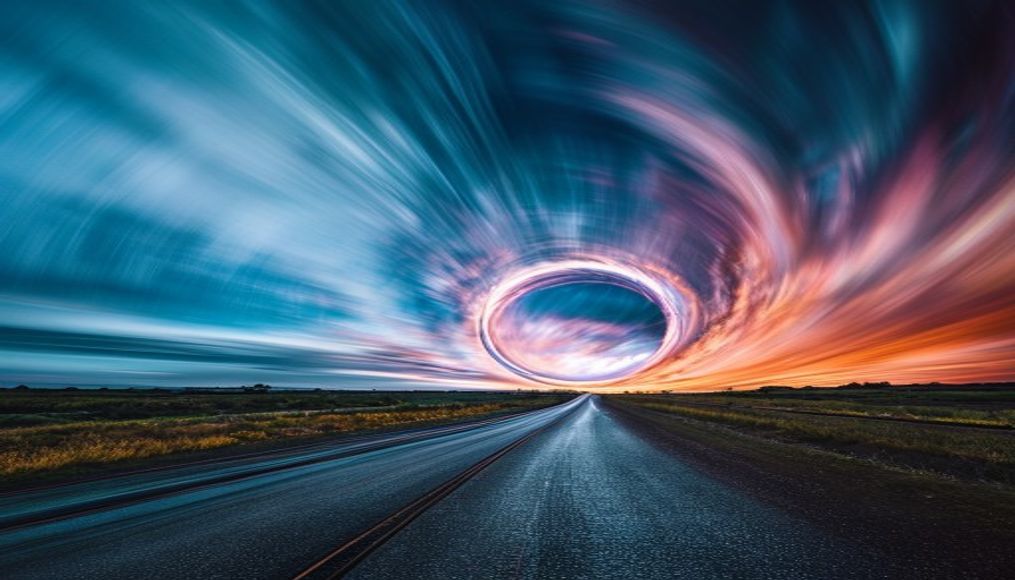
Black hole event horizon
1344×768 · AVIF · CC BY 4.0
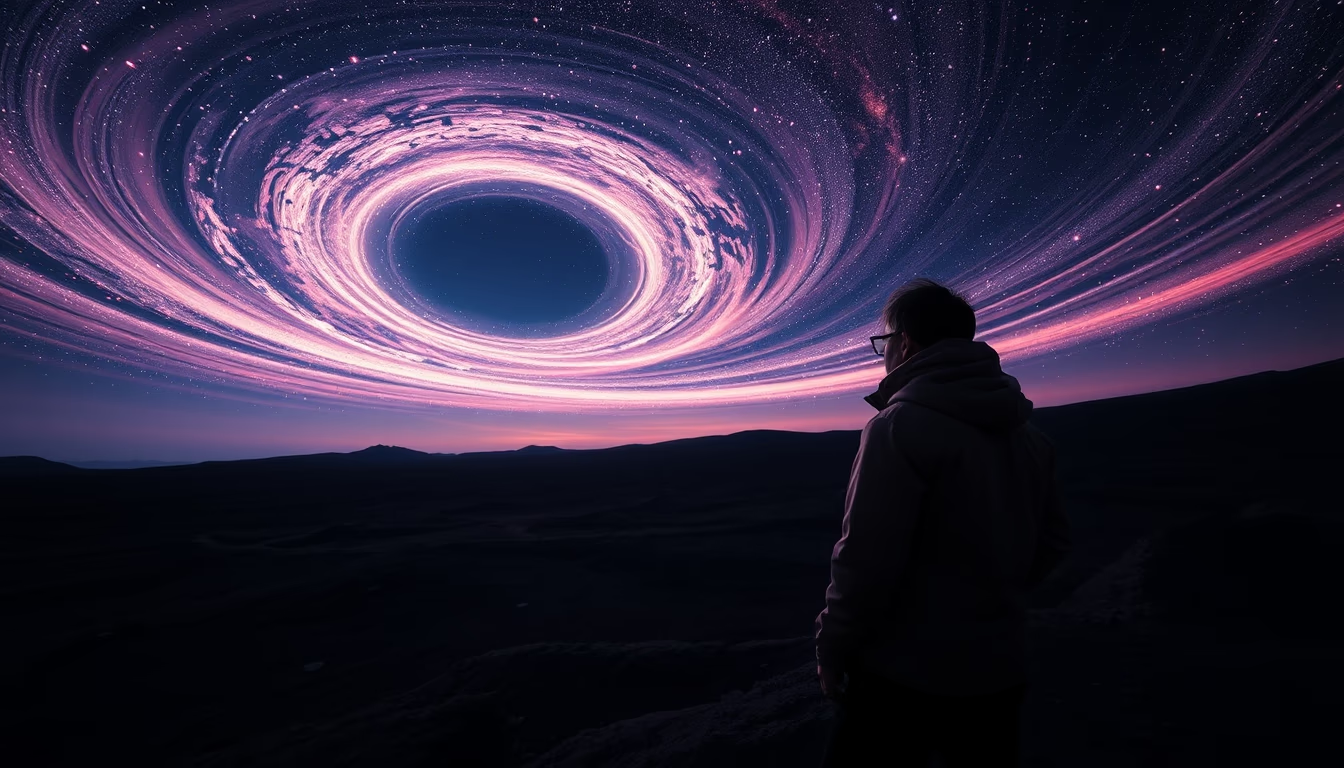
Black holes are regions of spacetime where gravity is so strong that nothing, not even light, can escape. The event horizon is the boundary defining this point of no return.
About this subject
Black holes are astronomical objects predicted by Einstein's General Theory of Relativity. A black hole forms when a massive star collapses under its own gravity, concentrating a huge amount of mass into an extremely small volume. The event horizon is the surface surrounding this point, from which the escape velocity exceeds the speed of light. This means anything that crosses this boundary, whether matter or radiation, becomes permanently trapped.
The concept of an event horizon is not merely theoretical. In 2019, the Event Horizon Telescope (EHT) captured the first direct image of a black hole, M87, located at the center of galaxy M87, about 55 million light-years from Earth. That image revealed a bright ring of light surrounding a dark region, which exactly matches the black hole's shadow projected against the hot matter of the accretion disk. The diameter of M87's event horizon is about 40 billion kilometers, larger than Neptune's orbit.
Black holes can be classified into three types: stellar-mass (with masses of a few dozen solar masses), supermassive (with millions to billions of solar masses, like M87 and Sagittarius A at the center of the Milky Way), and intermediate (still hypothetical). The event horizon of a typical stellar black hole is only a few kilometers in radius, while that of a supermassive one can be millions of kilometers. Despite their extreme nature, black holes are not cosmic vacuum cleaners; they only affect objects that come too close to their event horizon.
An interesting curiosity: inside the event horizon, the laws of physics as we know them break down. Space and time swap roles, so that the future of any object inside inevitably points toward the central singularity, where spacetime curvature becomes infinite. Ongoing studies with numerical simulations and gravitational observations, such as those by LIGO and Virgo, continue to reveal surprising properties of these fascinating objects.
Frequently Asked Questions
What is the event horizon of a black hole?
The event horizon is the boundary around a black hole from which nothing, not even light, can escape the gravitational pull. It is the point of no return.
How did scientists obtain the first image of a black hole?
Using the Event Horizon Telescope (EHT), a global network of radio telescopes, in 2019. They captured the shadow of the black hole M87* and its accretion disk.
What happens to matter that crosses the event horizon?
The matter is drawn toward the central singularity. Once inside, space and time swap roles, and the future path inevitably leads to the singularity.
Direct URL
https://pub-c7d6a6ea828543ac903a74a341ccb2e1.r2.dev/imagens/black-hole-event-horizon-long-exposure-p1.avifHow to credit
Include a visible link back to UtilizAí. Copy one of the snippets below:
<a href="https://xn--utiliza-eza.com/en/midia/imagens/black-hole-event-horizon-long-exposure-p1">Black hole event horizon</a> by <a href="https://xn--utiliza-eza.com">UtilizAí</a>, licensed under <a href="https://creativecommons.org/licenses/by/4.0/">CC BY 4.0</a>.
[Black hole event horizon](https://xn--utiliza-eza.com/en/midia/imagens/black-hole-event-horizon-long-exposure-p1) by [UtilizAí](https://xn--utiliza-eza.com), CC BY 4.0
License: CC-BY-4.0