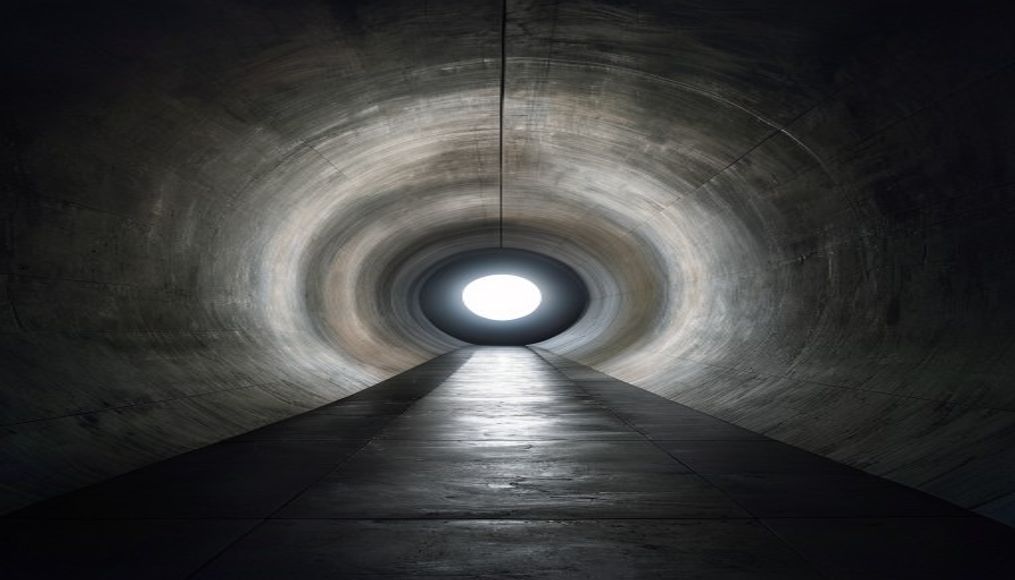
Big bang tunnel cern
1344×768 · AVIF · CC BY 4.0
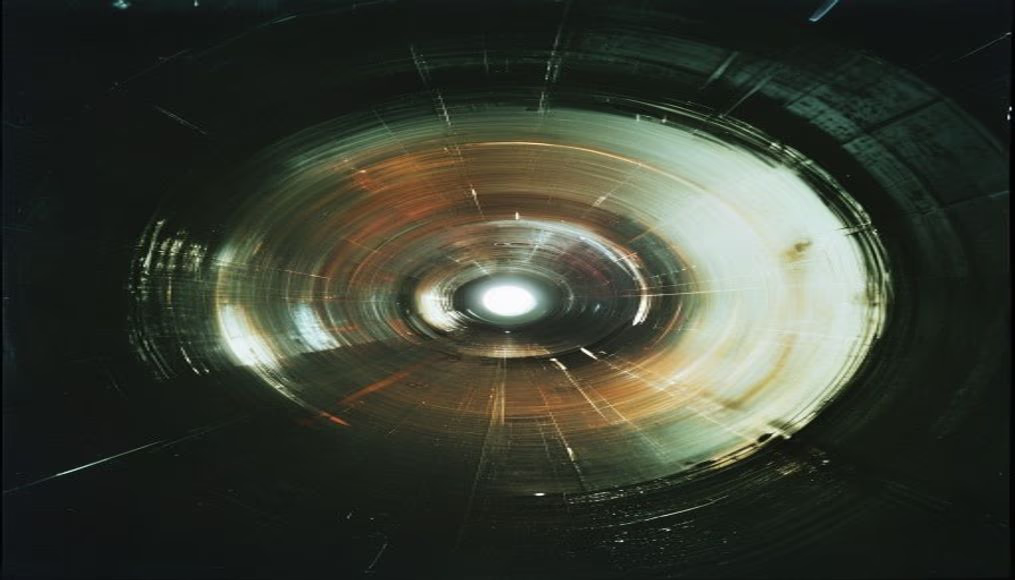
The Large Hadron Collider (LHC) tunnel at CERN, on the Franco-Swiss border, is the world's largest and most powerful particle accelerator.
About this subject
The LHC is a 27-kilometer underground ring, located about 100 meters deep. Construction began in 1998 and was completed in 2008, at a total cost of approximately 4.75 billion euros (at the time). The tunnel houses superconducting magnets that accelerate proton beams to near-light speeds, making them collide at four main points. These collisions recreate conditions similar to those just after the Big Bang, allowing studies on the origin of matter and fundamental forces.
In 2012, the LHC was instrumental in discovering the Higgs boson, a particle predicted by the Standard Model of particle physics. The confirmation led to the Nobel Prize in Physics for Peter Higgs and François Englert in 2013. Additionally, the LHC has produced a wide range of results, such as the observation of new exotic particles and precise measurements of rare phenomena. Currently, the accelerator is undergoing upgrades for the High-Luminosity LHC, which will increase the collision rate fivefold starting in 2029.
CERN, the European Organization for Nuclear Research, was founded in 1954 and includes 23 member states. The LHC tunnel crosses the border between France and Switzerland, passing beneath the Geneva region. The infrastructure includes four main detectors: ATLAS, CMS, ALICE, and LHCb, each specialized in different types of analyses. Over 10,000 scientists and engineers from more than 100 countries collaborate on experiments, making the LHC one of the largest scientific endeavors in history.
Frequently Asked Questions
What is CERN and where is it located?
CERN is the European Organization for Nuclear Research, located on the Franco-Swiss border near Geneva. It is the world's largest particle physics laboratory.
How large is the LHC tunnel?
The LHC tunnel has a circumference of 27 kilometers and is about 100 meters deep. It crosses two countries: France and Switzerland.
Can the LHC create black holes?
No. The collisions at the LHC could theoretically produce tiny, short-lived micro black holes that would evaporate instantly, posing no risk to Earth.
Direct URL
https://pub-c7d6a6ea828543ac903a74a341ccb2e1.r2.dev/imagens/big-bang-tunnel-cern-lo-fi-disposable-camera-p2.avifHow to credit
Include a visible link back to UtilizAí. Copy one of the snippets below:
<a href="https://xn--utiliza-eza.com/en/midia/imagens/big-bang-tunnel-cern-lo-fi-disposable-camera-p2">Big bang tunnel cern</a> by <a href="https://xn--utiliza-eza.com">UtilizAí</a>, licensed under <a href="https://creativecommons.org/licenses/by/4.0/">CC BY 4.0</a>.
[Big bang tunnel cern](https://xn--utiliza-eza.com/en/midia/imagens/big-bang-tunnel-cern-lo-fi-disposable-camera-p2) by [UtilizAí](https://xn--utiliza-eza.com), CC BY 4.0
License: CC-BY-4.0