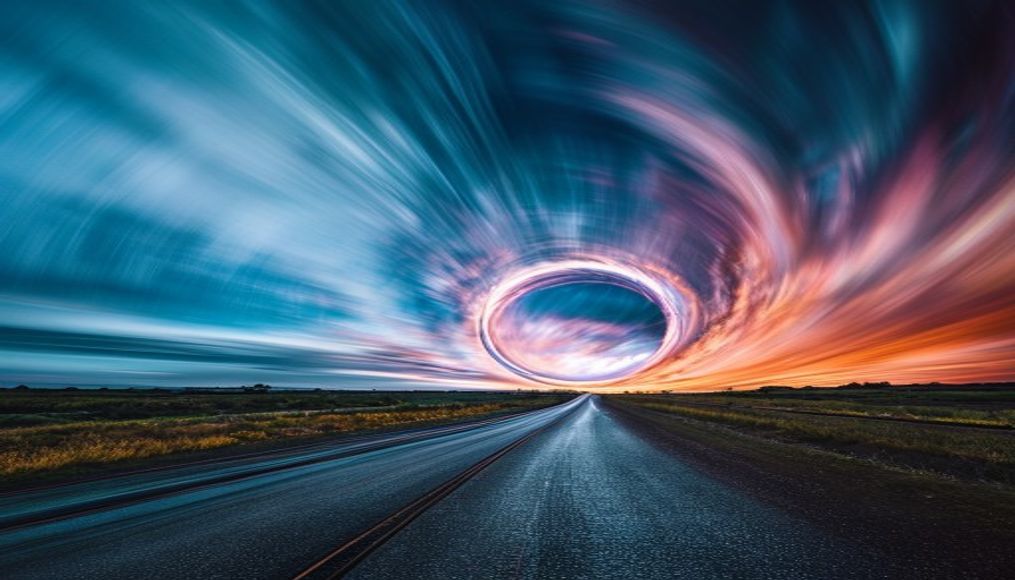
Big bang artistic concept
1344×768 · AVIF · CC BY 4.0
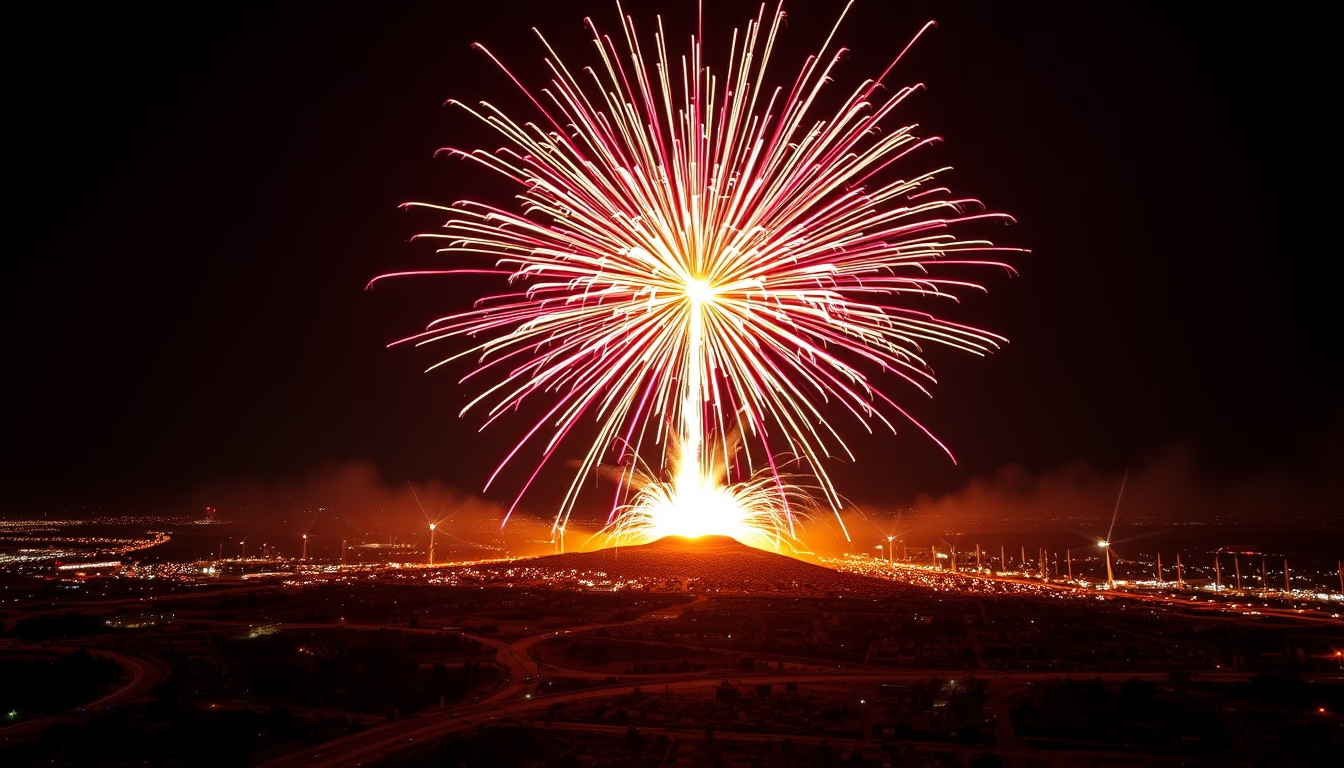
The Big Bang is the scientific theory describing the origin of the universe from an explosive singularity 13.8 billion years ago.
About this subject
The Big Bang was not an explosion in space, but the expansion of space itself from an infinitely dense and hot point known as a singularity. This theory, initially proposed by Georges Lemaître and confirmed by Edwin Hubble's discovery of the universe's expansion, is the most widely accepted cosmological model. The cosmic microwave background radiation, detected by Arno Penzias and Robert Wilson in 1965, provided crucial evidence, serving as an echo of the Big Bang's primordial heat.
In the first instants, the universe was a soup of subatomic particles at unimaginable temperatures. As it expanded and cooled, protons and neutrons formed, followed by the first light atomic nuclei, such as hydrogen and helium, in a process called primordial nucleosynthesis. After 380,000 years, electrons bound to nuclei, allowing radiation to travel freely; this radiation is observed today as the cosmic microwave background. This moment is known as recombination.
The Big Bang theory does not explain what existed before the singularity, as time and space began there. The model is continuously refined by observations from the James Webb Space Telescope and studies of dark energy, which accelerates the universe's expansion. Concepts like cosmic inflation, proposed by Alan Guth, help explain the observed uniformity. Although mysteries remain, such as dark matter, the Big Bang remains the best description for the birth of the cosmos we inhabit.
Frequently Asked Questions
What is the Big Bang?
The Big Bang is the scientific theory that explains that the universe emerged from an extremely hot and dense state about 13.8 billion years ago and has been expanding ever since.
What are the main evidences for the Big Bang?
The main evidences include the expansion of the universe observed by Hubble, the cosmic microwave background radiation, and the abundance of light elements such as hydrogen and helium.
What existed before the Big Bang?
Time and space began with the Big Bang, so the question becomes meaningless. Some hypotheses, such as loop quantum gravity, suggest a cyclic universe, but there is no consensus.
Direct URL
https://pub-c7d6a6ea828543ac903a74a341ccb2e1.r2.dev/imagens/big-bang-artistic-concept-national-geographic-style-p6.avifHow to credit
Include a visible link back to UtilizAí. Copy one of the snippets below:
<a href="https://xn--utiliza-eza.com/en/midia/imagens/big-bang-artistic-concept-national-geographic-style-p6">Big bang artistic concept</a> by <a href="https://xn--utiliza-eza.com">UtilizAí</a>, licensed under <a href="https://creativecommons.org/licenses/by/4.0/">CC BY 4.0</a>.
[Big bang artistic concept](https://xn--utiliza-eza.com/en/midia/imagens/big-bang-artistic-concept-national-geographic-style-p6) by [UtilizAí](https://xn--utiliza-eza.com), CC BY 4.0
License: CC-BY-4.0