Aurora over snow lake
1344×768 · AVIF · CC BY 4.0
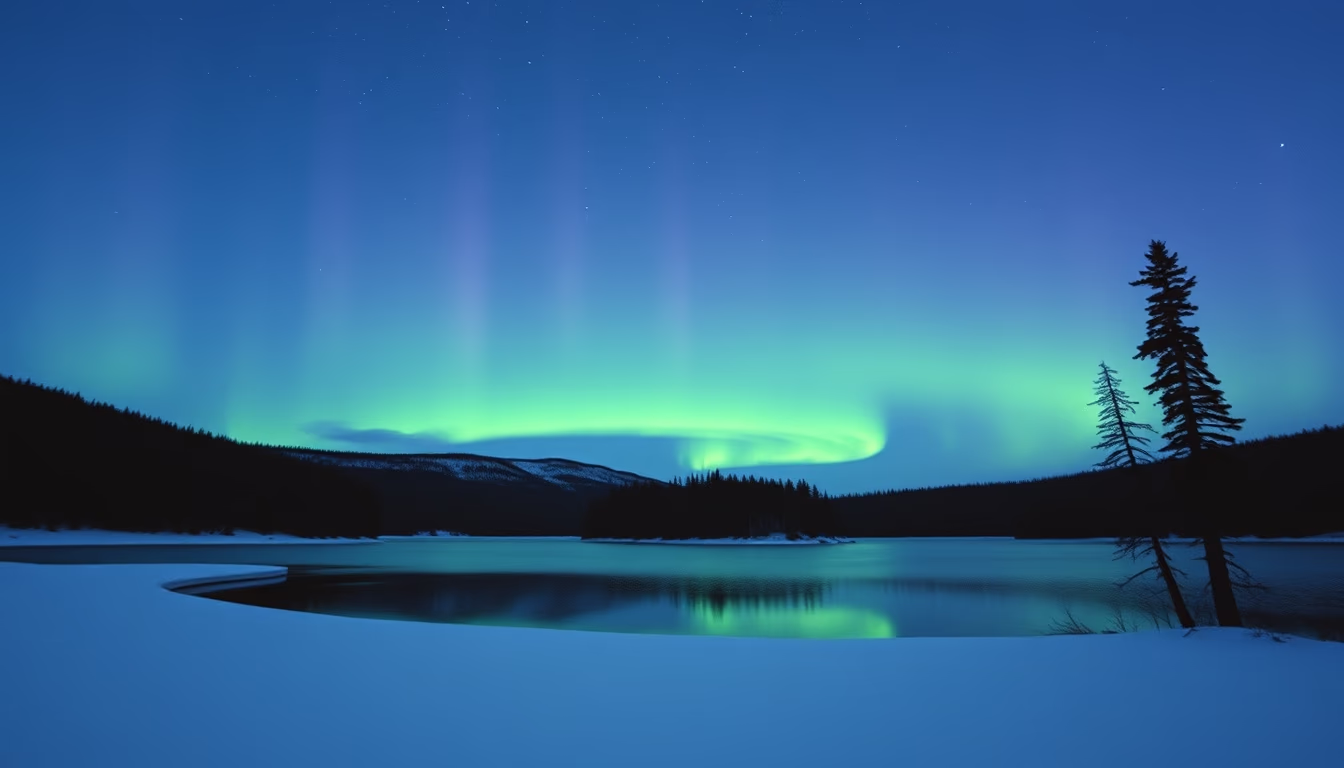
The northern aurora over a snow-covered lake creates a celestial spectacle of dancing colors, visible at high latitudes during winter.
About this subject
The aurora borealis, also known as the northern lights, is a luminous phenomenon that occurs in polar regions when charged particles from the solar wind collide with Earth's atmosphere. Guided by the planet's magnetic field, these particles excite oxygen and nitrogen atoms, which emit light in shades of green, red, purple, and blue. The display is most intense during winter months (September to March in the northern hemisphere), when nights are longer and darker, and coincides with solar activity cycles such as geomagnetic storms.
Snow-covered or frozen lakes, like those found in Alaska, Canada, Scandinavia, and Russia, provide ideal settings for observation, as the white surface reflects light and amplifies the aurora's glow. The absence of light pollution in remote areas enhances the experience. Photographing auroras over snowy landscapes requires technical skill, long exposures and cameras with good low-light performance, but the results are often breathtaking.
Culturally, the northern lights hold deep meaning for indigenous peoples such as the Sami and Inuit, who interpret them as ancestral spirits or divine messengers. In modern science, studying auroras helps understand Sun-Earth interactions and aids in predicting solar storms that can disrupt satellites and power grids. The phenomenon also draws tourists worldwide, boosting local economies in destinations like Tromsø (Norway) and Fairbanks (USA).
Frequently Asked Questions
What causes the colors of the aurora borealis?
The colors depend on the type of molecule excited and the altitude. Oxygen produces green (the most common) and red at high altitudes. Nitrogen yields blue and purple hues.
What is the best place to see auroras over frozen lakes?
Regions like Alaska (USA), Yukon (Canada), Lapland (Finland, Sweden, Norway), and Siberia (Russia) offer frozen lakes with minimal light pollution. Places like Lake Inari in Finland are popular.
Can the aurora borealis be seen in Brazil?
No, because Brazil is at low latitudes. The phenomenon is restricted to areas near the magnetic poles. Only during extreme solar storms can auroras be visible at mid-latitudes, but never in Brazil.
Direct URL
https://pub-c7d6a6ea828543ac903a74a341ccb2e1.r2.dev/imagens/aurora-over-snow-lake-lo-fi-disposable-camera-p2.avifHow to credit
Include a visible link back to UtilizAí. Copy one of the snippets below:
<a href="https://xn--utiliza-eza.com/en/midia/imagens/aurora-over-snow-lake-lo-fi-disposable-camera-p2">Aurora over snow lake</a> by <a href="https://xn--utiliza-eza.com">UtilizAí</a>, licensed under <a href="https://creativecommons.org/licenses/by/4.0/">CC BY 4.0</a>.
[Aurora over snow lake](https://xn--utiliza-eza.com/en/midia/imagens/aurora-over-snow-lake-lo-fi-disposable-camera-p2) by [UtilizAí](https://xn--utiliza-eza.com), CC BY 4.0
License: CC-BY-4.0