Aurora borealis green sky
1344×768 · AVIF · CC BY 4.0
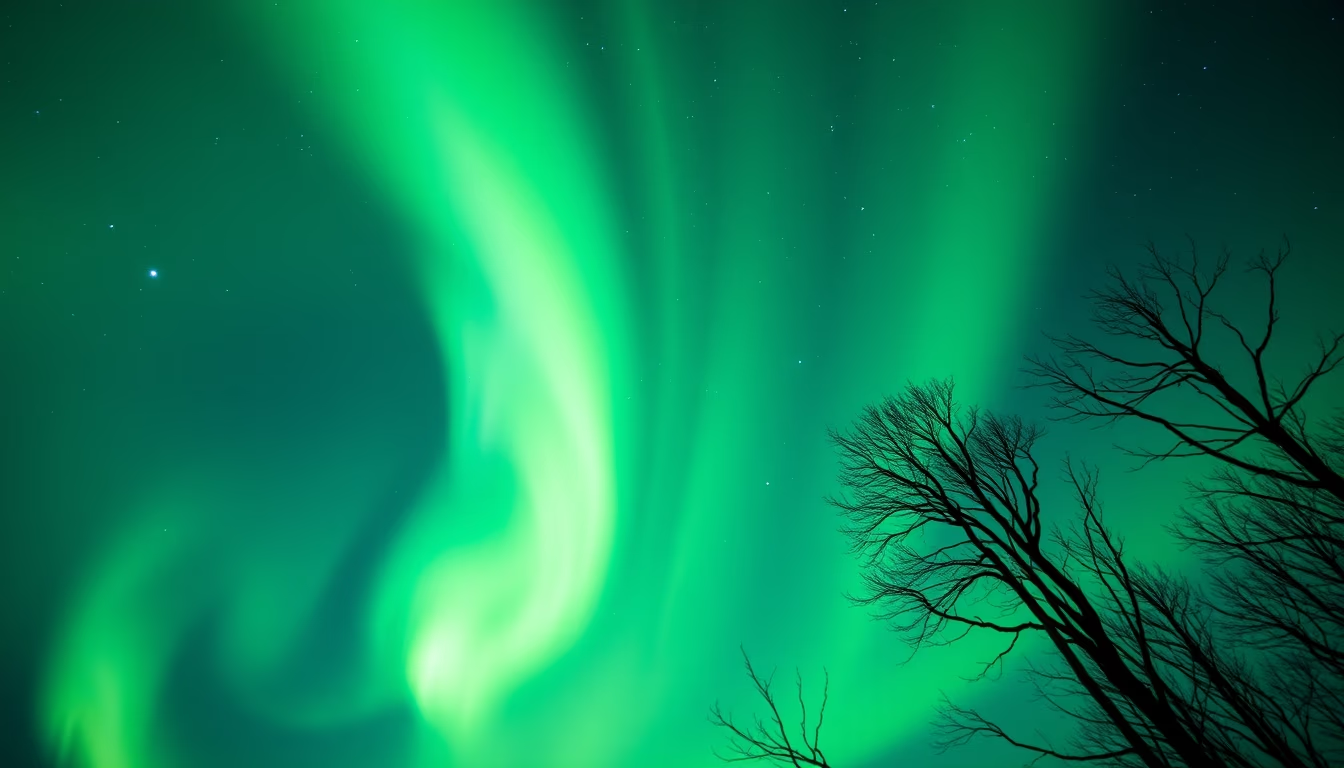
The aurora borealis is a natural light display in the polar regions, caused by the interaction of solar particles with Earth's magnetic field.
About this subject
The aurora borealis, also known as the northern lights, is one of nature's most captivating displays. It happens when charged particles from the Sun, mainly electrons and protons, collide with gases in Earth's upper atmosphere. These collisions excite atoms and molecules, which then release energy as light when they return to their ground state. The green color, the most common, is produced by atomic oxygen at altitudes between 100 and 250 kilometers.
Auroras are typically visible near the magnetic poles in regions such as Norway, Sweden, Finland, Canada, Alaska, and Russia. In the Southern Hemisphere, the equivalent phenomenon is called the aurora australis. The occurrence of auroras is linked to the 11-year solar cycle, with more frequent and intense displays during solar maximum. In 2026, the solar cycle is expected to be near its peak, making auroras particularly active and visible at lower latitudes than usual.
Culturally, auroras hold deep significance. Ancient Nordic people believed they were reflections from Valkyries or bridges to the heavens. Inuit saw them as dancing spirits. Modern science studies auroras through missions like ESA's Cluster and NASA's THEMIS, which investigate particle acceleration mechanisms. Photographing auroras requires manual camera settings and long exposures, and dark locations away from light pollution are ideal for observation.
Frequently Asked Questions
What causes the green color in the aurora borealis?
The green color is produced by excited atomic oxygen at altitudes between 100 and 250 km. When the electrons return to their ground state, they emit green light at a wavelength of 557.7 nm.
When is the best time to see the aurora borealis?
The best time is during winter, from September to March, when nights are longest and darkest. Additionally, during solar maximum (11-year cycle), auroras are more frequent and intense. The next peak is predicted for 2025-2026.
Can I see auroras in Brazil?
It is extremely rare because Brazil is near the equator. During very strong solar storms, auroras can be seen at lower latitudes, but in Brazil this occurs only once every several decades.
Direct URL
https://pub-c7d6a6ea828543ac903a74a341ccb2e1.r2.dev/imagens/aurora-borealis-green-sky-national-geographic-style-p1.avifHow to credit
Include a visible link back to UtilizAí. Copy one of the snippets below:
<a href="https://xn--utiliza-eza.com/en/midia/imagens/aurora-borealis-green-sky-national-geographic-style-p1">Aurora borealis green sky</a> by <a href="https://xn--utiliza-eza.com">UtilizAí</a>, licensed under <a href="https://creativecommons.org/licenses/by/4.0/">CC BY 4.0</a>.
[Aurora borealis green sky](https://xn--utiliza-eza.com/en/midia/imagens/aurora-borealis-green-sky-national-geographic-style-p1) by [UtilizAí](https://xn--utiliza-eza.com), CC BY 4.0
License: CC-BY-4.0