Atomic clock laboratory
1344×768 · AVIF · CC BY 4.0

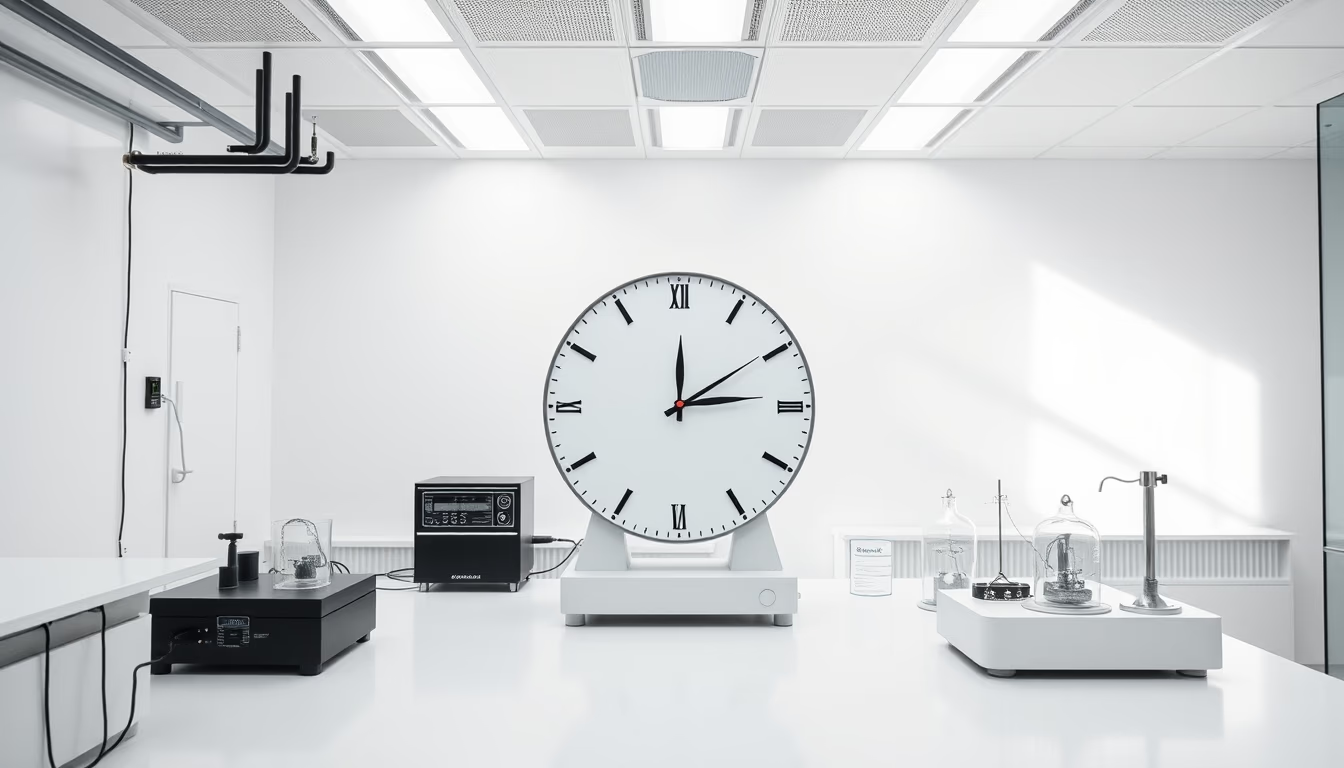
Atomic clock laboratories are research centers that develop and maintain the world's most precise clocks, based on quantum transitions of atoms.
About this subject
An atomic clock laboratory is a specialized facility where atomic clocks are designed, built, and operated, instruments that measure time with extremely high precision. These devices work by exploiting energy transitions between states of atoms, such as cesium-133 or strontium. The current definition of the second in the International System of Units (SI) is based on the resonance frequency of the cesium atom: 9,192,631,770 oscillations per second. Laboratories like the National Institute of Standards and Technology (NIST) in the United States and the Physikalisch-Technische Bundesanstalt (PTB) in Germany are world references in the development of these clocks.
The importance of atomic clocks extends beyond metrology. They are essential for satellite navigation systems like GPS, which relies on precise synchronization between satellites and ground receivers. They are also vital for telecommunications networks, financial data synchronization, and fundamental physics experiments, such as gravitational wave detection and tests of general relativity. Without these clocks, the Internet as we know it would not function, since data transmission requires accurate timing.
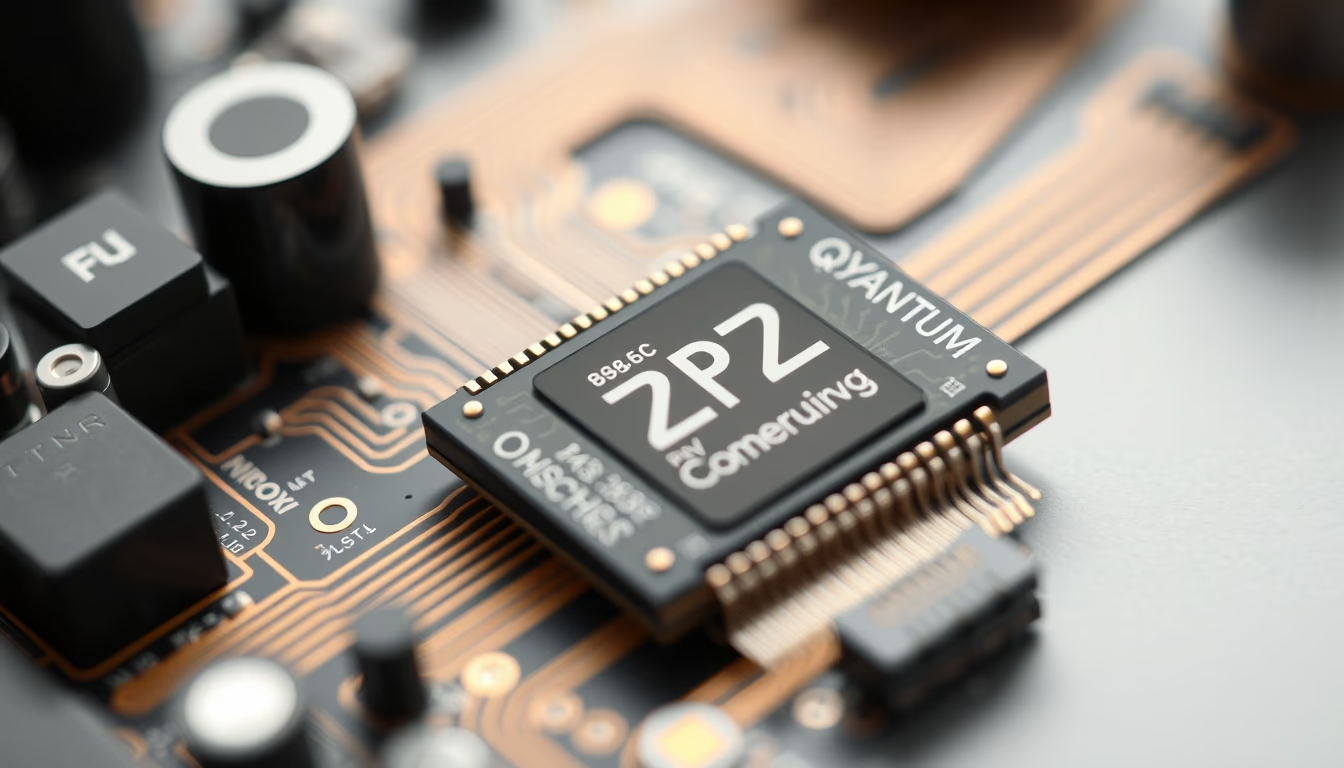
Interestingly, the most modern atomic clocks, such as optical clocks, are so accurate that they would not lose a second even in billions of years. The first functional atomic clock was built in 1955 by Louis Essen in the United Kingdom. Since then, technology has evolved to portable versions and even chip-scale atomic clocks, used in military and civilian applications. In Brazil, the National Observatory is responsible for maintaining official Brazilian time using cesium atomic standards.
Frequently Asked Questions
How does an atomic clock work?
An atomic clock measures time through the oscillation of atoms between specific energy states. For example, the cesium-133 atom emits radiation at a frequency of 9,192,631,770 Hz, which serves as a reference to define the second. The clock locks an oscillator to that frequency, generating precise pulses.
Where are atomic clocks used?
They are used in satellite navigation systems (GPS, GLONASS, Galileo), telecommunications networks, scientific research (e.g., fundamental physics and astronomy), high-frequency financial transactions, and data center synchronization.
How accurate is an atomic clock?
Cesium atomic clocks have an accuracy of about 1 second in 300 million years. Optical clocks can achieve 1 second in 15 billion years, surpassing the age of the universe.
Direct URL
https://pub-c7d6a6ea828543ac903a74a341ccb2e1.r2.dev/imagens/atomic-clock-laboratory-macro-closeup-p11.avifHow to credit
Include a visible link back to UtilizAí. Copy one of the snippets below:
<a href="https://xn--utiliza-eza.com/en/midia/imagens/atomic-clock-laboratory-macro-closeup-p11">Atomic clock laboratory</a> by <a href="https://xn--utiliza-eza.com">UtilizAí</a>, licensed under <a href="https://creativecommons.org/licenses/by/4.0/">CC BY 4.0</a>.
[Atomic clock laboratory](https://xn--utiliza-eza.com/en/midia/imagens/atomic-clock-laboratory-macro-closeup-p11) by [UtilizAí](https://xn--utiliza-eza.com), CC BY 4.0
License: CC-BY-4.0