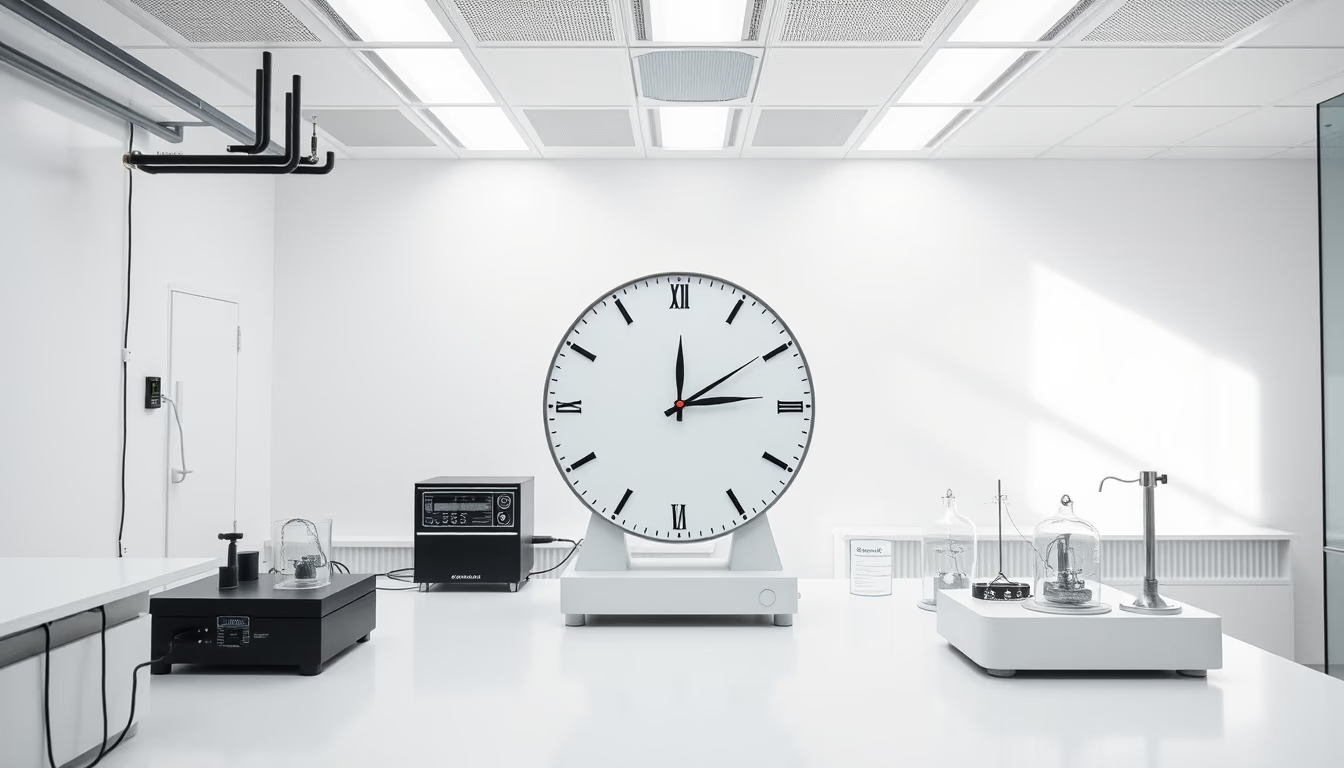
Atomic clock laboratory
1344×768 · AVIF · CC BY 4.0

Atomic clock laboratories house devices that measure time with an accuracy of one second every 300 million years, essential for systems like GPS and communication networks.
About this subject
Atomic clock laboratories are specialized facilities that maintain and develop the world's most precise time standards. These clocks operate by measuring the transition frequency between energy levels of atoms, typically cesium or rubidium, which resonate with microwaves. The current definition of the second in the International System of Units (SI) is based on the cesium-133 atom, which oscillates exactly 9,192,631,770 times per second. This extraordinary precision allows atomic clocks to lose only one second every 300 million years.
In Brazil, the National Institute of Metrology, Quality and Technology (INMETRO) operates the time and frequency laboratory responsible for generating and disseminating the Brazilian Legal Time, synchronized with Coordinated Universal Time (UTC). The laboratory uses cesium and hydrogen atomic clocks to ensure time accuracy in the country. These devices are kept under controlled temperature and pressure conditions to minimize external interference.
Globally, centers like the National Institute of Standards and Technology (NIST) in the United States and the Physikalisch-Technische Bundesanstalt (PTB) in Germany are benchmarks. The NIST-F2, for instance, is a cesium fountain atomic clock that defines the US time standard with an uncertainty of 1x10^-16. These institutions collaborate to generate International Atomic Time (TAI), the basis for UTC. Critical applications depend on this precision: satellite navigation systems like GPS, telecommunication network synchronization, and financial transactions.
The evolution of atomic clocks continues with the development of optical clocks, which use strontium or ytterbium atoms and can be up to a hundred times more precise than cesium ones. These advances will allow redefining the second in the future and open doors for testing fundamental physics theories, such as general relativity. Atomic clock laboratories are thus the backbone of time metrology in the 21st century.
Frequently Asked Questions
How accurate is an atomic clock?
The most advanced cesium atomic clocks have an accuracy of about one second every 300 million years. Optical clocks can be up to a hundred times more precise, deviating only one second in 30 billion years.
Why are atomic clocks important for GPS?
GPS relies on precise time synchronization between satellites and receivers. Each satellite carries multiple atomic clocks to measure distance accurately, as a 1 nanosecond error translates to 30 centimeters of positioning error.
Where is the world's most precise atomic clock?
Currently, the most precise atomic clock is the NIST-F2, located at the National Institute of Standards and Technology (NIST) in the United States. It defines the US time standard with an uncertainty of 1x10^-16.
Direct URL
https://pub-c7d6a6ea828543ac903a74a341ccb2e1.r2.dev/imagens/atomic-clock-laboratory-long-exposure-p3.avifHow to credit
Include a visible link back to UtilizAí. Copy one of the snippets below:
<a href="https://xn--utiliza-eza.com/en/midia/imagens/atomic-clock-laboratory-long-exposure-p3">Atomic clock laboratory</a> by <a href="https://xn--utiliza-eza.com">UtilizAí</a>, licensed under <a href="https://creativecommons.org/licenses/by/4.0/">CC BY 4.0</a>.
[Atomic clock laboratory](https://xn--utiliza-eza.com/en/midia/imagens/atomic-clock-laboratory-long-exposure-p3) by [UtilizAí](https://xn--utiliza-eza.com), CC BY 4.0
License: CC-BY-4.0