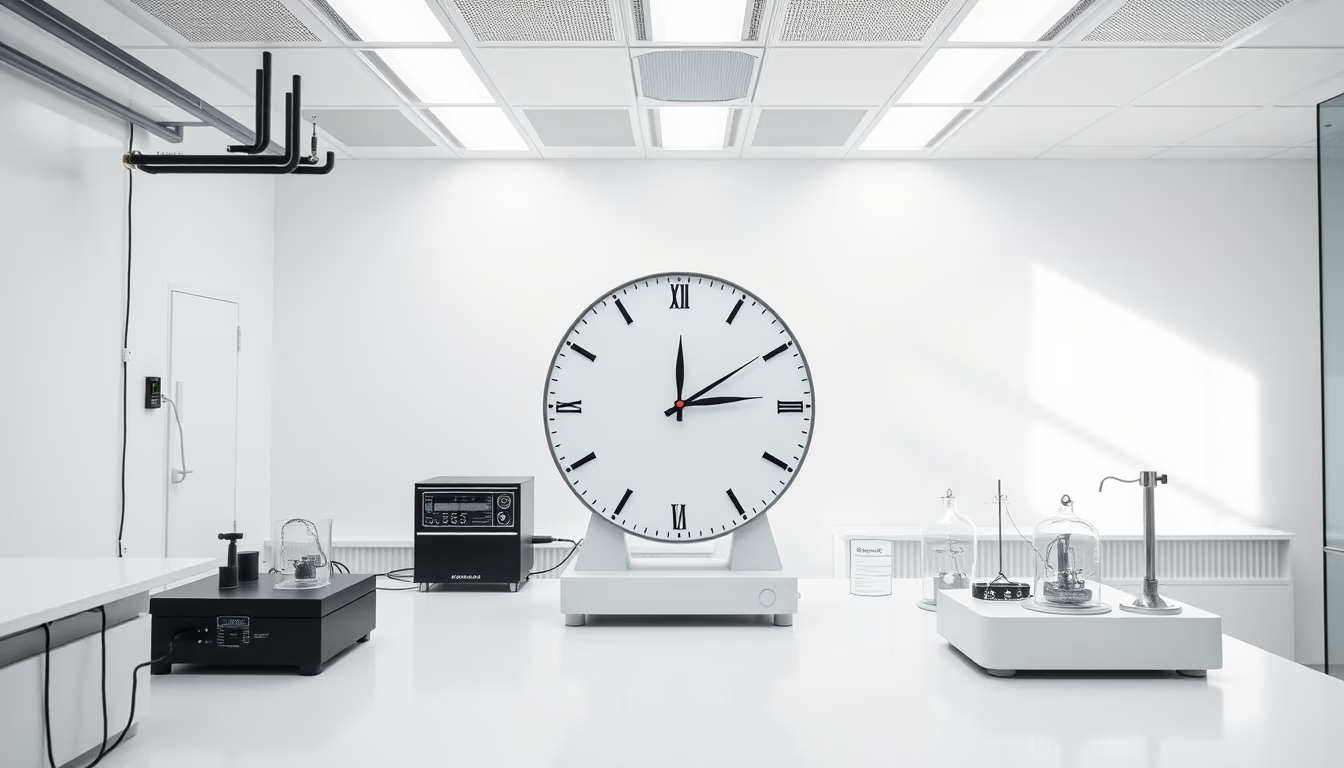
Atomic clock laboratory
1344×768 · AVIF · CC BY 4.0

Atomic clock laboratories house ultra-precise time standards, such as hydrogen masers and cesium fountains, which define the second in the International System of Units.
About this subject
Atomic clock laboratories are facilities responsible for maintaining and developing primary time standards. They house devices such as cesium clocks and hydrogen masers that generate signals with an accuracy of about one second in 300 million years. These standards are essential for satellite navigation systems like GPS and Galileo, telecommunications networks, and the synchronization of financial transactions.
In Brazil, the main laboratory is the Time Service of the National Institute of Metrology, Quality and Technology (INMETRO), located in Rio de Janeiro. It operates a set of atomic clocks that keep Brazilian Legal Time, synchronized with Coordinated Universal Time (UTC). The laboratory also participates in international comparisons, such as those of the International Bureau of Weights and Measures (BIPM), to ensure global traceability.
The operating principle is based on the transition between energy levels in cesium-133 atoms. The radiation emitted in this transition has a frequency of 9,192,631,770 hertz, which has defined the second since 1967. Modern techniques, such as laser-cooled cesium fountains, achieve relative uncertainties smaller than 1×10⁻¹⁵.
In addition to cesium, other elements like rubidium and hydrogen are used, each with specific advantages. Hydrogen masers offer better short-term stability, while cesium fountains are more accurate. These laboratories often employ vacuum systems, magnetic shielding, and strict thermal control to isolate the clocks from external disturbances.
Frequently Asked Questions
How does an atomic clock work?
An atomic clock uses the transition between energy levels of atoms, typically cesium-133, to generate an ultra-stable frequency signal. The radiation emitted in this transition has a fixed frequency (9,192,631,770 Hz for cesium), which serves as the standard for measuring time.
What is the typical accuracy of an atomic clock?
Commercial atomic clocks achieve an accuracy of about one second per million years, while primary standards in national laboratories reach uncertainties of one second per 300 million years or more.
Where are the main atomic clock laboratories located in Brazil?
The main laboratory is at INMETRO in Rio de Janeiro, maintaining the Brazilian Legal Time. Other institutions, such as the National Observatory and some universities, also operate atomic clocks for research and calibration.
Direct URL
https://pub-c7d6a6ea828543ac903a74a341ccb2e1.r2.dev/imagens/atomic-clock-laboratory-lo-fi-disposable-camera-p1.avifHow to credit
Include a visible link back to UtilizAí. Copy one of the snippets below:
<a href="https://xn--utiliza-eza.com/en/midia/imagens/atomic-clock-laboratory-lo-fi-disposable-camera-p1">Atomic clock laboratory</a> by <a href="https://xn--utiliza-eza.com">UtilizAí</a>, licensed under <a href="https://creativecommons.org/licenses/by/4.0/">CC BY 4.0</a>.
[Atomic clock laboratory](https://xn--utiliza-eza.com/en/midia/imagens/atomic-clock-laboratory-lo-fi-disposable-camera-p1) by [UtilizAí](https://xn--utiliza-eza.com), CC BY 4.0
License: CC-BY-4.0