Asteroid belt artistic
1344×768 · AVIF · CC BY 4.0
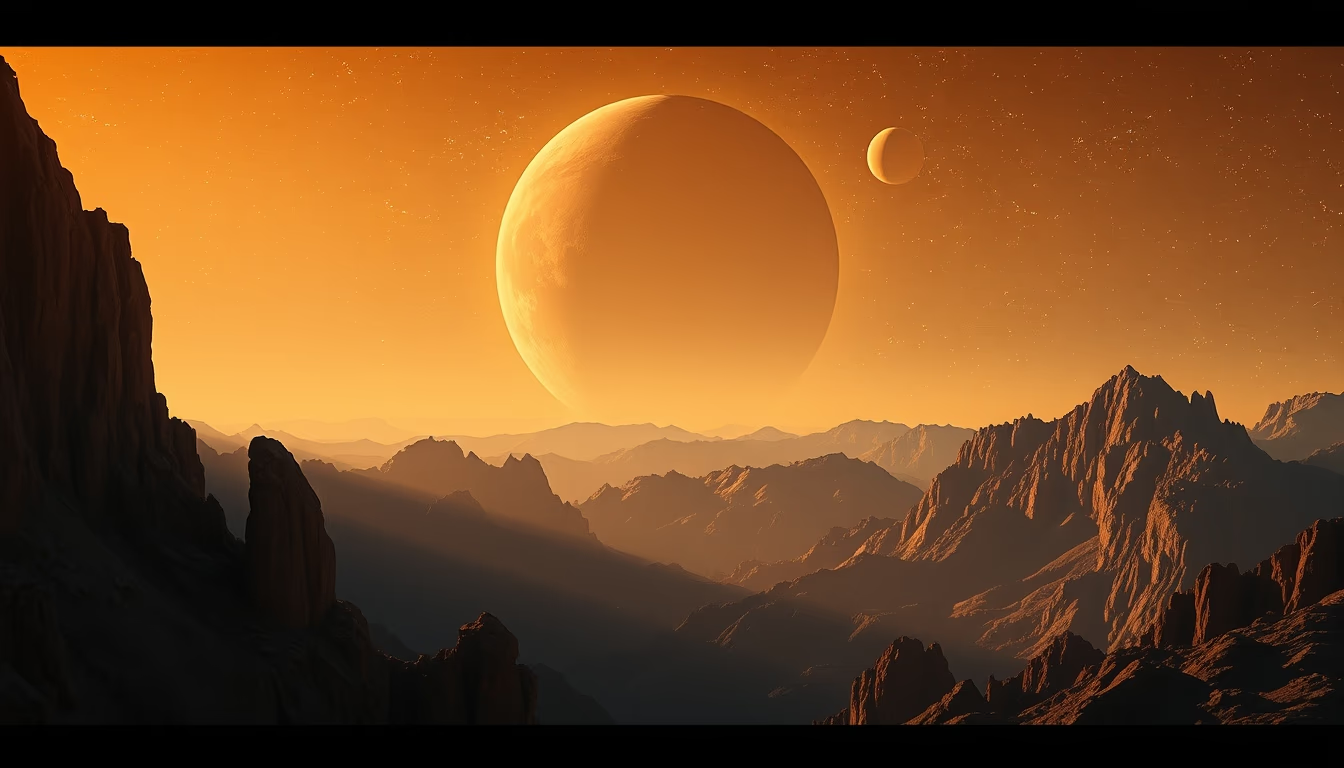
The asteroid belt between Mars and Jupiter holds millions of rocky bodies that preserve secrets of the early Solar System.
About this subject
The asteroid belt is a region of the Solar System located roughly between the orbits of Mars and Jupiter, at a distance of 2.2 to 3.2 astronomical units from the Sun. It contains millions of rocky and metallic bodies ranging in size from tiny dust grains to objects hundreds of kilometers across, such as Ceres, the largest asteroid and a dwarf planet, with a diameter of about 940 km. The belt is believed to be composed of remnants from the solar nebula that never coalesced into a planet due to Jupiter's gravitational influence.
The composition of asteroids varies widely: some are carbon-rich (C-type), others silicate-rich (S-type), and there are metallic ones (M-type). These bodies are valuable sources of information about the conditions of the early Solar System over 4.5 billion years ago. Space missions like NASA's Dawn have visited Vesta and Ceres, revealing surfaces with craters, ice volcanoes, and possible subsurface oceans. The belt is also a source of meteorites that fall to Earth, providing direct samples of its composition.
Beyond scientific interest, the asteroid belt attracts attention for its economic potential. Mining metallic asteroids like Psyche, about 226 km in diameter and composed mainly of iron and nickel, could yield trillions of dollars in resources. However, technological and legal challenges still prevent commercial exploitation. Culturally, the belt is often depicted in movies and games as a dense debris field, though in reality the average distance between asteroids is about 1 million kilometers, making collisions unlikely.
Interestingly, there are asteroid families that originated from ancient collisions, such as the Flora family, which may have produced the asteroid that caused the extinction of the dinosaurs. Studying these groups helps understand orbital dynamics and impact history in the Solar System. The asteroid belt remains a natural laboratory for planetary science and a target for future exploration missions.
Frequently Asked Questions
How many asteroids are in the belt?
It is estimated that there are millions of asteroids in the belt, but only about 200 with a diameter larger than 100 km have been identified. The vast majority are small fragments.
Why didn't the asteroid belt form a planet?
Jupiter's gravity disrupted the bodies in the region, preventing them from coalescing into a planet. Instead, they collided and fragmented over time.
Is it possible to visit the asteroid belt?
Robotic missions have visited asteroids, such as Dawn (Ceres and Vesta) and OSIRIS-REx (Bennu). Crewed trips are still unfeasible due to distance and radiation risks.
Direct URL
https://pub-c7d6a6ea828543ac903a74a341ccb2e1.r2.dev/imagens/asteroid-belt-artistic-travel-photography-p6.avifHow to credit
Include a visible link back to UtilizAí. Copy one of the snippets below:
<a href="https://xn--utiliza-eza.com/en/midia/imagens/asteroid-belt-artistic-travel-photography-p6">Asteroid belt artistic</a> by <a href="https://xn--utiliza-eza.com">UtilizAí</a>, licensed under <a href="https://creativecommons.org/licenses/by/4.0/">CC BY 4.0</a>.
[Asteroid belt artistic](https://xn--utiliza-eza.com/en/midia/imagens/asteroid-belt-artistic-travel-photography-p6) by [UtilizAí](https://xn--utiliza-eza.com), CC BY 4.0
License: CC-BY-4.0