Asteroid belt artistic
1344×768 · AVIF · CC BY 4.0
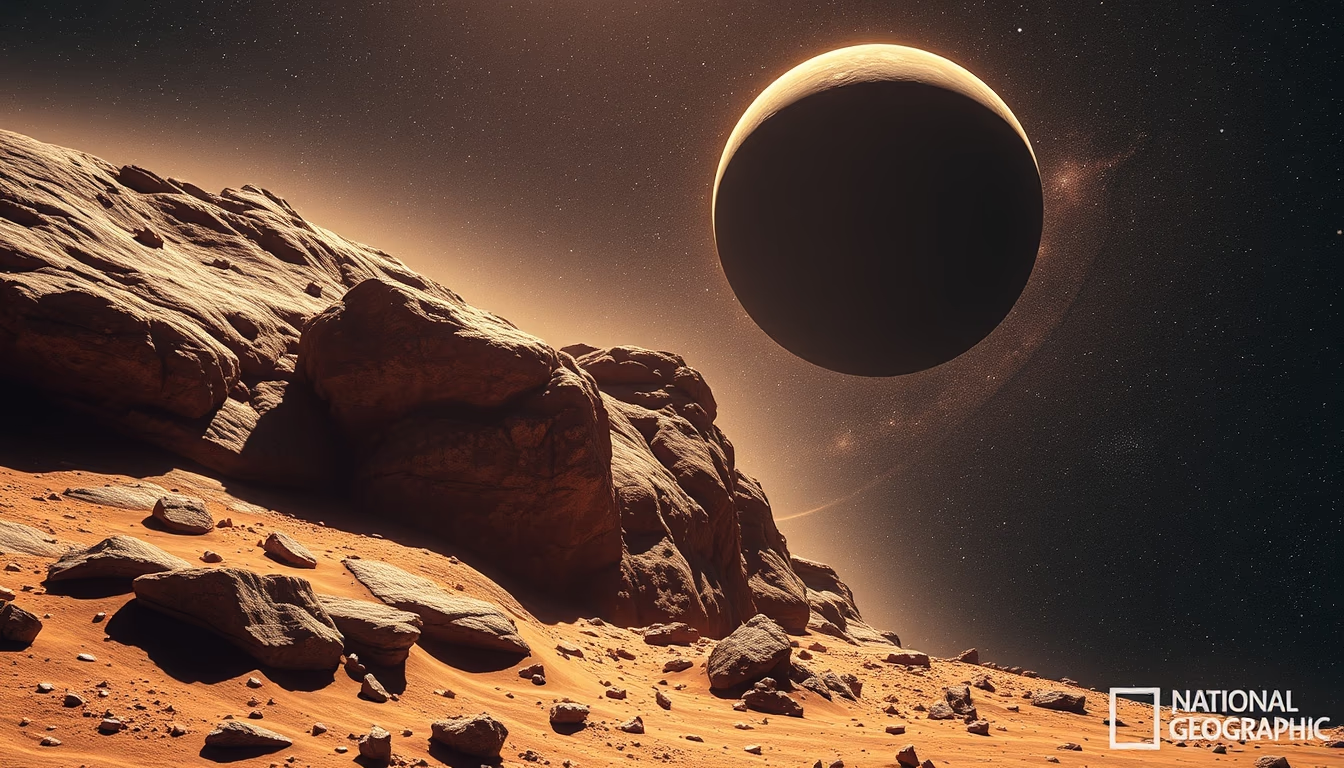
The asteroid belt, a region between Mars and Jupiter, contains millions of rocky bodies ranging from dust grains to planetoids like Ceres.
About this subject
The asteroid belt is a region of the Solar System located between the orbits of Mars and Jupiter, spanning approximately 2.2 to 3.2 astronomical units from the Sun. It is estimated to contain between 1.1 and 1.9 million asteroids larger than 1 km in diameter, along with millions of smaller bodies. The total mass of the belt is about 4% of the Moon's mass, with more than half concentrated in four objects: Ceres, Vesta, Pallas, and Hygiea. Ceres, the largest, is classified as a dwarf planet and has a diameter of about 940 km, being the only belt object with a spherical shape due to its own gravity.
The origin of the belt dates back to the formation of the Solar System about 4.6 billion years ago. Theoretical models suggest that the region could have formed a planet, but Jupiter's gravitational influence prevented material from accreting, resulting in fragments that continue to collide and disintegrate today. Collisions are frequent and produce dust that forms the zodiacal light, a faint glow observed in the night sky. The belt is not a dense barrier as depicted in fiction: the average distance between asteroids is several million kilometers, and spacecraft cross the region safely.
Studying the belt is crucial for understanding planetary evolution and the primitive composition of the Solar System. Asteroids are considered fossils of the solar nebula, preserving materials unaltered by geological processes. NASA's Dawn mission explored Vesta and Ceres, revealing evidence of volcanic activity and the presence of ice. The belt is also the source of meteorites that fall to Earth, enabling direct laboratory analysis. Additionally, asteroids are potential targets for future mining, with resources such as platinum-group metals and water.
Facts: The asteroid belt is not the only one in the Solar System; belts exist around other stars. The largest known asteroid in the belt (Ceres) was discovered in 1801 by Giuseppe Piazzi. In 2023, the Psyche mission launched to study a metallic asteroid that may be the exposed core of a protoplanet.
Frequently Asked Questions
What is the asteroid belt?
It is a region of the Solar System between Mars and Jupiter containing millions of asteroids of various sizes, from dust to planetoids like Ceres.
What is the largest asteroid in the belt?
Ceres, about 940 km in diameter, is the largest object in the belt and classified as a dwarf planet.
Is there a risk of collision with Earth from the asteroid belt?
Most belt asteroids are in stable orbits, but collisions can eject fragments that may eventually cross Earth's orbit, posing a potential risk monitored by planetary defense programs.
Direct URL
https://pub-c7d6a6ea828543ac903a74a341ccb2e1.r2.dev/imagens/asteroid-belt-artistic-national-geographic-style-p7.avifHow to credit
Include a visible link back to UtilizAí. Copy one of the snippets below:
<a href="https://xn--utiliza-eza.com/en/midia/imagens/asteroid-belt-artistic-national-geographic-style-p7">Asteroid belt artistic</a> by <a href="https://xn--utiliza-eza.com">UtilizAí</a>, licensed under <a href="https://creativecommons.org/licenses/by/4.0/">CC BY 4.0</a>.
[Asteroid belt artistic](https://xn--utiliza-eza.com/en/midia/imagens/asteroid-belt-artistic-national-geographic-style-p7) by [UtilizAí](https://xn--utiliza-eza.com), CC BY 4.0
License: CC-BY-4.0