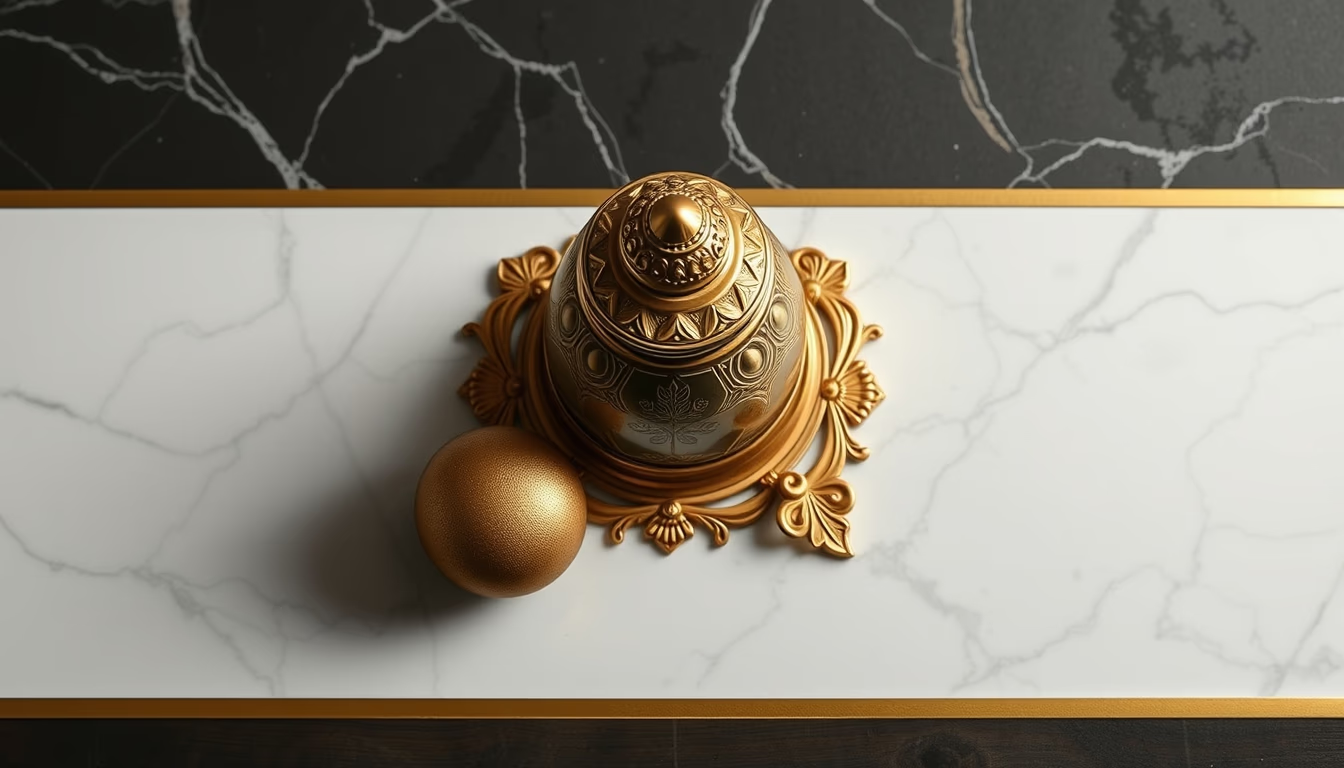
Art nouveau klimt gold
1344×768 · AVIF · CC BY 4.0
Gustav Klimt's use of gold in Art Nouveau blended symbolism, sensuality, and Byzantine ornamentation, defining an era.
About this subject
Gustav Klimt, a leading figure of the Art Nouveau movement (known as the Vienna Secession in Austria), became famous for his lavish use of gold leaf. Inspired by Byzantine mosaics and religious art, he applied gold to works like 'The Kiss' (1907-1908) and 'Portrait of Adele Bloch-Bauer I' (1907). The gold was not merely decorative: it symbolized transcendence, the divine, and the fusion of the earthly with the spiritual, key themes of fin-de-siècle symbolism.
Klimt's golden phase, spanning 1899 to 1910, coincided with his break from academic tradition and the founding of the Vienna Secession in 1897. This group rejected historicism and sought to integrate fine arts, architecture, and design. Klimt incorporated geometric patterns, spirals, and disguised phallic motifs into ornamentation, creating an erotic and innovative visual language. His use of gold also resonated with contemporary jewelry and metalwork, such as René Lalique's pieces.
The technique involved applying gold leaf over gesso, combined with tempera and oil, resulting in textured surfaces that reflected light dynamically. This approach influenced artists like Egon Schiele and marked a transition to modern art. Gold in Klimt's work is not mere embellishment: it expresses a critique of bourgeois hypocrisy while celebrating eroticism and life. His works remain universal icons, reproduced on posters and merchandise, but their artistic context is often oversimplified.
Today, Klimt's legacy in Art Nouveau is studied as a fusion of global influences: from Ravenna's mosaics to Japanese painting. The 1908 Vienna exhibition, where 'The Kiss' debuted, solidified his unique style. Despite early criticism for its sexual content, Klimt broke barriers and established gold as a narrative element in Western art, inspiring generations of designers and artists.
Frequently Asked Questions
Why did Gustav Klimt use so much gold in his paintings?
Klimt was influenced by Byzantine mosaics he saw in Ravenna, Italy, and medieval religious art. Gold symbolized the divine and transcendence, while adding a luminous quality to his works, creating an ethereal and luxurious atmosphere.
What is the relationship between Klimt and the Art Nouveau movement?
Klimt was a leading figure of the Vienna Secession, the Austrian branch of Art Nouveau. He shared the movement's use of flowing lines, floral ornamentation, and integration of arts, but his personal style was more decorative and symbolic, with a strong erotic undertone.
What does Klimt's 'The Kiss' represent?
'The Kiss' is one of Klimt's most iconic works. It depicts an embracing couple in a flower field, wrapped in golden robes. It represents romantic and spiritual union, with gold symbolizing the eternal and divine, while geometric patterns suggest both decoration and sexuality.
Direct URL
https://pub-c7d6a6ea828543ac903a74a341ccb2e1.r2.dev/imagens/art-nouveau-klimt-gold-documentary-nature-style-fresh10.avifHow to credit
Include a visible link back to UtilizAí. Copy one of the snippets below:
<a href="https://xn--utiliza-eza.com/en/midia/imagens/art-nouveau-klimt-gold-documentary-nature-style-fresh10">Art nouveau klimt gold</a> by <a href="https://xn--utiliza-eza.com">UtilizAí</a>, licensed under <a href="https://creativecommons.org/licenses/by/4.0/">CC BY 4.0</a>.
[Art nouveau klimt gold](https://xn--utiliza-eza.com/en/midia/imagens/art-nouveau-klimt-gold-documentary-nature-style-fresh10) by [UtilizAí](https://xn--utiliza-eza.com), CC BY 4.0
License: CC-BY-4.0