Andromeda galaxy spiral
1344×768 · AVIF · CC BY 4.0
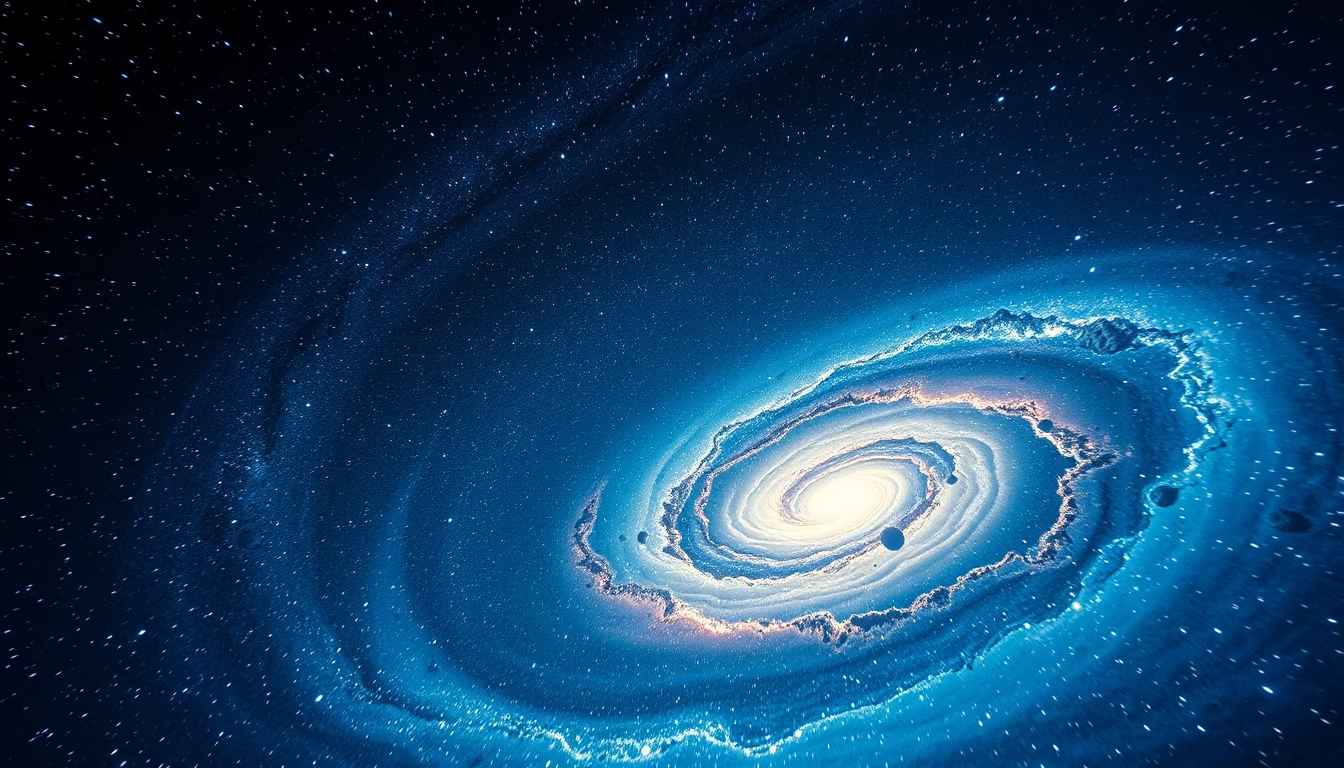
The Andromeda Galaxy (M31) is the largest spiral galaxy in the Local Group and one of the most distant objects visible to the naked eye.
About this subject
The Andromeda Galaxy, cataloged as M31 or NGC 224, is a spiral galaxy located approximately 2.5 million light-years from Earth in the constellation Andromeda. With a diameter of about 220,000 light-years, it is significantly larger than the Milky Way, which spans about 100,000 light-years. It is estimated to contain roughly 1 trillion stars, twice the number in our galaxy. Its spiral structure features two prominent main arms and several fainter arms, visible in long-exposure images.
The first recorded observation of Andromeda was made by the Persian astronomer Al-Sufi in 964 AD, who described it as a "small cloud" in the night sky. Centuries later, Charles Messier included it in his catalog of diffuse objects in 1764, unaware that it was a separate galaxy. It was not until 1923 that Edwin Hubble, using the 100-inch Hooker telescope at Mount Wilson, identified Cepheid variable stars in Andromeda, proving that it lay outside the Milky Way and establishing the scale of the universe.
Andromeda is on a collision course with the Milky Way, moving toward us at about 110 km/s. The two galaxies are expected to begin merging in approximately 4.5 billion years, forming a new giant elliptical galaxy nicknamed "Milkomeda." During this process, the spiral structures will be destroyed, and millions of stars may be ejected, though direct collisions between stars are extremely unlikely due to the vast interstellar distances.
The Andromeda Galaxy serves as a natural laboratory for studying galactic evolution. Its similarity to the Milky Way allows astronomers to compare star formation processes, dark matter distribution, and spiral arm dynamics. Observations from the Spitzer and Hubble telescopes have revealed that Andromeda has a double galactic bulge, suggesting past mergers with smaller galaxies, and a ring of star formation near its center, indicating ongoing activity.
Frequently Asked Questions
Will the Andromeda Galaxy collide with the Milky Way?
Yes, Andromeda is approaching the Milky Way at about 110 km/s, and the two galaxies are expected to begin merging in approximately 4.5 billion years, forming a new giant elliptical galaxy.
How many stars does the Andromeda Galaxy have?
Andromeda is estimated to contain about 1 trillion stars, roughly twice the estimated number for the Milky Way, which has about 100 to 400 billion stars.
What is the distance from Earth to the Andromeda Galaxy?
The Andromeda Galaxy is located approximately 2.5 million light-years from Earth, making it the most distant large object visible to the naked eye.
Direct URL
https://pub-c7d6a6ea828543ac903a74a341ccb2e1.r2.dev/imagens/andromeda-galaxy-spiral-lo-fi-disposable-camera-p4.avifHow to credit
Include a visible link back to UtilizAí. Copy one of the snippets below:
<a href="https://xn--utiliza-eza.com/en/midia/imagens/andromeda-galaxy-spiral-lo-fi-disposable-camera-p4">Andromeda galaxy spiral</a> by <a href="https://xn--utiliza-eza.com">UtilizAí</a>, licensed under <a href="https://creativecommons.org/licenses/by/4.0/">CC BY 4.0</a>.
[Andromeda galaxy spiral](https://xn--utiliza-eza.com/en/midia/imagens/andromeda-galaxy-spiral-lo-fi-disposable-camera-p4) by [UtilizAí](https://xn--utiliza-eza.com), CC BY 4.0
License: CC-BY-4.0