Andromeda galaxy spiral
1344×768 · AVIF · CC BY 4.0
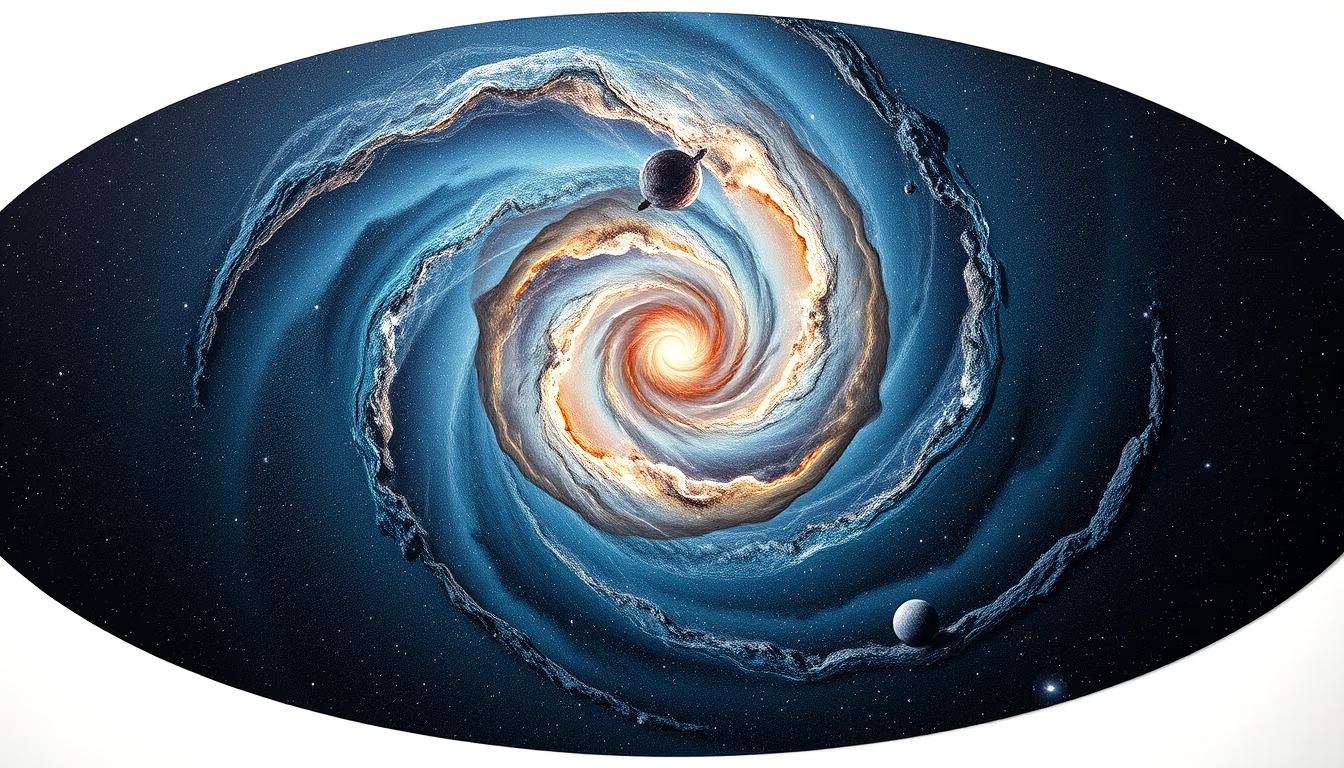
The Andromeda Galaxy (M31) is the largest galaxy in the Local Group, a majestic spiral located 2.5 million light-years from Earth.
About this subject
The Andromeda Galaxy, cataloged as Messier 31 or NGC 224, is a barred spiral galaxy notable for being the most distant object visible to the naked eye under dark skies. Spanning approximately 220,000 light-years in diameter, it is significantly larger than the Milky Way, which measures about 100,000 light-years across. Andromeda is estimated to contain about one trillion stars, roughly twice the number in our own galaxy. Its spiral structure features prominent arms and a bright core, home to a supermassive black hole with a mass equivalent to about 100 million Suns. The name derives from the princess of Greek mythology, following the tradition of naming celestial objects after mythological figures. Currently, Andromeda is approaching the Milky Way at a speed of about 110 kilometers per second, and the two galaxies are on a collision course that is expected to occur in about 4.5 billion years. This cosmic event, already predicted by computer simulations, will result in the merger of the galaxies into a giant elliptical, popularly nicknamed “Milkomeda.” Recent observations from the Hubble Space Telescope and other observatories have revealed that Andromeda has a much larger hot gas halo than previously thought, extending up to 2 million light-years, suggesting that the halos of the two galaxies are already interacting. The galaxy is a frequent target for amateur and professional astrophotographers, and its study helps understand the evolution of spiral galaxies like our own.
Frequently Asked Questions
Is Andromeda bigger than the Milky Way?
Yes, Andromeda is about 220,000 light-years in diameter, while the Milky Way is roughly 100,000 light-years. It also contains more stars, around one trillion compared to 200-400 billion in our galaxy.
When will Andromeda collide with the Milky Way?
The collision is predicted to occur in about 4.5 billion years. The galaxies will merge into a single elliptical galaxy, sometimes called 'Milkomeda'.
Can I see Andromeda with the naked eye?
Yes, in areas with low light pollution and dark skies, Andromeda is visible to the naked eye as a faint, elongated smudge in the constellation Andromeda. It is the most distant object visible without optical aid.
Direct URL
https://pub-c7d6a6ea828543ac903a74a341ccb2e1.r2.dev/imagens/andromeda-galaxy-spiral-isometric-flat-lay-p7.avifHow to credit
Include a visible link back to UtilizAí. Copy one of the snippets below:
<a href="https://xn--utiliza-eza.com/en/midia/imagens/andromeda-galaxy-spiral-isometric-flat-lay-p7">Andromeda galaxy spiral</a> by <a href="https://xn--utiliza-eza.com">UtilizAí</a>, licensed under <a href="https://creativecommons.org/licenses/by/4.0/">CC BY 4.0</a>.
[Andromeda galaxy spiral](https://xn--utiliza-eza.com/en/midia/imagens/andromeda-galaxy-spiral-isometric-flat-lay-p7) by [UtilizAí](https://xn--utiliza-eza.com), CC BY 4.0
License: CC-BY-4.0