Andromeda galaxy spiral
1344×768 · AVIF · CC BY 4.0
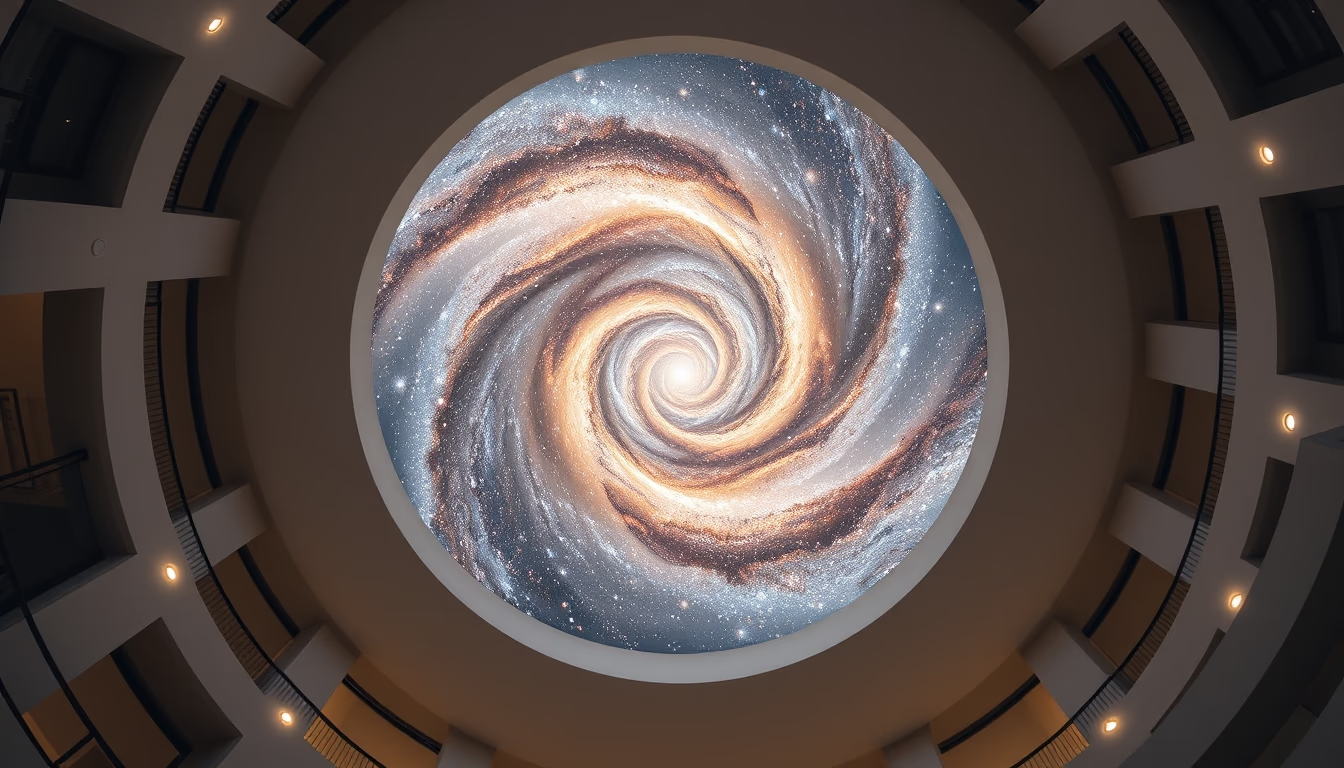
The Andromeda Galaxy, also known as M31, is the nearest large spiral galaxy to the Milky Way, approximately 2.5 million light-years away.
About this subject
The Andromeda Galaxy (M31) is a spiral galaxy located in the constellation Andromeda, and it is the largest member of the Local Group, which includes the Milky Way, the Triangulum Galaxy, and about 50 other smaller galaxies. With a diameter of approximately 220,000 light-years, Andromeda is significantly larger than the Milky Way, which spans about 100,000 light-years. It is estimated to contain about one trillion stars, compared to the Milky Way’s 200 to 400 billion.
Andromeda’s structure features prominent spiral arms and a bright core. Detailed observations reveal that its center hosts a supermassive black hole with a mass equivalent to 100 million Suns. The galaxy also has two bright satellite galaxies, M32 and M110, which are visible with amateur telescopes. Additionally, Andromeda is approaching the Milky Way at a speed of about 110 km/s, and a collision between the two galaxies is predicted to occur in approximately 4.5 billion years.
Historically, Andromeda was first recorded by the Persian astronomer Al-Sufi in the 10th century, who described it as a "small cloud." In the 18th century, Charles Messier cataloged it as M31. It was only in the early 20th century that Edwin Hubble demonstrated that Andromeda lay beyond the Milky Way, establishing it as an independent galaxy. Today, Andromeda is one of the most studied objects in the sky, providing insights into the formation and evolution of spiral galaxies.
Frequently Asked Questions
What is the distance to the Andromeda Galaxy?
The Andromeda Galaxy is approximately 2.5 million light-years away from Earth, making it the nearest large spiral galaxy to the Milky Way.
Will the Andromeda Galaxy collide with the Milky Way?
Yes, the two galaxies are approaching each other and are expected to collide in about 4.5 billion years, eventually merging into a new elliptical galaxy.
How many stars are in the Andromeda Galaxy?
Andromeda is estimated to contain about one trillion stars, more than double the Milky Way's 200 to 400 billion stars.
Direct URL
https://pub-c7d6a6ea828543ac903a74a341ccb2e1.r2.dev/imagens/andromeda-galaxy-spiral-architectural-photography-p2.avifHow to credit
Include a visible link back to UtilizAí. Copy one of the snippets below:
<a href="https://xn--utiliza-eza.com/en/midia/imagens/andromeda-galaxy-spiral-architectural-photography-p2">Andromeda galaxy spiral</a> by <a href="https://xn--utiliza-eza.com">UtilizAí</a>, licensed under <a href="https://creativecommons.org/licenses/by/4.0/">CC BY 4.0</a>.
[Andromeda galaxy spiral](https://xn--utiliza-eza.com/en/midia/imagens/andromeda-galaxy-spiral-architectural-photography-p2) by [UtilizAí](https://xn--utiliza-eza.com), CC BY 4.0
License: CC-BY-4.0