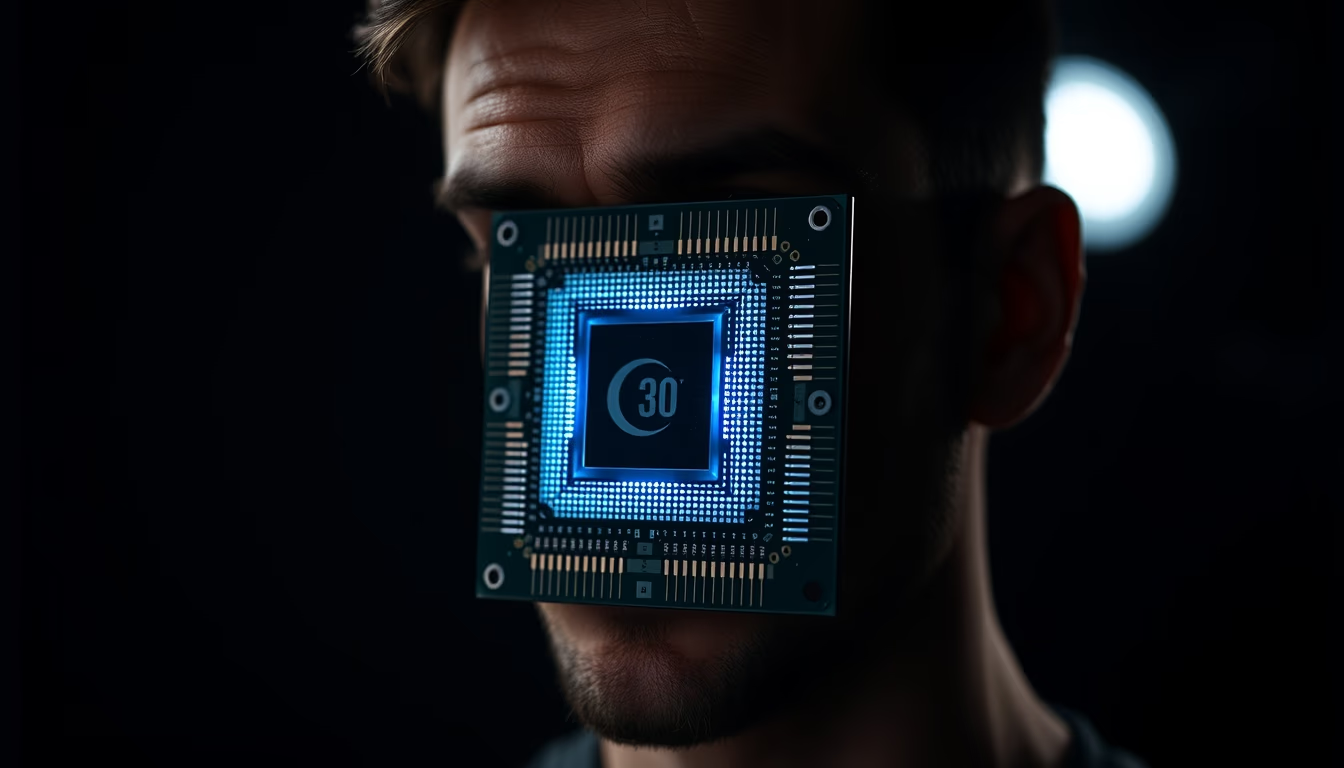
Quantum entanglement visualization
1344×768 · AVIF · CC BY 4.0

Quantum entanglement is a phenomenon where particles instantaneously correlate, challenging classical intuition and forming the basis for technologies like quantum computing and cryptography.
About this subject
Quantum entanglement, which Albert Einstein called "spooky action at a distance", is one of the most intriguing properties of quantum mechanics. When two particles become entangled, their quantum states become interdependent so that measuring one instantly influences the other, regardless of the distance between them. This phenomenon was formalized by Erwin Schrödinger in 1935, following the famous EPR (Einstein-Podolsky-Rosen) paper that questioned the completeness of quantum theory. Decades later, experiments such as those by Alain Aspect in the 1980s confirmed the violation of Bell's inequalities, proving that entanglement is real and cannot be explained by local hidden variables.
Quantum entanglement has revolutionary practical applications. In quantum computing, entangled qubits allow processing information in parallel, speeding up algorithms for factorization and molecular simulation. In quantum cryptography, key distribution based on entanglement provides absolute security because any attempt at interception alters the quantum state, making it detectable by the parties. Furthermore, the phenomenon is essential for quantum teleportation of states between distant locations without transporting matter.
Visualizations of quantum entanglement, such as in this image, aim to graphically represent the instantaneous correlation between particles. Concepts like Bloch spheres or quantum circuit diagrams are often used to illustrate entangled states and their transformations. For the general public, these representations help understand an abstract concept that defies classical intuition. Entanglement is not merely a theoretical curiosity; it is being explored in laboratories and companies like Google and IBM in the quest for scalable quantum processors.
Frequently Asked Questions
What is quantum entanglement?
Quantum entanglement is a phenomenon where two or more particles become correlated such that the state of one cannot be described independently of the others, even when separated by large distances. Measuring one particle instantly affects the other.
How is quantum entanglement used in practice?
It is fundamental for quantum computing, enabling parallel processing, and for quantum cryptography, which ensures security based on the laws of physics. It is also used in quantum teleportation of states.
Does entanglement violate the theory of relativity?
No. Although the correlation is instantaneous, it cannot transmit information faster than light because measuring one particle does not allow controlling the outcome. Special relativity remains intact.
Direct URL
https://pub-c7d6a6ea828543ac903a74a341ccb2e1.r2.dev/imagens/quantum-entanglement-visualization-national-geographic-style-p6.avifHow to credit
Include a visible link back to UtilizAí. Copy one of the snippets below:
<a href="https://xn--utiliza-eza.com/en/midia/imagens/quantum-entanglement-visualization-national-geographic-style-p6">Quantum entanglement visualization</a> by <a href="https://xn--utiliza-eza.com">UtilizAí</a>, licensed under <a href="https://creativecommons.org/licenses/by/4.0/">CC BY 4.0</a>.
[Quantum entanglement visualization](https://xn--utiliza-eza.com/en/midia/imagens/quantum-entanglement-visualization-national-geographic-style-p6) by [UtilizAí](https://xn--utiliza-eza.com), CC BY 4.0
License: CC-BY-4.0