Concorde supersonic display
1344×768 · AVIF · CC BY 4.0
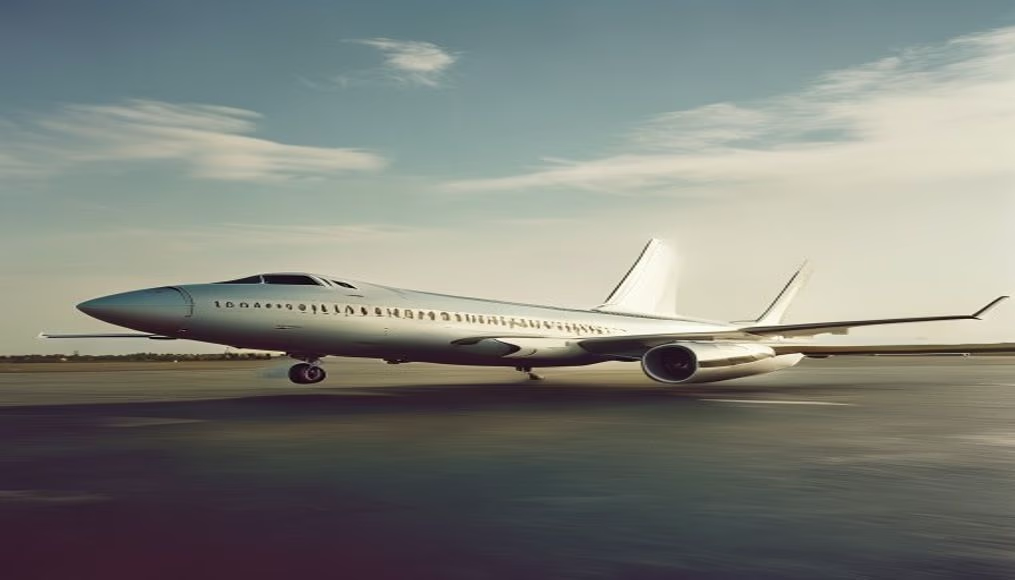
The Concorde, the iconic Anglo-French supersonic airliner, revolutionized commercial aviation with speeds of Mach 2.04 and a sleek design.
About this subject
The Concorde was a supersonic airliner developed jointly by British Aircraft Corporation (UK) and Aérospatiale (France). Its first commercial flight took place on January 21, 1976, operated by British Airways and Air France. Capable of carrying up to 100 passengers, the Concorde reached speeds exceeding 2,100 km/h, cutting travel time between London and New York to about three and a half hours. The distinctive long fuselage and delta wing design were optimized for supersonic flight but consumed fuel heavily, limiting economic viability.
Development began in the 1950s, with the first prototype flying in 1969. The aircraft was an aerospace engineering milestone, incorporating innovations such as a movable nose that lowered for better visibility during takeoff and landing. Despite technical success, only 20 units were built, and only 14 entered commercial service. The sonic boom restricted routes to oceanic segments, as overland supersonic flight was banned in most countries.
The oil crisis in the 1970s and high operating costs turned the Concorde into a luxury symbol, with fares reaching up to US$10,000 (adjusted for inflation). The only fatal accident, the Air France Flight 4590 crash in Paris in 2000, hastened its decline. After the September 11 attacks, demand plummeted, and the final retirement came on November 26, 2003. Today, several Concordes are preserved in museums, including the Musée de l'Air et de l'Espace in Le Bourget, France, and the Intrepid Museum in New York.
Interestingly, the Concorde inspired later supersonic commercial projects, such as the Boeing 2707 (cancelled) and more recent ventures like Boom Supersonic Overture. The legacy of the Concorde endures as a testament to human ambition in overcoming speed and engineering barriers.
Frequently Asked Questions
Why was the Concorde retired?
The Concorde was retired due to high operating costs, declining demand after the 2000 crash and the September 11 attacks, expensive maintenance, and route restrictions from sonic booms.
How many passengers could the Concorde carry?
The Concorde seated up to 100 passengers in a standard configuration, with rows of 2-2 in the front and 2-1 in the rear.
What was the Concorde's maximum speed?
The Concorde cruised at Mach 2.04 (about 2,180 km/h) at an altitude of 60,000 feet (18,300 meters), more than twice the speed of sound.
Direct URL
https://pub-c7d6a6ea828543ac903a74a341ccb2e1.r2.dev/imagens/concorde-supersonic-display-film-grain-authentic-p1.avifHow to credit
Include a visible link back to UtilizAí. Copy one of the snippets below:
<a href="https://xn--utiliza-eza.com/en/midia/imagens/concorde-supersonic-display-film-grain-authentic-p1">Concorde supersonic display</a> by <a href="https://xn--utiliza-eza.com">UtilizAí</a>, licensed under <a href="https://creativecommons.org/licenses/by/4.0/">CC BY 4.0</a>.
[Concorde supersonic display](https://xn--utiliza-eza.com/en/midia/imagens/concorde-supersonic-display-film-grain-authentic-p1) by [UtilizAí](https://xn--utiliza-eza.com), CC BY 4.0
License: CC-BY-4.0