Bubble chamber tracks
1344×768 · AVIF · CC BY 4.0
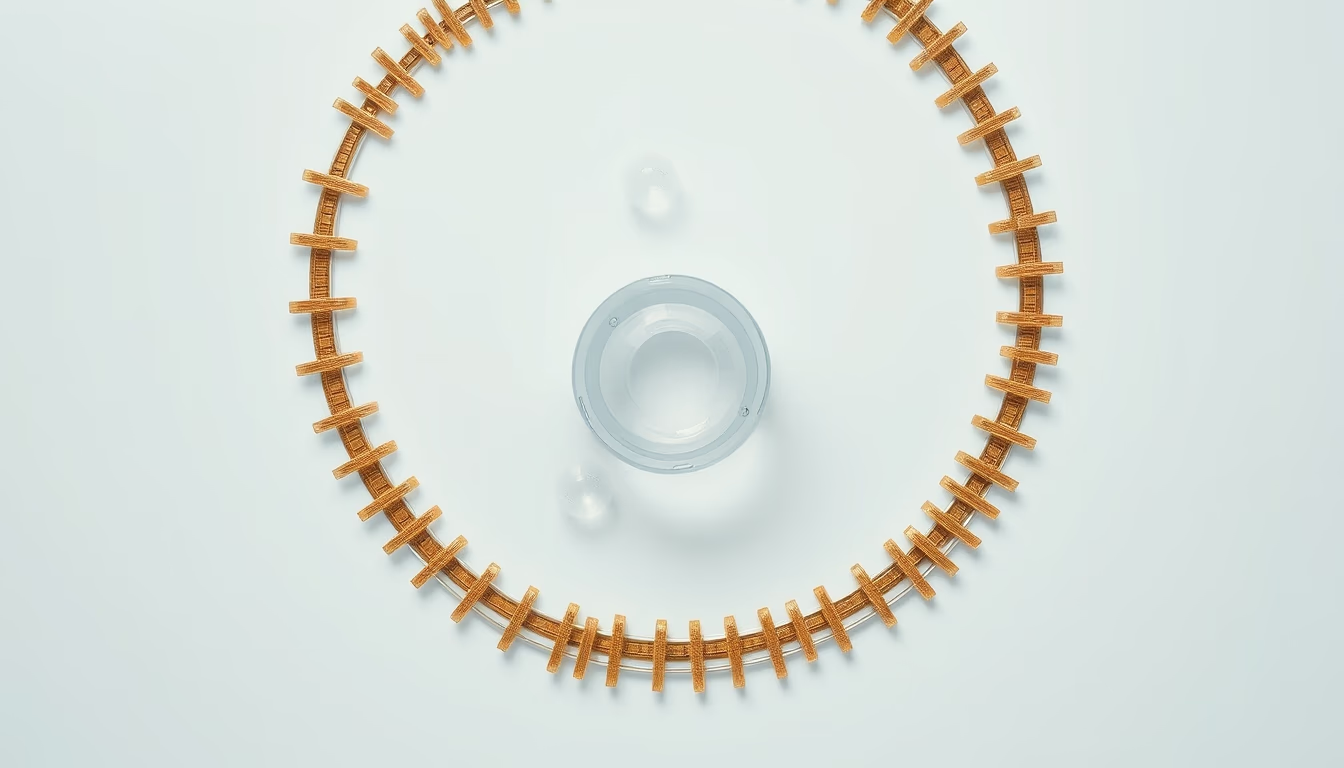
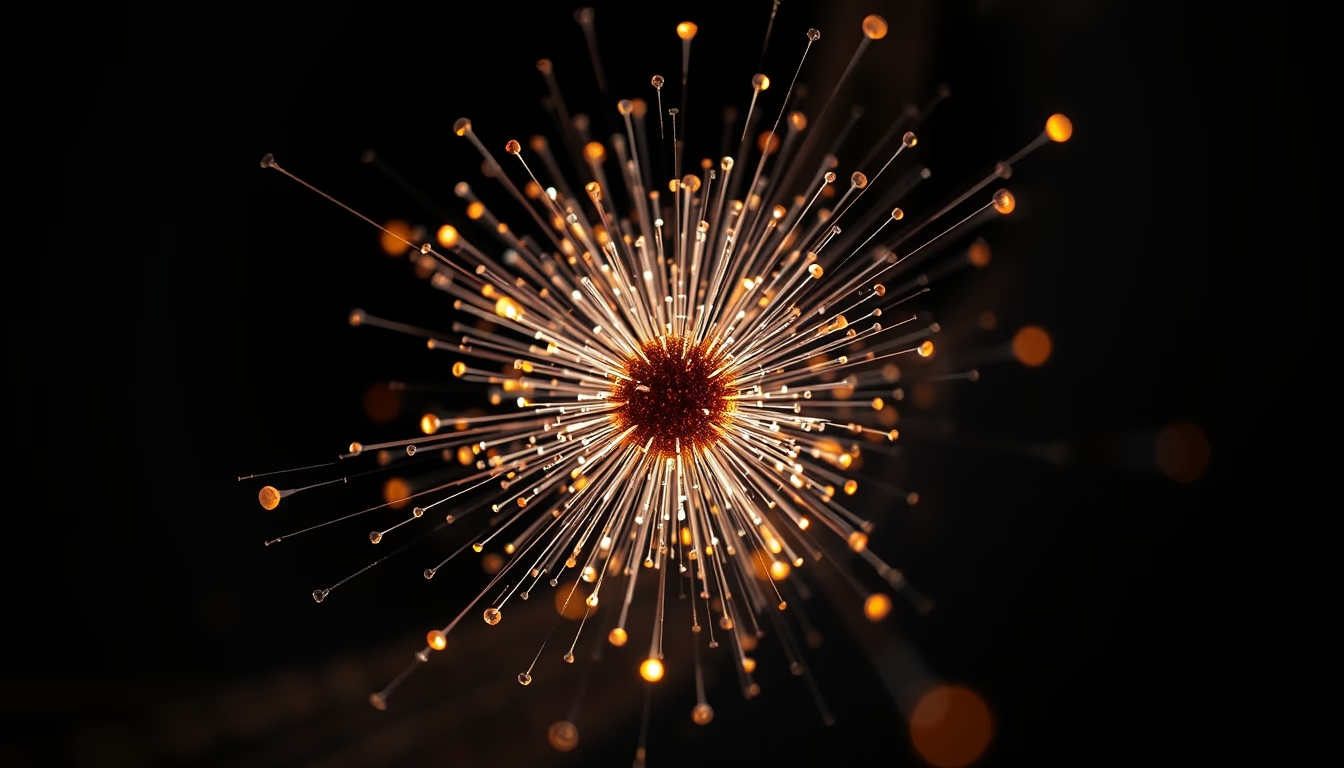
Bubble chamber tracks reveal the paths of subatomic particles, visually recording fundamental interactions in particle physics.
About this subject
A bubble chamber is a particle detector invented in 1952 by physicist Donald Glaser, who was awarded the Nobel Prize in Physics in 1960. The device consists of a vessel containing a superheated liquid, usually liquid hydrogen or deuterium, maintained under pressure just above the boiling point. When a charged particle passes through the liquid, it ionizes molecules along its path, forming vapor nuclei that expand into visible bubbles. These bubbles are photographed, creating a three-dimensional record of particle trajectories.
Bubble chambers were crucial for major discoveries such as the omega-minus meson in 1964 and the observation of neutrinos in 1970. They enabled the study of weak and strong interactions and confirmed the existence of numerous particles predicted by the Standard Model. The Gargamelle experiment at CERN used a bubble chamber filled with propane and freon to discover weak neutral currents in 1973.
As technology advanced, bubble chambers were gradually replaced by electronic detectors like spark chambers and wire chambers. Nevertheless, they remain valuable educational and historical tools. Analysis of tracks allows identification of particle momentum, charge, and mass, since curvature in a magnetic field provides information about the charge-to-mass ratio. Bubble chamber images are iconic in scientific culture, symbolizing direct visualization of the subatomic world.
Frequently Asked Questions
How does a bubble chamber work?
A bubble chamber contains a superheated liquid. When a charged particle passes through, it ionizes the liquid, forming bubbles that are photographed.
What important discoveries were made with bubble chambers?
Key discoveries include the omega-minus meson (1964) and the weak neutral currents by the Gargamelle experiment (1973).
Why were bubble chambers replaced?
They were replaced by electronic detectors like wire chambers, which offer higher event rates and faster data analysis.
Direct URL
https://pub-c7d6a6ea828543ac903a74a341ccb2e1.r2.dev/imagens/bubble-chamber-tracks-isometric-flat-lay-p11.avifHow to credit
Include a visible link back to UtilizAí. Copy one of the snippets below:
<a href="https://xn--utiliza-eza.com/en/midia/imagens/bubble-chamber-tracks-isometric-flat-lay-p11">Bubble chamber tracks</a> by <a href="https://xn--utiliza-eza.com">UtilizAí</a>, licensed under <a href="https://creativecommons.org/licenses/by/4.0/">CC BY 4.0</a>.
[Bubble chamber tracks](https://xn--utiliza-eza.com/en/midia/imagens/bubble-chamber-tracks-isometric-flat-lay-p11) by [UtilizAí](https://xn--utiliza-eza.com), CC BY 4.0
License: CC-BY-4.0