Atomic clock laboratory
1344×768 · AVIF · CC BY 4.0
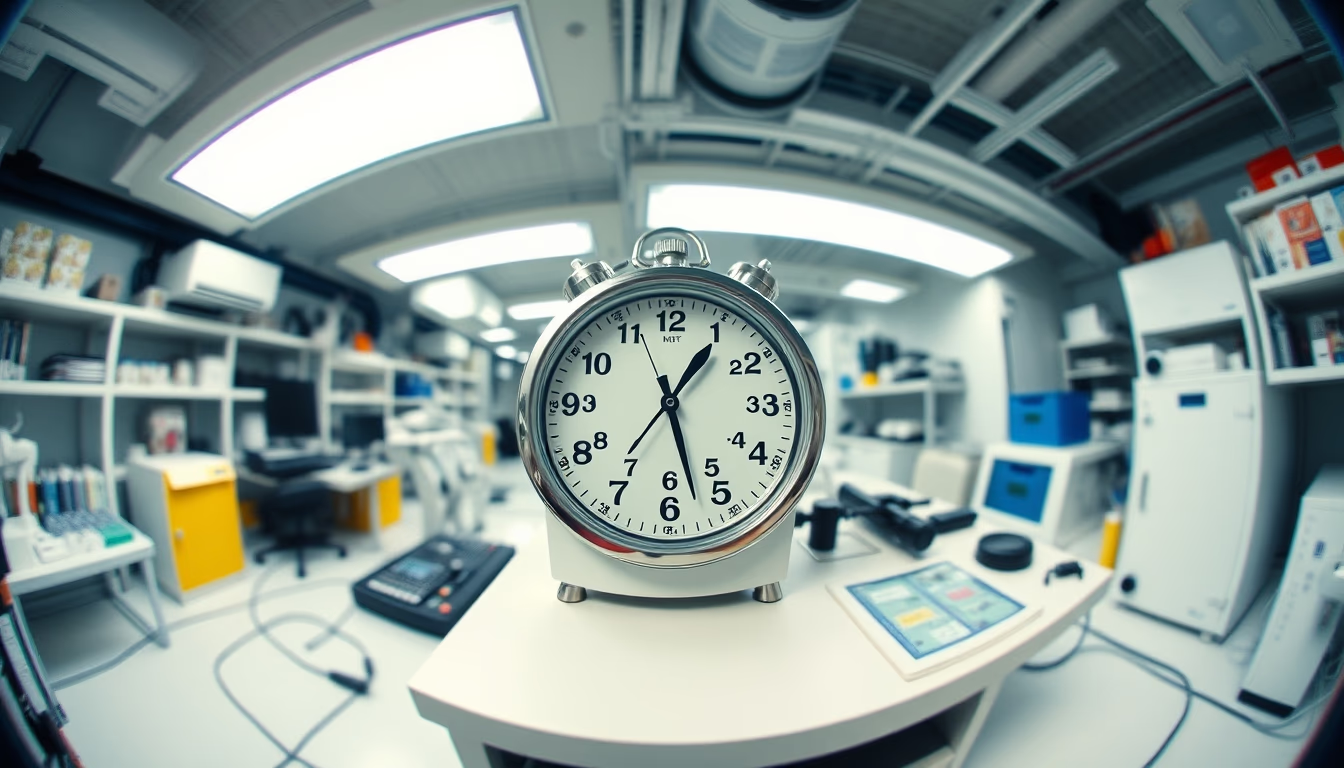
Atomic clock laboratories house ultra-precise instruments that define the international standard of time, the second.
About this subject
Atomic clocks are devices that measure time based on the oscillations of atoms, typically cesium or rubidium. They serve as the reference for defining the second in the International System of Units (SI). The current standard, adopted in 1967, defines the second as 9,192,631,770 periods of radiation corresponding to the transition between two hyperfine levels of the ground state of the cesium-133 atom. This precision allows atomic clocks to gain or lose less than one second in 100 million years.
Laboratories such as the United States Naval Observatory (USNO) and the National Institute of Standards and Technology (NIST) in the US, as well as the International Bureau of Weights and Measures (BIPM) in France, maintain ensembles of atomic clocks to generate International Atomic Time (TAI). These clocks are essential for satellite navigation systems (GPS, GLONASS, Galileo), telecommunications, power grid synchronization, and scientific research requiring extremely accurate time measurements.
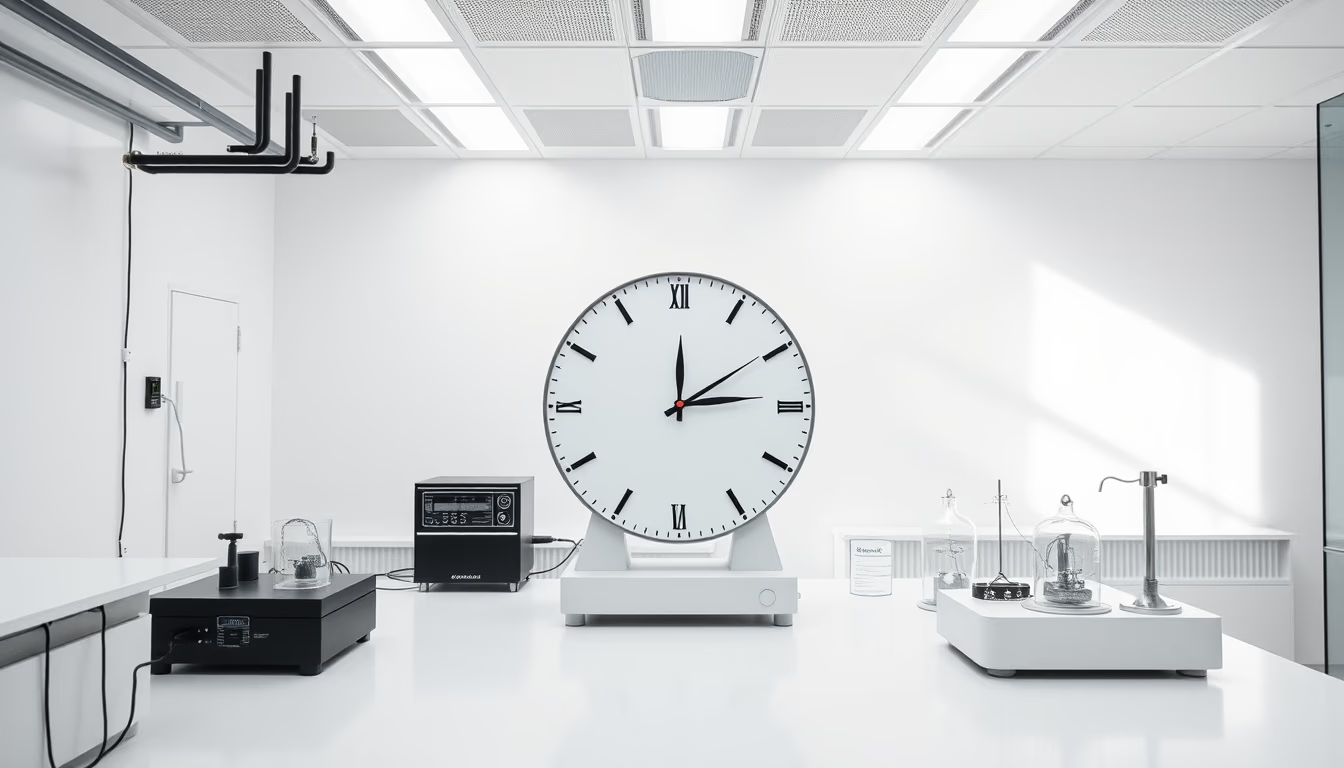
The evolution of atomic clocks includes cesium fountain models, which use laser-cooled atoms, and optical clocks based on ions or neutral atoms such as strontium or ytterbium. The latter have achieved even higher precision, with uncertainties on the order of one part in 10^18. In specialized laboratories, these instruments occupy climate-controlled rooms with vibration and magnetic field isolation to prevent external interference that could affect measurements.
Frequently Asked Questions
How does an atomic clock work?
An atomic clock uses the natural oscillation of atoms, typically cesium-133, as a pendulum. The atoms are excited by microwaves at a specific frequency, and a feedback system adjusts that frequency to maximize the atomic transition, producing an extremely stable time signal.
Where are atomic clocks used in everyday life?
They underpin GPS systems, synchronization of telecommunications networks and the internet, high-frequency financial transactions, and smart power grids. Precise time is also critical for scientific experiments in particle physics and astronomy.
What is the most accurate atomic clock ever built?
Currently, optical clocks such as those based on strontium or ytterbium are the most accurate, with uncertainties around one part in 10^18. This means they would not gain or lose a second over the entire age of the universe.
Direct URL
https://pub-c7d6a6ea828543ac903a74a341ccb2e1.r2.dev/imagens/atomic-clock-laboratory-fish-eye-wide-angle-p5.avifHow to credit
Include a visible link back to UtilizAí. Copy one of the snippets below:
<a href="https://xn--utiliza-eza.com/en/midia/imagens/atomic-clock-laboratory-fish-eye-wide-angle-p5">Atomic clock laboratory</a> by <a href="https://xn--utiliza-eza.com">UtilizAí</a>, licensed under <a href="https://creativecommons.org/licenses/by/4.0/">CC BY 4.0</a>.
[Atomic clock laboratory](https://xn--utiliza-eza.com/en/midia/imagens/atomic-clock-laboratory-fish-eye-wide-angle-p5) by [UtilizAí](https://xn--utiliza-eza.com), CC BY 4.0
License: CC-BY-4.0