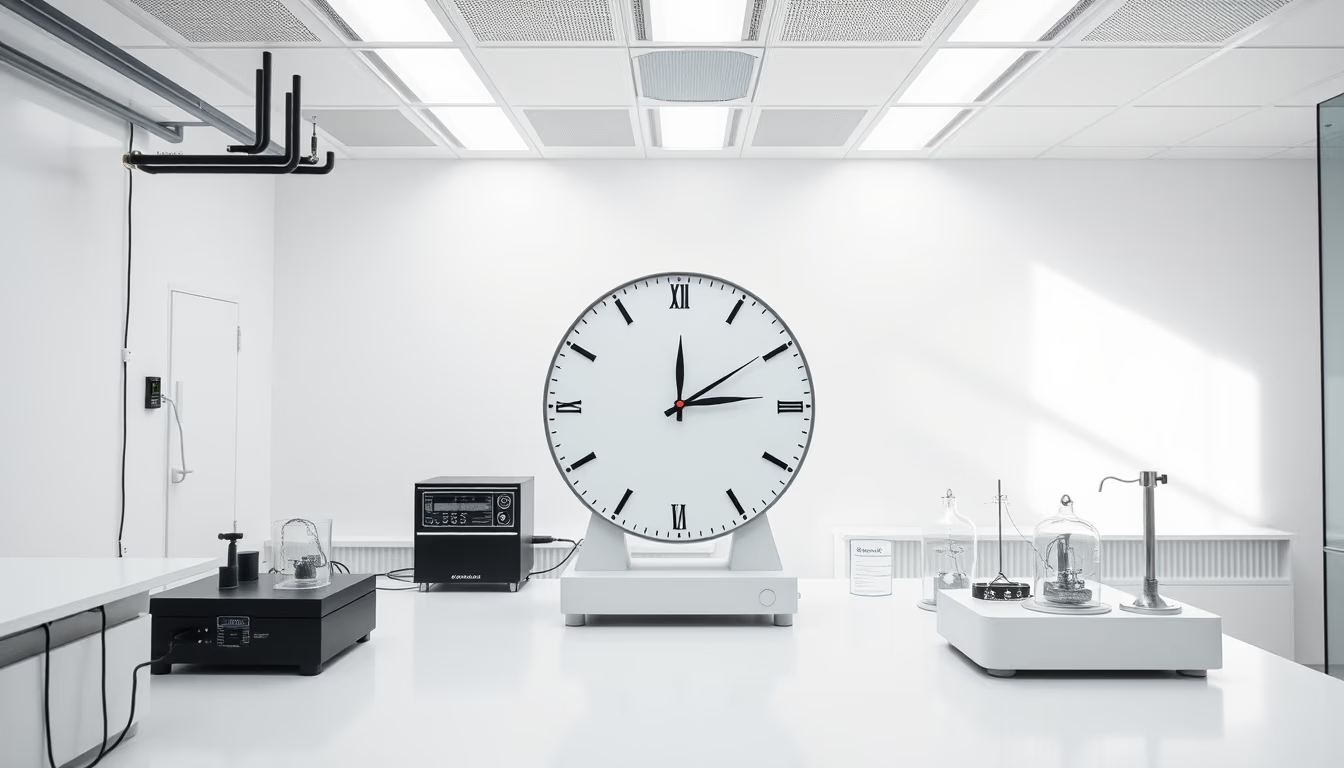
Atomic clock laboratory
1344×768 · AVIF · CC BY 4.0

Atomic clock laboratories maintain the global time standard, essential for GPS, telecommunications, and science.
About this subject
Atomic clock laboratories are metrology facilities housing the most precise timekeeping devices ever built. These clocks rely on quantum transitions in atoms such as cesium or rubidium, which oscillate at extremely stable frequencies. The second, the SI base unit, is defined by 9,192,631,770 cycles of radiation from cesium-133 atoms. Laboratories like NIST (USA), PTB (Germany), and the National Observatory (Brazil) maintain these standards, contributing to Coordinated Universal Time (UTC).
The importance of these labs extends far beyond simple timing. Global positioning systems (GPS) depend on atomic clocks aboard satellites, which synchronize signals to calculate coordinates within meters. Without constant calibration from ground-based laboratories, GPS would rapidly lose accuracy. Modern telecommunications, power grids, and financial transactions also require nanosecond-level synchronization, enabled by these centers.
Atomic clocks also allow testing of fundamental physics, such as Einstein's general relativity. Time dilation predicted by the theory is confirmed by tiny differences between clocks at different altitudes, measured in specialized labs. Today, labs like JILA (USA) are developing optical clocks based on strontium atoms, which can be up to a hundred times more accurate than cesium clocks, paving the way for a redefinition of the second.
In Brazil, the National Observatory in Rio de Janeiro maintains the legal time standard and coordinates the Brazilian Official Time, essential for industry and research. The constant evolution of these laboratories, through international collaboration, ensures that humanity continues to measure time with increasing precision, impacting everything from everyday navigation to space exploration.
Frequently Asked Questions
How does an atomic clock work?
An atomic clock measures time using the transition between two energy levels of an atom, typically cesium or rubidium. The frequency of the radiation emitted in this transition is extremely stable and serves as a reference for counting seconds.
Where are the main atomic clock laboratories?
The main ones are at NIST (USA), PTB (Germany), the National Observatory (Brazil), and other metrology institutes worldwide, which collaborate to define Coordinated Universal Time (UTC).
Why are atomic clocks important for GPS?
GPS satellites carry atomic clocks that send synchronized signals. The time difference between signal emission and reception allows distance calculation. Without atomic precision, location would be inaccurate by kilometers.
Direct URL
https://pub-c7d6a6ea828543ac903a74a341ccb2e1.r2.dev/imagens/atomic-clock-laboratory-film-grain-authentic-p0.avifHow to credit
Include a visible link back to UtilizAí. Copy one of the snippets below:
<a href="https://xn--utiliza-eza.com/en/midia/imagens/atomic-clock-laboratory-film-grain-authentic-p0">Atomic clock laboratory</a> by <a href="https://xn--utiliza-eza.com">UtilizAí</a>, licensed under <a href="https://creativecommons.org/licenses/by/4.0/">CC BY 4.0</a>.
[Atomic clock laboratory](https://xn--utiliza-eza.com/en/midia/imagens/atomic-clock-laboratory-film-grain-authentic-p0) by [UtilizAí](https://xn--utiliza-eza.com), CC BY 4.0
License: CC-BY-4.0