AI neural network glowing nodes and connections in 3D space
1344×768 · AVIF · CC BY 4.0
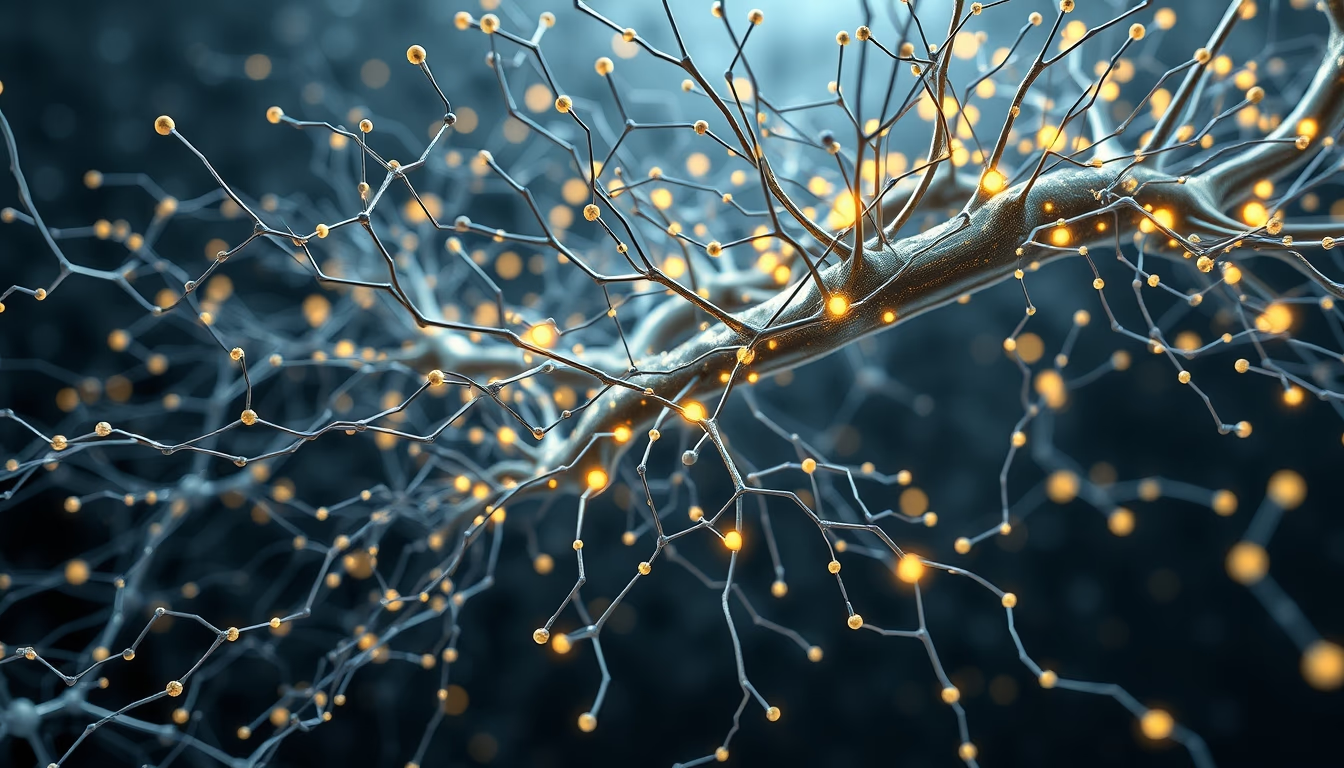
Artificial neural networks are computational models inspired by the human brain, composed of nodes and connections that process information.
About this subject
Artificial neural networks are the backbone of deep learning, a subfield of artificial intelligence that has revolutionized areas such as computer vision, natural language processing, and speech recognition. Inspired by the biological structure of neurons, these networks consist of layers of interconnected nodes, where each connection has an adjustable weight. During training, weights are optimized to minimize errors, allowing the network to learn complex patterns from data.
The visual representation of glowing nodes and connections in a three-dimensional space is a common metaphor to illustrate the architecture of a neural network. In practice, neural networks can have millions of parameters and operate in high-dimensional spaces that cannot be directly visualized. However, this simplified image helps convey the idea of parallel processing and interconnection.
The development of neural networks dates back to the 1940s with the McCulloch-Pitts model, but it was from the 2000s onward, with increased computational power and the availability of large datasets, that they became practical. Today, they are used in everyday applications such as movie recommendations, medical diagnoses, and autonomous vehicles.
A curiosity: the architecture of a neural network can be tailored for specific tasks. For example, convolutional neural networks (CNNs) are ideal for images, while recurrent neural networks (RNNs) are used for time sequences. The glow of nodes in the image can symbolize the activation of neurons during stimulus processing.
Frequently Asked Questions
What are artificial neural networks?
They are computational models inspired by the human brain, composed of nodes (artificial neurons) and connections that process information. They learn patterns from data by adjusting connection weights during training.
How are neural networks trained?
Training involves feeding the network input data and comparing its outputs to the expected results. The error is calculated and connection weights are adjusted using algorithms like backpropagation, repeating the process until the network achieves good accuracy.
What are practical applications of neural networks?
They are used in image and speech recognition, machine translation, autonomous vehicles, medical diagnoses, recommendation systems, and many other fields involving complex pattern recognition.
Direct URL
https://pub-c7d6a6ea828543ac903a74a341ccb2e1.r2.dev/imagens/ai-neural-network-glowing-nodes-and-connections-in-3d-space-editorial-portrait-overcast-soft-daylight.avifHow to credit
Include a visible link back to UtilizAí. Copy one of the snippets below:
<a href="https://xn--utiliza-eza.com/en/midia/imagens/ai-neural-network-glowing-nodes-and-connections-in-3d-space-editorial-portrait-overcast-soft-daylight">AI neural network glowing nodes and connections in 3D space</a> by <a href="https://xn--utiliza-eza.com">UtilizAí</a>, licensed under <a href="https://creativecommons.org/licenses/by/4.0/">CC BY 4.0</a>.
[AI neural network glowing nodes and connections in 3D space](https://xn--utiliza-eza.com/en/midia/imagens/ai-neural-network-glowing-nodes-and-connections-in-3d-space-editorial-portrait-overcast-soft-daylight) by [UtilizAí](https://xn--utiliza-eza.com), CC BY 4.0
License: CC-BY-4.0