Fiber optic cables glowing in dark
1344×768 · AVIF · CC BY 4.0
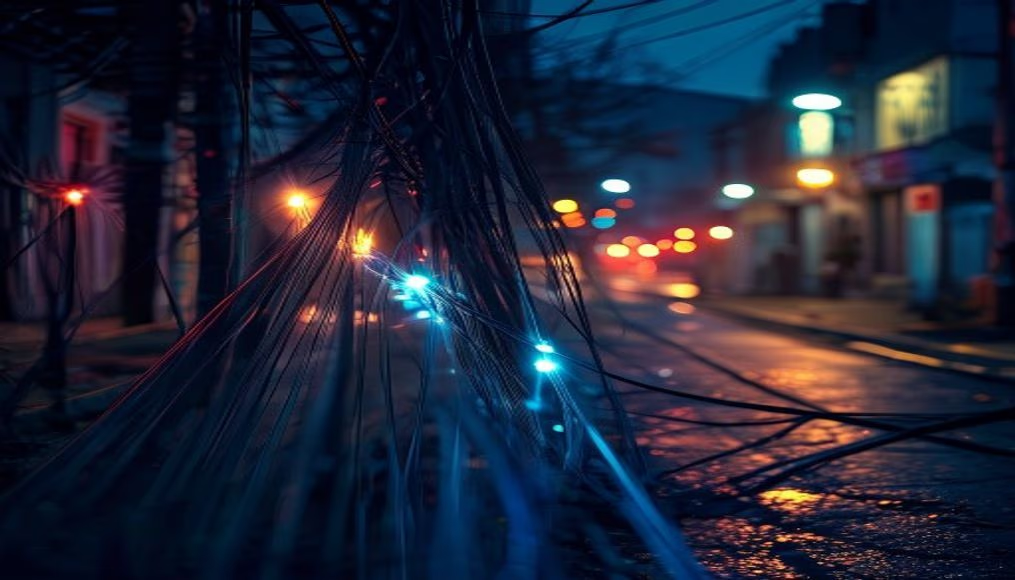
Fiber optic cables transmit data via light pulses, enabling high-speed internet and instant global communications.
About this subject
Fiber optic cables revolutionized telecommunications since their commercial introduction in the 1970s. Unlike traditional copper wires that use electrical signals, fiber optics use light beams traveling through thin glass or plastic filaments. This technology enables far superior transmission speeds, reaching tens of terabits per second over long distances.
The structure of a fiber optic cable consists of a pure glass core surrounded by a cladding that reflects light back into the core, maintaining signal strength for kilometers. Light is generated by lasers or LEDs and modulated to encode data. A single fiber can carry multiple information channels simultaneously using wavelength division multiplexing, a technology that dramatically increases capacity.
In Brazil, fiber optic expansion accelerated mainly in the 2000s, driven by investments from operators like Vivo, Claro, and Oi. Today, the country has one of the largest fiber optic networks in the world, with millions of kilometers of cables connecting cities and remote regions. This technology is essential for streaming services, telemedicine, distance education, and real-time financial transactions.
A curiosity: signal attenuation in modern fiber optics is extremely low, allowing a signal to travel hundreds of kilometers without amplification. This contrasts with copper cables, which quickly lose quality over short distances. Additionally, fiber optics are immune to electromagnetic interference, making them ideal for industrial and submarine environments, such as the cables that connect continents and form the backbone of the global internet.
Frequently Asked Questions
How does fiber optic transmit data?
Fiber optic transmits data as light pulses generated by lasers or LEDs. These pulses travel through the glass core, reflected by the cladding, and are decoded at the receiving end.
What are the advantages of fiber optic over copper cable?
Fiber optic offers higher bandwidth, lower signal loss over long distances, and immunity to electromagnetic interference, resulting in faster and more reliable connections.
Is fiber optic only used for residential internet?
No. Fiber optic is essential in long-haul networks, submarine cables, data centers, medicine (endoscopy), military, and sensing systems.
Direct URL
https://pub-c7d6a6ea828543ac903a74a341ccb2e1.r2.dev/imagens/fiber-optic-cables-glowing-in-dark-street-photography-v11.avifHow to credit
Include a visible link back to UtilizAí. Copy one of the snippets below:
<a href="https://xn--utiliza-eza.com/en/midia/imagens/fiber-optic-cables-glowing-in-dark-street-photography-v11">Fiber optic cables glowing in dark</a> by <a href="https://xn--utiliza-eza.com">UtilizAí</a>, licensed under <a href="https://creativecommons.org/licenses/by/4.0/">CC BY 4.0</a>.
[Fiber optic cables glowing in dark](https://xn--utiliza-eza.com/en/midia/imagens/fiber-optic-cables-glowing-in-dark-street-photography-v11) by [UtilizAí](https://xn--utiliza-eza.com), CC BY 4.0
License: CC-BY-4.0