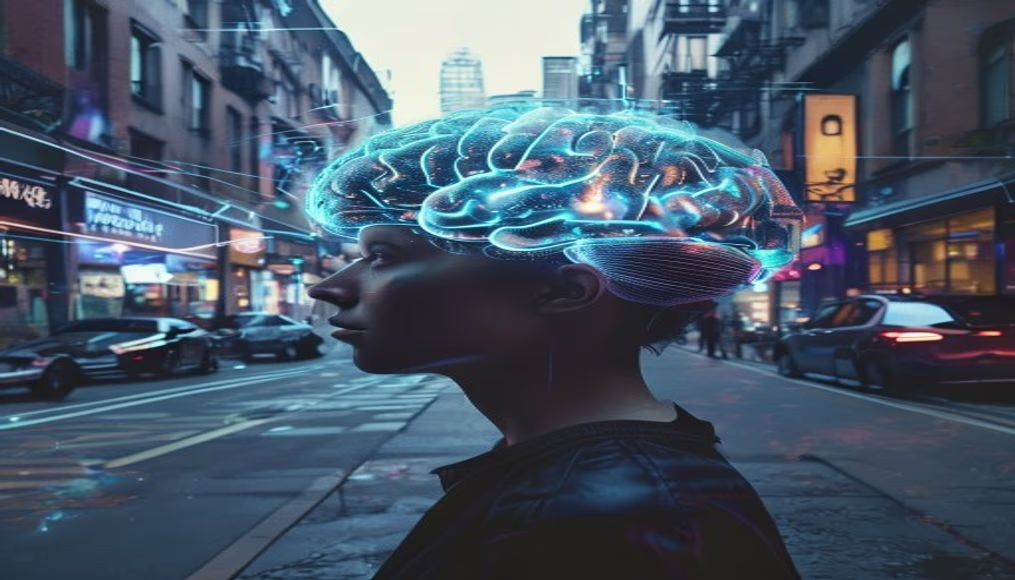
AI neural network 3D visualization
1344×768 · AVIF · CC BY 4.0

Three-dimensional visualization of an artificial neural network, highlighting synaptic connections and processing layers in a computational model.
About this subject
Artificial neural networks are computational models inspired by the human brain, composed of artificial neurons organized in layers. Each neuron receives inputs, applies weights and activation functions, and transmits outputs to the next layer. This structure allows the network to learn complex patterns from data, forming the basis of deep learning.
3D visualization of a neural network, like the one depicted, is often used in educational and marketing materials to illustrate the architecture of models such as convolutional neural networks (CNNs) or recurrent neural networks (RNNs). In practice, these networks have thousands or millions of parameters, and the three-dimensional representation simplifies understanding of data flow between hidden, input, and output layers.
The 'commercial product photography' style suggests applications in corporate presentations, technology websites, or promotional materials for AI companies. The choice of vibrant colors and soft lighting is common to convey modernity and innovation, associating the technology with concepts of intelligence and connectivity.
Interestingly, the first artificial neural network, the Perceptron, was created in 1958 by Frank Rosenblatt. Since then, advances in hardware and algorithms have enabled the training of increasingly deep networks, such as GPT-3 with 175 billion parameters. 3D visualization helps communicate this complexity in an accessible way.
Frequently Asked Questions
What is an artificial neural network?
An artificial neural network is a computational model inspired by the human brain, composed of artificial neurons organized in layers. It learns patterns from data and is used in tasks such as image recognition, natural language processing, and predictions.
How does learning work in a neural network?
Learning occurs by adjusting the weights of connections between neurons based on output errors. The backpropagation algorithm computes gradients to minimize the loss function, updating weights iteratively.
What is the difference between shallow and deep neural networks?
Shallow networks have few hidden layers (usually one or two), while deep networks (deep learning) have many layers, enabling them to learn more abstract and complex representations of data.
Direct URL
https://pub-c7d6a6ea828543ac903a74a341ccb2e1.r2.dev/imagens/ai-neural-network-3d-visualization-commercial-product-photography.avifHow to credit
Include a visible link back to UtilizAí. Copy one of the snippets below:
<a href="https://xn--utiliza-eza.com/en/midia/imagens/ai-neural-network-3d-visualization-commercial-product-photography">AI neural network 3D visualization</a> by <a href="https://xn--utiliza-eza.com">UtilizAí</a>, licensed under <a href="https://creativecommons.org/licenses/by/4.0/">CC BY 4.0</a>.
[AI neural network 3D visualization](https://xn--utiliza-eza.com/en/midia/imagens/ai-neural-network-3d-visualization-commercial-product-photography) by [UtilizAí](https://xn--utiliza-eza.com), CC BY 4.0
License: CC-BY-4.0