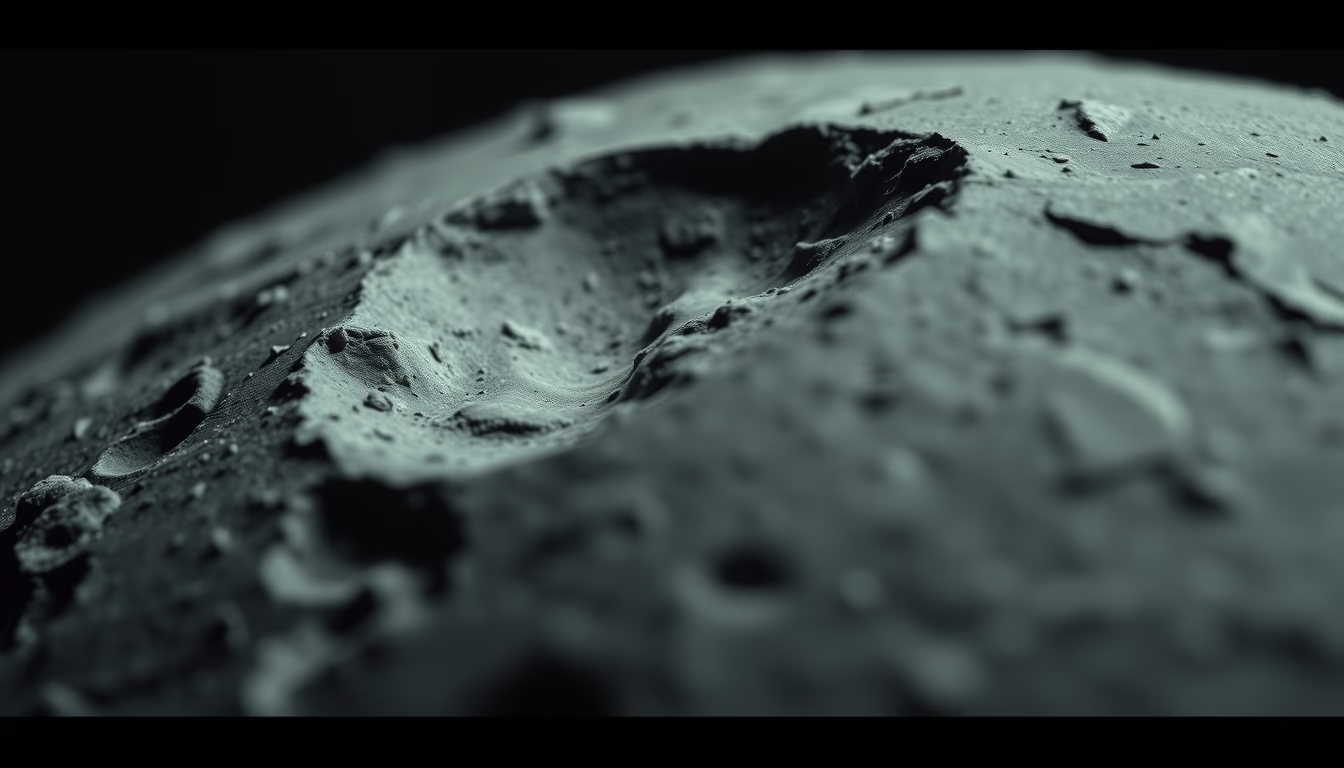
Parker solar probe sun
1344×768 · AVIF · CC BY 4.0

The Parker Solar Probe is NASA's spacecraft revolutionizing the study of the Sun, coming closer than any previous mission.
About this subject
Launched on August 12, 2018, the Parker Solar Probe is NASA's first mission to "touch" the Sun. Named after astrophysicist Eugene Parker, who predicted the existence of the solar wind, the probe performs a series of progressively closer approaches to our star. Unlike space telescopes that observe the Sun from a distance, Parker collects data directly from the solar corona, a region of millions of degrees Celsius surrounding the visible surface.
To withstand extreme heat, the spacecraft has a carbon-composite heat shield 11.4 centimeters thick, capable of resisting temperatures above 1,400°C. During its orbits, it reaches record speeds, in 2023, it became the fastest human-made object ever, exceeding 635,000 km/h. These capabilities allow it to fly as close as 6.2 million kilometers from the Sun's surface, seven times closer than any previous spacecraft.
Parker Solar Probe's discoveries have already transformed heliophysics. It identified magnetic structures called "switchbacks" in the solar wind, helped explain why the corona is hotter than the surface (the coronal heating paradox), and found a dust-free zone around the Sun. Its instruments measure magnetic fields, energetic particles, and solar plasma, providing crucial data for predicting solar storms that affect satellites and power grids on Earth.
The mission is planned to last until 2025, with the final and closest approach in December of that year. Each perihelion passage occurs every few months, with the probe using Venus's gravity to adjust its orbit. The legacy of the Parker Solar Probe will be fundamental to understanding not only the Sun but also stars in general and their influence on planetary systems.
Frequently Asked Questions
What is the maximum speed achieved by the Parker Solar Probe?
In 2023, the Parker Solar Probe reached approximately 635,000 km/h (176 km/s), making it the fastest human-made object ever. Its speed will continue to increase until the end of the mission.
How does the probe get so close to the Sun without melting?
It has a carbon-composite heat shield 11.4 cm thick that reflects most of the solar radiation. The shield keeps the instruments at about 30°C, while the front side reaches over 1,400°C.
What are the 'switchbacks' discovered by the Parker Solar Probe?
They are zigzag magnetic structures in the solar wind where the magnetic field abruptly reverses. They may hold the key to understanding how the solar wind is accelerated and heated, one of the central mysteries of heliophysics.
Direct URL
https://pub-c7d6a6ea828543ac903a74a341ccb2e1.r2.dev/imagens/parker-solar-probe-sun-studio-editorial-portrait-fresh14.avifHow to credit
Include a visible link back to UtilizAí. Copy one of the snippets below:
<a href="https://xn--utiliza-eza.com/en/midia/imagens/parker-solar-probe-sun-studio-editorial-portrait-fresh14">Parker solar probe sun</a> by <a href="https://xn--utiliza-eza.com">UtilizAí</a>, licensed under <a href="https://creativecommons.org/licenses/by/4.0/">CC BY 4.0</a>.
[Parker solar probe sun](https://xn--utiliza-eza.com/en/midia/imagens/parker-solar-probe-sun-studio-editorial-portrait-fresh14) by [UtilizAí](https://xn--utiliza-eza.com), CC BY 4.0
License: CC-BY-4.0