James webb deep field
1344×768 · AVIF · CC BY 4.0

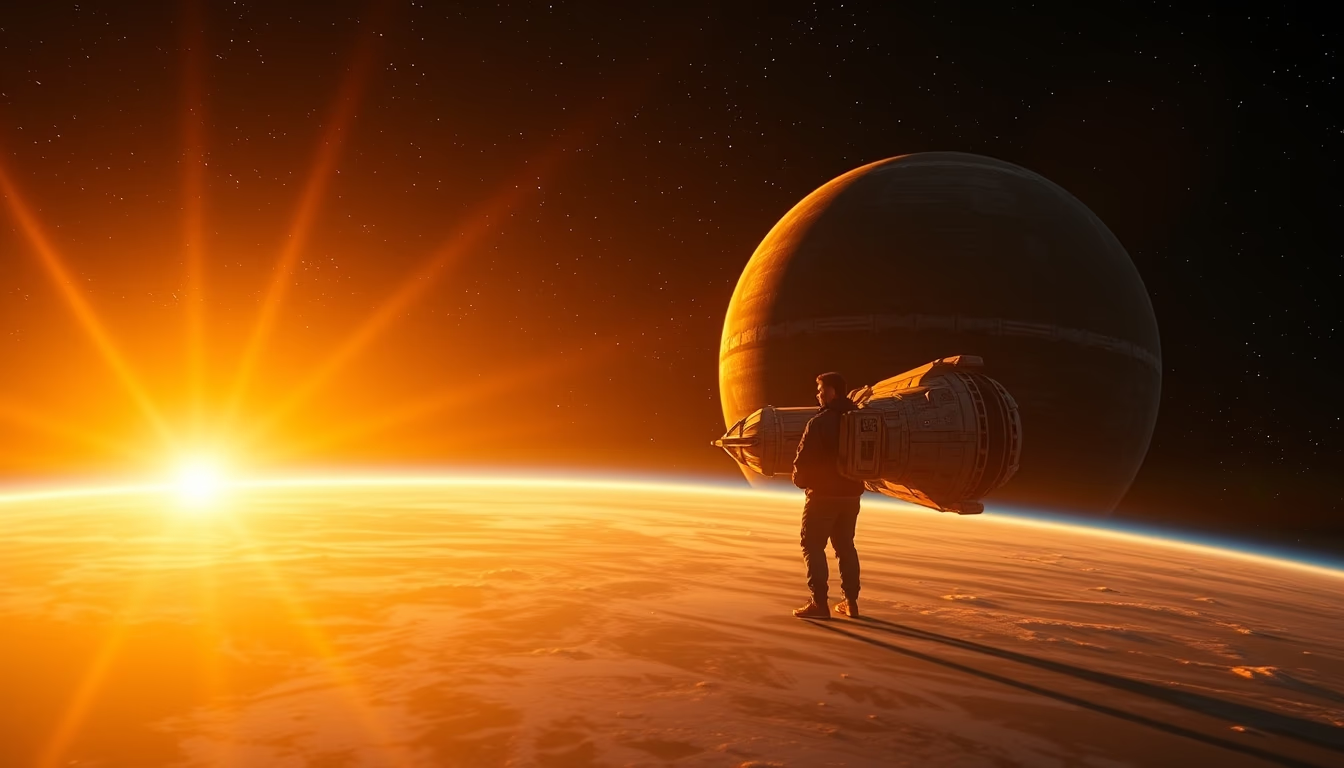
The James Webb Space Telescope has revealed the sharpest infrared deep field of the universe, transforming our understanding of galaxy formation.
About this subject
The James Webb Space Telescope (JWST), launched in December 2021, is the most powerful space observatory ever built. Its first deep field image, released in July 2022, shows the galaxy cluster SMACS 0723 as it appeared 4.6 billion years ago, with thousands of even more distant galaxies visible in the background. Unlike Hubble, which observes mainly visible and ultraviolet light, Webb operates in the infrared, allowing it to see through cosmic dust clouds and capture light from the first stars and galaxies formed after the Big Bang.
The image known as Webb's First Deep Field is composed of exposures at different infrared wavelengths, totaling 12.5 hours of observation, much less than the weeks required for Hubble deep fields. This deep field reveals objects with redshifts above 5, including galaxy candidates with redshift 13.2, corresponding to only 400 million years after the Big Bang. Webb's sharpness and sensitivity allow the study of galactic morphology, star formation, and the presence of supermassive black holes in very remote cosmic epochs.
Webb's observation program includes several deep fields, such as CEERS (Cosmic Evolution Early Release Science) and GLASS (Grism Lens-Amplified Survey from Space), which map regions of the sky with gravitational lensing to amplify the brightness of distant galaxies. These data are revolutionizing astronomy, providing evidence on the reionization of the universe and the abundance of primordial galaxies. Webb has also discovered unexpectedly massive galaxies in the early cosmos, challenging models of galaxy formation.
The comparison with the Hubble Deep Field, which in 1995 showed thousands of galaxies in a small region of the sky, illustrates the technological advance: while Hubble reached galaxies up to redshift 6, Webb has already detected candidates at redshift 16. Future Webb deep fields, combined with observations from the Roman Space Telescope, promise to map cosmic evolution with unprecedented detail.
Frequently Asked Questions
What is a deep field in astronomy?
A deep field is a long-exposure image of a small patch of sky, revealing extremely distant and faint objects. For James Webb, infrared deep fields show galaxies formed hundreds of millions of years after the Big Bang.
How does the James Webb deep field differ from the Hubble deep field?
Webb observes in the infrared, allowing it to see more distant and dust-obscured galaxies. While the Hubble Deep Field reached redshifts up to 6, Webb has identified candidates at redshift 16, corresponding to just 400 million years after the Big Bang.
What surprising discoveries has the Webb deep field revealed?
Webb discovered very massive and mature galaxies at very early times, which cosmological models did not predict. This suggests that galaxy formation may have been faster than thought, challenging current theories.
Direct URL
https://pub-c7d6a6ea828543ac903a74a341ccb2e1.r2.dev/imagens/james-webb-deep-field-minimalist-composition-fresh16.avifHow to credit
Include a visible link back to UtilizAí. Copy one of the snippets below:
<a href="https://xn--utiliza-eza.com/en/midia/imagens/james-webb-deep-field-minimalist-composition-fresh16">James webb deep field</a> by <a href="https://xn--utiliza-eza.com">UtilizAí</a>, licensed under <a href="https://creativecommons.org/licenses/by/4.0/">CC BY 4.0</a>.
[James webb deep field](https://xn--utiliza-eza.com/en/midia/imagens/james-webb-deep-field-minimalist-composition-fresh16) by [UtilizAí](https://xn--utiliza-eza.com), CC BY 4.0
License: CC-BY-4.0