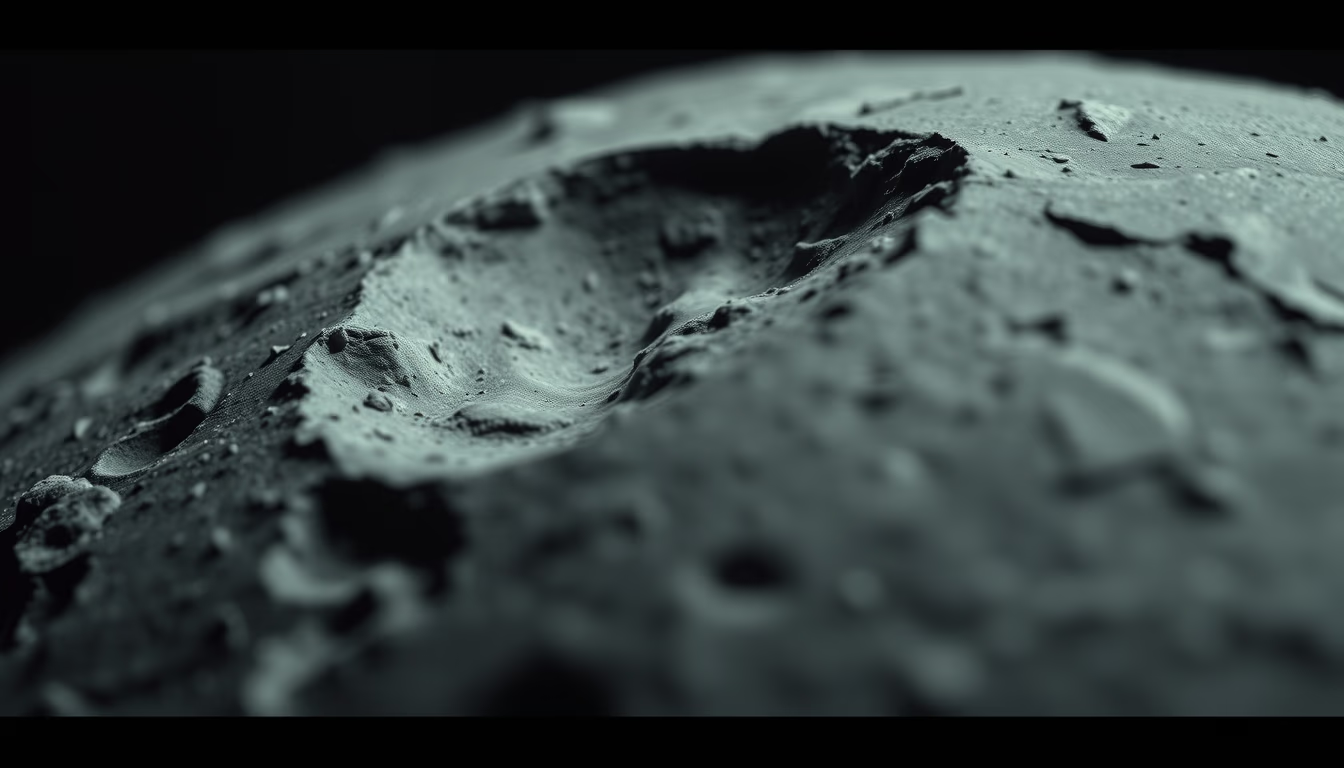
Cassini saturn rings
1344×768 · AVIF · CC BY 4.0
The Cassini-Huygens probe revolutionized knowledge about Saturn and its rings, revealing unprecedented details over 13 years of mission.
About this subject
The Cassini-Huygens mission, a collaboration between NASA, ESA, and ASI, launched in 1997 and arrived at Saturn in 2004. Over 13 years, the probe orbited the gas giant, studying its rings, moons, and magnetosphere. Saturn's rings, composed mainly of water ice and rocky particles, were photographed in unprecedented resolution. Cassini discovered structures such as density waves, small shepherd moons (like Daphnis and Pan) that sculpt the rings, and a thin molecular oxygen atmosphere around the F ring.
The rings are extremely thin: despite spanning about 282,000 km in diameter, their average thickness is only 10 meters. The probe also observed seasonal changes in the rings, such as increased dust during equinoxes. In 2017, Cassini performed the Grand Finale, diving between the planet and its rings to obtain final data before disintegrating into Saturn's atmosphere. This controlled end prevented contamination of potentially habitable moons like Enceladus and Titan.
Cassini's images transformed the scientific understanding of planetary rings. They showed that the rings are dynamic and relatively young, with an estimated age between 10 and 100 million years. Subsequent studies suggest the rings may have formed from an icy moon shattered by impacts or tidal forces. The mission also revealed that the rings are gradually losing material to the planet, indicating they could disappear in a few hundred million years.
Trivia: the Cassini probe was named after the Italian astronomer Giovanni Cassini, who discovered four of Saturn's moons and the main division in its rings (Cassini Division) in the 17th century. The mission left a legacy of over 450 GB of data and inspired future exploration, such as the Dragonfly mission to Titan.
Frequently Asked Questions
What was the main discovery of the Cassini probe about Saturn's rings?
Cassini revealed that the rings are dynamic and young (10 to 100 million years old), with structures like small shepherd moons and density waves. It also discovered that the rings are losing material to Saturn, which may lead to their disappearance in a few hundred million years.
Why was Cassini destroyed at the end of the mission?
The probe was directed to disintegrate into Saturn's atmosphere to avoid contaminating moons like Enceladus and Titan, which may harbor conditions suitable for life. This procedure ensured terrestrial microorganisms did not reach those celestial bodies.
How many years did the Cassini mission last at Saturn?
The probe orbited Saturn for 13 years, from 2004 to 2017, during which it sent thousands of images and data that revolutionized knowledge about the planet and its rings.
Direct URL
https://pub-c7d6a6ea828543ac903a74a341ccb2e1.r2.dev/imagens/cassini-saturn-rings-documentary-photography-fresh15.avifHow to credit
Include a visible link back to UtilizAí. Copy one of the snippets below:
<a href="https://xn--utiliza-eza.com/en/midia/imagens/cassini-saturn-rings-documentary-photography-fresh15">Cassini saturn rings</a> by <a href="https://xn--utiliza-eza.com">UtilizAí</a>, licensed under <a href="https://creativecommons.org/licenses/by/4.0/">CC BY 4.0</a>.
[Cassini saturn rings](https://xn--utiliza-eza.com/en/midia/imagens/cassini-saturn-rings-documentary-photography-fresh15) by [UtilizAí](https://xn--utiliza-eza.com), CC BY 4.0
License: CC-BY-4.0