Atomic clock laboratory
1344×768 · AVIF · CC BY 4.0
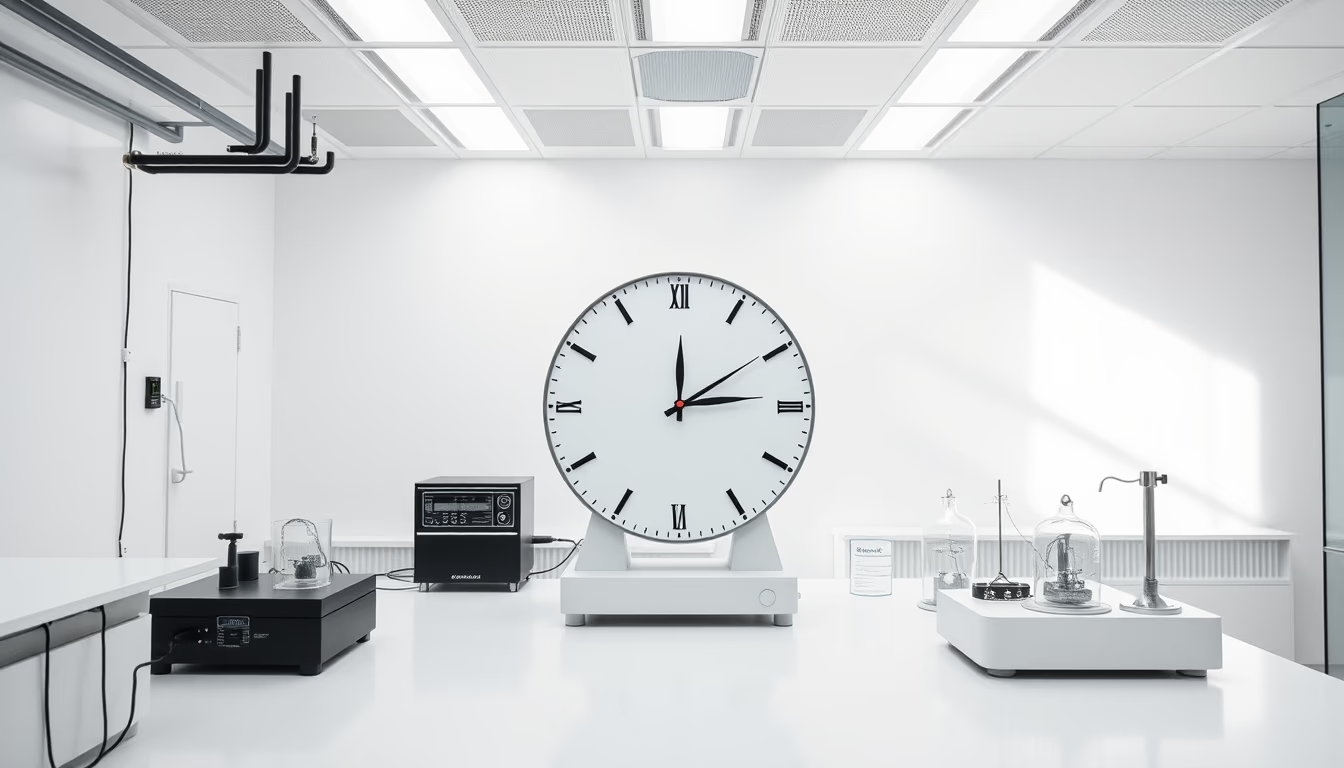
Atomic clock laboratories are research centers that define the second, the fundamental unit of time, with accuracy to one second every 300 million years.
About this subject
Atomic clock laboratories house the most precise instruments ever built by humanity, capable of measuring time with an uncertainty of a few parts in 10^16. These devices operate by exploiting transitions between energy levels of atoms, typically cesium-133, whose radiation period defines the second in the International System of Units (SI). The National Institute of Standards and Technology (NIST) in the United States, the Physikalisch-Technische Bundesanstalt (PTB) in Germany, and the U.S. Naval Observatory are examples of institutions that maintain primary time standards.
Since the first demonstration of an atomic clock in 1949, the technology has evolved significantly. Cesium fountain clocks, such as NIST-F2, achieve uncertainties of 1×10^-16. More recently, optical clocks based on strontium or ytterbium atoms surpass these values by exploiting transitions at visible frequencies. These advances underpin global systems like GPS, which relies on a network of atomic clocks aboard satellites to provide precise coordinates.
The time generated in these laboratories is disseminated internationally by the International Bureau of Weights and Measures (BIPM), which coordinates International Atomic Time (TAI). The difference between TAI and mean solar time has necessitated the introduction of leap seconds since 1972, adjustments that maintain synchronization between Earth's rotation and atomic clocks. Though controversial, these adjustments illustrate the interplay between astronomical and atomic measurements.
Frequently Asked Questions
How does an atomic clock work?
Atomic clocks measure time using the frequency of radiation emitted when an atom, such as cesium-133, transitions between two energy levels. This frequency is extremely stable and serves as a reference to define the second.
What is the most accurate atomic clock in the world?
Currently, optical clocks based on strontium or ytterbium atoms lead, with accuracy to one second in approximately 15 billion years, surpassing traditional cesium fountain clocks.
What are atomic clock laboratories used for?
They maintain national time standards, calibrate other clocks, and provide the foundation for satellite navigation systems, telecommunications, and scientific research that requires precise synchronization.
Direct URL
https://pub-c7d6a6ea828543ac903a74a341ccb2e1.r2.dev/imagens/atomic-clock-laboratory-minimalist-composition-p12.avifHow to credit
Include a visible link back to UtilizAí. Copy one of the snippets below:
<a href="https://xn--utiliza-eza.com/en/midia/imagens/atomic-clock-laboratory-minimalist-composition-p12">Atomic clock laboratory</a> by <a href="https://xn--utiliza-eza.com">UtilizAí</a>, licensed under <a href="https://creativecommons.org/licenses/by/4.0/">CC BY 4.0</a>.
[Atomic clock laboratory](https://xn--utiliza-eza.com/en/midia/imagens/atomic-clock-laboratory-minimalist-composition-p12) by [UtilizAí](https://xn--utiliza-eza.com), CC BY 4.0
License: CC-BY-4.0