Usb-c connector macro
1344×768 · AVIF · CC BY 4.0
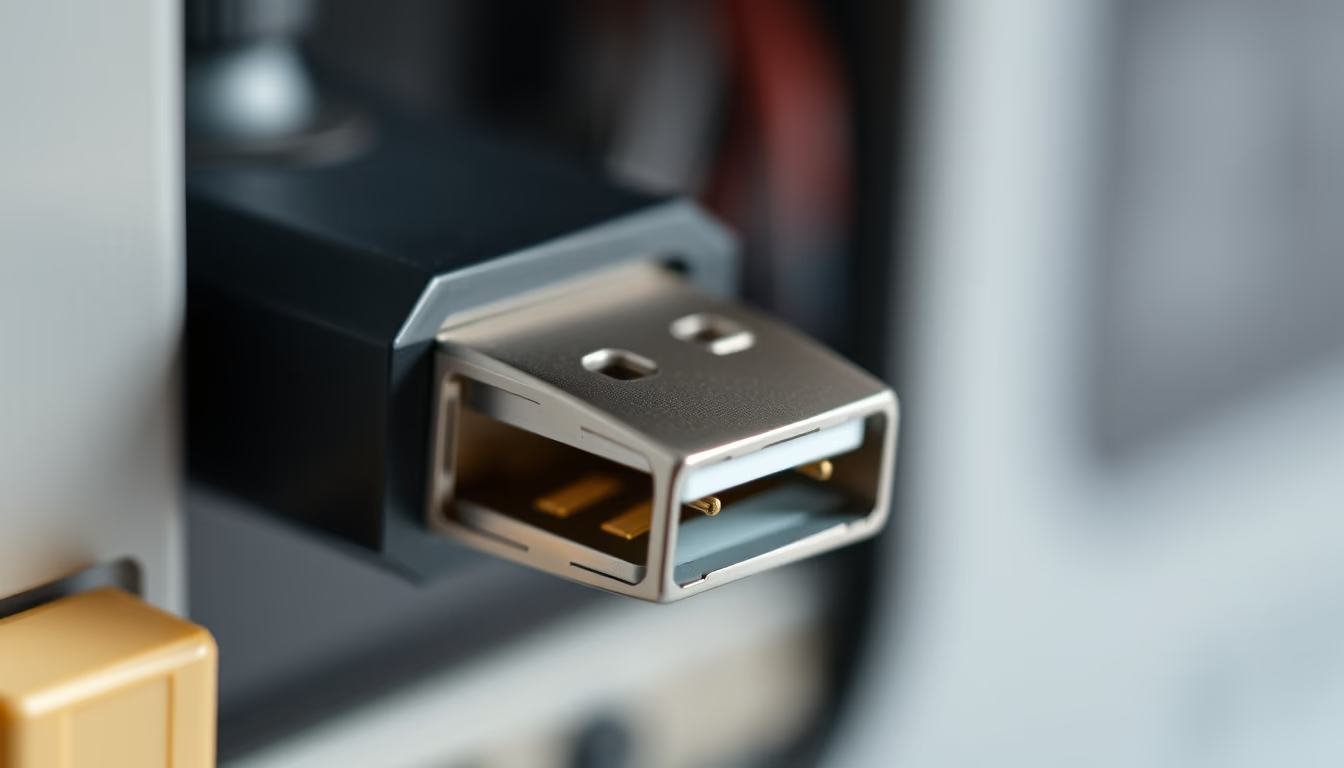
The USB-C connector is a reversible 24-pin standard that unifies charging, data transfer, and video output in one cable, adopted globally since 2014.
About this subject
Developed by the USB Implementers Forum (USB-IF), the USB-C connector launched in 2014 as an evolution of earlier standards like USB-A and micro-USB. Its key innovation was the symmetrical, reversible design, eliminating the frustration of plug orientation. Additionally, USB-C supports a wide range of protocols: USB 3.1, 3.2, and USB4 for data transfer, Thunderbolt 3 and 4 for high speed, and Power Delivery (USB PD) for charging up to 240 watts. This allows a single cable to replace multiple cords, from laptop chargers to HDMI cables.
Adoption of USB-C has grown rapidly. It is now found in modern smartphones (including iPhones from the 15 onwards), laptops (MacBooks, Chromebooks, many Windows models), tablets, monitors, game consoles (Nintendo Switch, Steam Deck), and even headphones. The European Union mandated USB-C as the common charging port for small and medium electronic devices starting in 2024, a measure aimed at reducing e-waste and simplifying consumer life. Compared to older connectors, USB-C is thinner and more durable, with an estimated lifespan of 10,000 insertion cycles.
Technically, the connector has 24 pins arranged symmetrically, enabling reversibility. Data rates vary: USB 3.1 Gen 1 reaches 5 Gbps, Gen 2 hits 10 Gbps, USB 3.2 Gen 2x2 achieves 20 Gbps, and USB4 or Thunderbolt 4 deliver up to 40 Gbps. Power Delivery 3.1 raises charging capacity to 240W, sufficient for gaming laptops and workstations. An E-marker chip in the cable informs the device of its maximum current and data capacity, ensuring safety. However, the proliferation of low-quality cables can cause performance issues and even damage. The standard requires certified cables to undergo rigorous testing.
The future of USB-C includes USB4 2.0, doubling bandwidth to 80 Gbps, and optical cables that can extend distances beyond 2 meters. Its versatility is driving adoption in sectors like automotive (electric vehicle charging) and industrial (sensors and actuators). The trend is for electronic devices to gradually phase out dedicated ports like HDMI and DisplayPort in favor of USB-C, solidifying it as the ultimate universal connector.
Frequently Asked Questions
Is USB-C backward compatible with older USB versions?
Yes, USB-C can be used with adapters for USB-A, micro-USB, or others. However, speed and power will be limited to the older standard of the adapter and device.
What is the difference between USB-C and Thunderbolt?
Thunderbolt 3 and 4 share the same USB-C physical connector but offer higher bandwidth (up to 40 Gbps), support for multiple monitors, and daisy-chaining capabilities. Not every USB-C cable supports Thunderbolt.
How to identify a quality USB-C cable?
Look for cables certified by USB-IF that specify support for USB PD and desired data rates. Cables for fast charging (above 60W) must contain an E-marker chip. Avoid very cheap cables without clear specifications.
Direct URL
https://pub-c7d6a6ea828543ac903a74a341ccb2e1.r2.dev/imagens/usb-c-connector-macro-national-geographic-style-p8.avifHow to credit
Include a visible link back to UtilizAí. Copy one of the snippets below:
<a href="https://xn--utiliza-eza.com/en/midia/imagens/usb-c-connector-macro-national-geographic-style-p8">Usb-c connector macro</a> by <a href="https://xn--utiliza-eza.com">UtilizAí</a>, licensed under <a href="https://creativecommons.org/licenses/by/4.0/">CC BY 4.0</a>.
[Usb-c connector macro](https://xn--utiliza-eza.com/en/midia/imagens/usb-c-connector-macro-national-geographic-style-p8) by [UtilizAí](https://xn--utiliza-eza.com), CC BY 4.0
License: CC-BY-4.0