Supercomputer hall
1344×768 · AVIF · CC BY 4.0
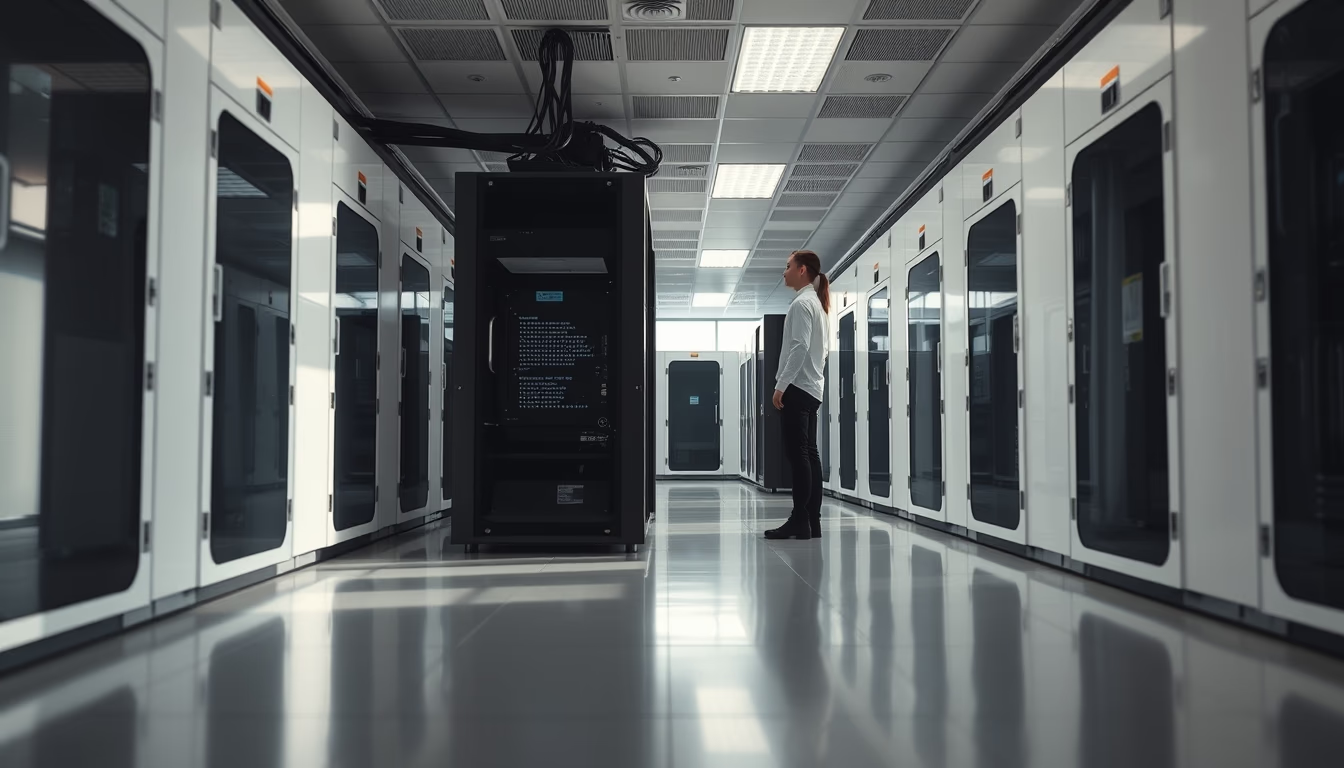
Supercomputer halls house high-performance machines used in scientific research, climate forecasting, and artificial intelligence.
About this subject
Supercomputers are extremely powerful computing systems capable of performing trillions of operations per second. The rooms that house them, known as supercomputer halls, are specially designed environments to support the immense energy and cooling demands of these machines. In Brazil, the Santos Dumont supercomputer, located at the National Laboratory for Scientific Computing (LNCC) in Petrópolis, is one of the most powerful in Latin America, used for climate simulations, genomics studies, and aerospace engineering.
Architecture of a supercomputer hall involves liquid cooling systems or precision air conditioning to dissipate the heat generated by processors. The electrical consumption of a single supercomputer can equate to that of a small town. Therefore, energy efficiency is a critical factor in the design of these spaces, with frequent use of renewable sources and heat recycling techniques.
These computing centers are fundamental to advances in areas such as meteorology, drug discovery, particle physics, and artificial intelligence. For instance, the Fugaku supercomputer in Japan was used to simulate the spread of the coronavirus and test vaccines. The Summit supercomputer in the United States contributed to mapping black holes. The processing power of these machines allows solving problems that would be unfeasible on conventional computers.
The future of supercomputer halls points toward exascale computing (capable of performing a quintillion operations per second) and integration with generative artificial intelligence. Countries like China, Japan, and the United States compete for leadership in this technological race, while Brazil seeks to expand its High Performance Computing (HPC) infrastructure to meet national research and innovation demands.
Frequently Asked Questions
What defines a supercomputer?
A supercomputer is a computer with extremely high processing capacity, usually measured in FLOPS (floating point operations per second). They are used for complex calculations in science, engineering, and artificial intelligence.
What is the largest supercomputer in Brazil?
Currently, Brazil's largest supercomputer is Santos Dumont, installed at LNCC in Petrópolis, with a capacity of about 5.1 petaflops. It is used for research in climatology, genomics, and physics.
How are supercomputers cooled?
Supercomputers generate a lot of heat and require specialized cooling systems, such as direct liquid cooling to the chips or high-precision air conditioning. Many facilities use chilled water or immersion tanks to dissipate heat.
Direct URL
https://pub-c7d6a6ea828543ac903a74a341ccb2e1.r2.dev/imagens/supercomputer-hall-minimalist-composition-p10.avifHow to credit
Include a visible link back to UtilizAí. Copy one of the snippets below:
<a href="https://xn--utiliza-eza.com/en/midia/imagens/supercomputer-hall-minimalist-composition-p10">Supercomputer hall</a> by <a href="https://xn--utiliza-eza.com">UtilizAí</a>, licensed under <a href="https://creativecommons.org/licenses/by/4.0/">CC BY 4.0</a>.
[Supercomputer hall](https://xn--utiliza-eza.com/en/midia/imagens/supercomputer-hall-minimalist-composition-p10) by [UtilizAí](https://xn--utiliza-eza.com), CC BY 4.0
License: CC-BY-4.0