Sitar indian carved
1344×768 · AVIF · CC BY 4.0
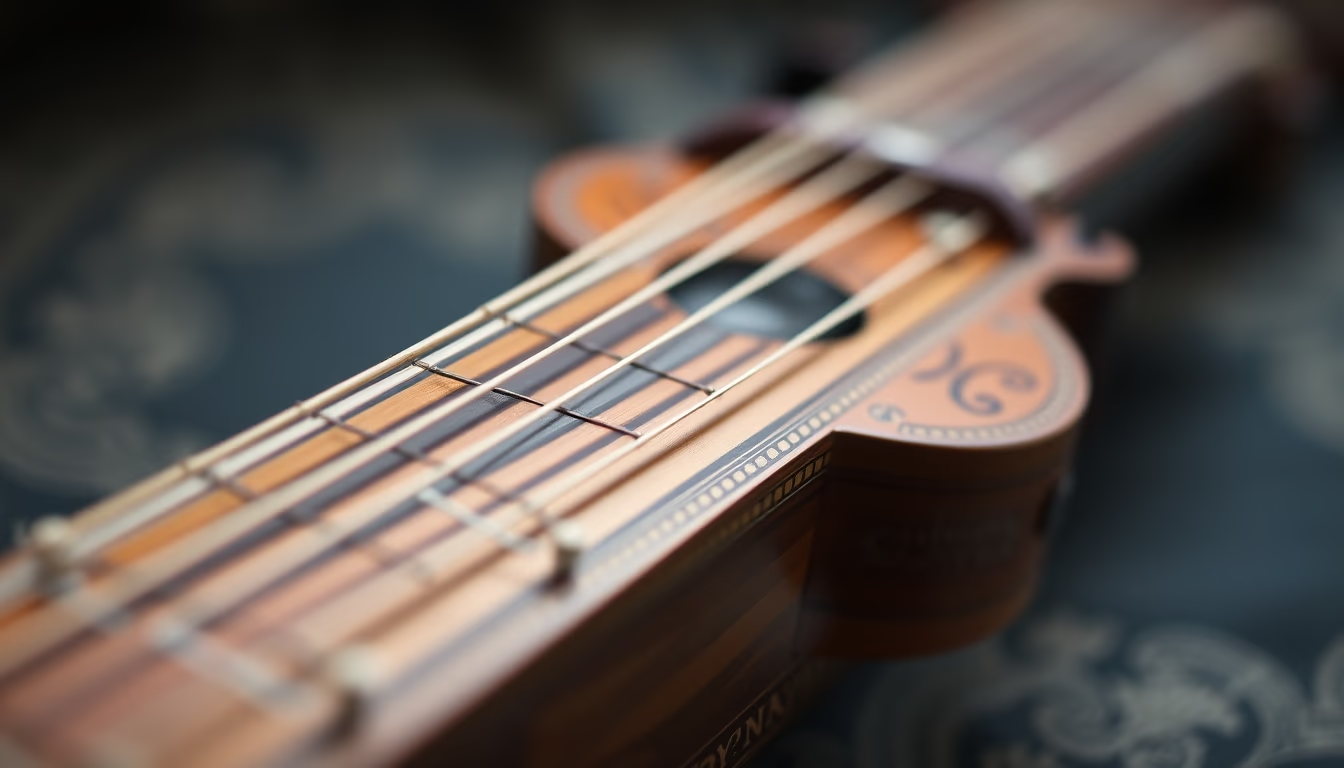
Close-up of the carved decorative details of a sitar, a classical string instrument from India, renowned for its hypnotic tone and rich ornamentation.
About this subject
The sitar is a plucked string instrument originating from the Indian subcontinent, with its development traced back to the 13th century during the Delhi Sultanate. Its current form was solidified in the 18th century, especially within the Hindustani classical music tradition. The instrument features a long neck and a resonating chamber made from a gourd, typically covered in hand-carved wood. The carving, often found on the neck and base, depicts floral and geometric patterns reflecting Mughal aesthetics.
The sitar comprises a complex set of strings: 6 or 7 main strings and 11 to 13 sympathetic strings (taraf), which vibrate resonantly to produce its characteristic sound. Tuned specifically for each raga, mastery requires years of practice. Its timbre is described as mystical and meditative, essential for raga performance.
Famous musicians include Ravi Shankar, who popularized the sitar in the West from the 1950s, influencing artists like George Harrison of the Beatles. The sitar also appears in film soundtracks and contemporary electronic music. Artisanal construction is highly specialized, with luthier families in India, such as those in Kolkata and Miraj, passing down the craft for generations.
The intricate carving is not merely decorative: each piece is designed to balance acoustics and aesthetics. The wood used is typically teak or cedar, dyed with natural pigments and polished with shellac. Preservation of the carving technique is an intangible cultural heritage, threatened by mass production but still valued by musicians and collectors.
Frequently Asked Questions
What is the difference between a sitar and a guitar?
The sitar is an Indian instrument with sympathetic strings and a unique resonant timbre, whereas the guitar is Western and typically has six strings without sympathetic strings. Tuning and playing techniques also differ significantly.
How long does it take to learn to play the sitar?
Learning sitar requires dedication: to play basic ragas, it takes 2 to 3 years of regular practice. Mastery can take decades due to complex ornamentation and improvisation techniques.
Is the sitar only used in Indian classical music?
No. While essential in Hindustani classical music, the sitar is also used in world fusion, film scores, experimental music, and even rock, as demonstrated by Ravi Shankar and Western collaborations.
Direct URL
https://pub-c7d6a6ea828543ac903a74a341ccb2e1.r2.dev/imagens/sitar-indian-carved-macro-closeup-p2.avifHow to credit
Include a visible link back to UtilizAí. Copy one of the snippets below:
<a href="https://xn--utiliza-eza.com/en/midia/imagens/sitar-indian-carved-macro-closeup-p2">Sitar indian carved</a> by <a href="https://xn--utiliza-eza.com">UtilizAí</a>, licensed under <a href="https://creativecommons.org/licenses/by/4.0/">CC BY 4.0</a>.
[Sitar indian carved](https://xn--utiliza-eza.com/en/midia/imagens/sitar-indian-carved-macro-closeup-p2) by [UtilizAí](https://xn--utiliza-eza.com), CC BY 4.0
License: CC-BY-4.0