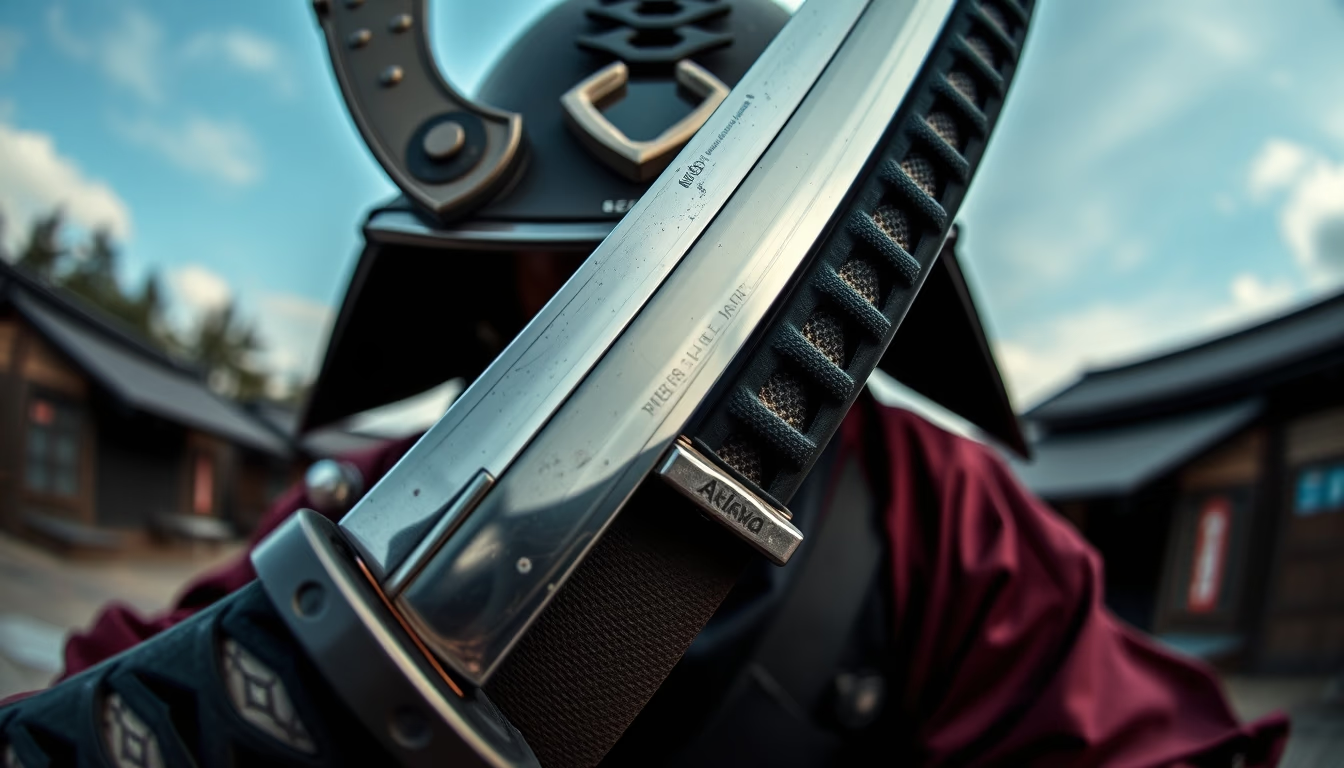
Sextant navigation tool
1344×768 · AVIF · CC BY 4.0

Sextant, an astronomical navigation tool that revolutionized maritime exploration, combining precision and elegance.
About this subject
The sextant is an optical instrument used to measure angles between celestial bodies and the horizon, essential for celestial navigation. Invented in the 18th century, it succeeded the astrolabe and quadrant, offering greater precision. Its name comes from the Latin 'sextans', meaning sixth part, because its arc measures 60 degrees, one sixth of a full circle.
The importance of the sextant was fundamental to the Age of Discovery and global maritime trade. With it, navigators could accurately determine latitude at sea by measuring the height of the Sun at noon or stars like Polaris (in the Northern Hemisphere). The invention of the marine chronometer by John Harrison later allowed longitude calculation, complementing the sextant's use.
Interestingly, the sextant was also used in non-maritime contexts such as aviation and polar exploration. Today, although GPS has largely replaced its practical use, the sextant remains a symbol of nautical skill and is taught in navigation schools as an emergency backup. Its construction requires carefully calibrated mirrors and filters, and antique models are prized as collectibles and décor.
In the context of high fashion editorial, an image of a sextant evokes a vintage, adventurous aesthetic, harking back to an era of elegant exploration. The instrument is often associated with nautical themes, travel, and discovery, blending technical functionality with visual appeal.
Frequently Asked Questions
How does a sextant work?
The sextant measures the angle between a celestial body (like the Sun) and the horizon. The user adjusts a movable mirror until the reflected image of the celestial body aligns with the horizon, reading the angle on the graduated arc. This angle, combined with the exact time, allows calculation of latitude.
Is the sextant still used today?
Although GPS is standard, the sextant is still taught in navigation schools as a backup method in case of electronic failure. Some sailors and adventurers use it for tradition or to maintain celestial navigation skills.
What is the difference between a sextant and an octant?
The octant measures up to 90 degrees (eighth of a circle) and was the predecessor of the sextant. The sextant measures up to 120 degrees, offering greater range and precision, especially for measuring the Sun's altitude.
Direct URL
https://pub-c7d6a6ea828543ac903a74a341ccb2e1.r2.dev/imagens/sextant-navigation-tool-high-fashion-editorial-p5.avifHow to credit
Include a visible link back to UtilizAí. Copy one of the snippets below:
<a href="https://xn--utiliza-eza.com/en/midia/imagens/sextant-navigation-tool-high-fashion-editorial-p5">Sextant navigation tool</a> by <a href="https://xn--utiliza-eza.com">UtilizAí</a>, licensed under <a href="https://creativecommons.org/licenses/by/4.0/">CC BY 4.0</a>.
[Sextant navigation tool](https://xn--utiliza-eza.com/en/midia/imagens/sextant-navigation-tool-high-fashion-editorial-p5) by [UtilizAí](https://xn--utiliza-eza.com), CC BY 4.0
License: CC-BY-4.0