Public charging station
1344×768 · AVIF · CC BY 4.0
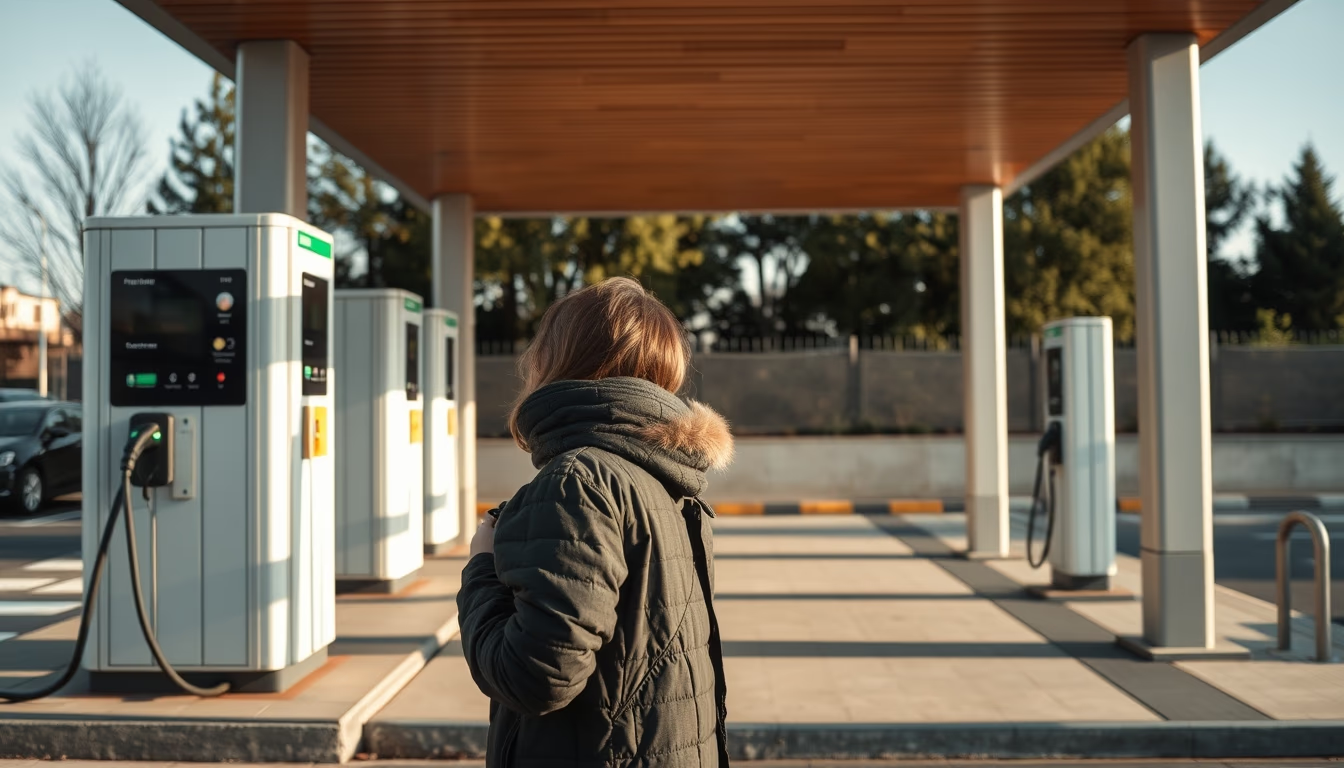
Public EV charging stations are becoming common in urban and rural areas, including wine regions around the world.
About this subject
Public EV charging stations are electric vehicle supply equipment that allow drivers to recharge their car batteries away from home. These stations are increasingly found in urban areas, highways, and commercial establishments. Globally, the growth of electric vehicle adoption has driven the expansion of charging infrastructure, with over 2 million public charging points installed worldwide by 2025. In wine regions such as Napa Valley in the United States and the Douro Valley in Portugal, wineries have installed charging stations to attract eco-conscious tourists, blending sustainability with wine tourism.
Technically, public charging stations adhere to international standards like IEC 61851. Common connectors include Type 2 (Mennekes) for AC charging, CCS (Combined Charging System) for DC fast charging, and CHAdeMO for Japanese vehicles. Power levels range from 7 kW for slow charging to 350 kW for ultra-fast charging, which can add 300 km of range in about 20 minutes. Countries like the Netherlands and Germany lead in station density, while networks such as Shell Recharge and ChargePoint operate globally. The minimalist design of many charging stations, featuring clean lines and digital interfaces, aligns with modern aesthetics and functional simplicity.
Integration with mobile apps enables users to locate stations, check availability, and process payments seamlessly. Some stations incorporate solar panels to generate renewable energy on-site. In the wine tourism sector, offering charging facilities can attract visitors who drive electric vehicles, encouraging longer stays and increased sales of wine and other products. This convergence of electric mobility and sustainable tourism is expected to be a major trend in 2026, with more wineries and distilleries investing in charging infrastructure as part of their environmental and marketing strategies.
Frequently Asked Questions
How long does it take to charge an electric car at a public station?
It depends on the station's power output and the battery capacity. Slow chargers (7 kW) may take 4 to 8 hours for a full charge, while ultra-fast chargers (350 kW) can recharge 80% of the battery in about 20 to 30 minutes.
Are public charging stations free?
Not all. Many stations charge per kilowatt-hour or per minute of use, but some are free as a courtesy from businesses like shopping malls, hotels, and wineries. Paid stations operated by private networks are common.
Can I use any public station with my electric car?
Yes, if your car has the compatible connector. Most cars in Europe and Brazil use Type 2 for AC and CCS for DC. Some Japanese cars use CHAdeMO. Adapters may work in some cases, but it's best to check compatibility beforehand.
Direct URL
https://pub-c7d6a6ea828543ac903a74a341ccb2e1.r2.dev/imagens/public-charging-station-minimalist-composition-p0.avifHow to credit
Include a visible link back to UtilizAí. Copy one of the snippets below:
<a href="https://xn--utiliza-eza.com/en/midia/imagens/public-charging-station-minimalist-composition-p0">Public charging station</a> by <a href="https://xn--utiliza-eza.com">UtilizAí</a>, licensed under <a href="https://creativecommons.org/licenses/by/4.0/">CC BY 4.0</a>.
[Public charging station](https://xn--utiliza-eza.com/en/midia/imagens/public-charging-station-minimalist-composition-p0) by [UtilizAí](https://xn--utiliza-eza.com), CC BY 4.0
License: CC-BY-4.0