Insect compound eye macro
1344×768 · AVIF · CC BY 4.0
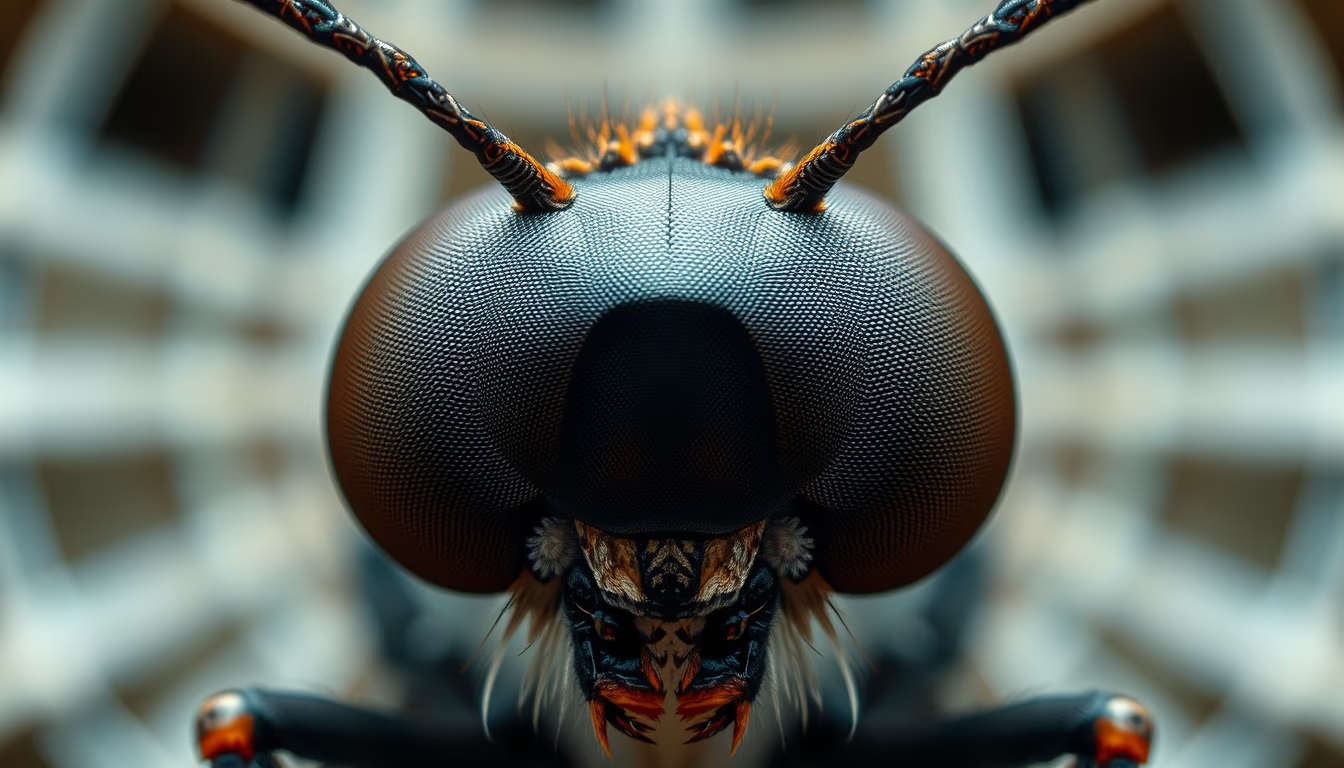
Insect compound eyes are fascinating structures made of thousands of individual units called ommatidia, each functioning as a tiny eye.
About this subject
Compound eyes are a hallmark of insects and other arthropods, such as crustaceans and arachnids. Unlike human eyes, which have a single lens, they consist of repeating units called ommatidia. Each ommatidium contains a lens, a crystalline cone, and photoreceptor cells that capture light and send signals to the insect's brain. The number of ommatidia varies widely among species: ants may have only a dozen, while dragonflies boast over 28,000. This architecture provides an almost panoramic field of view and extreme sensitivity to motion, though resolution is low compared to vertebrate eyes.
The characteristic hexagonal pattern on the surface of a compound eye is not merely aesthetic; it optimizes the packing of ommatidia, allowing maximum visual coverage. Each ommatidium points in a slightly different direction, creating a mosaic image. Some insects, like bees, can detect ultraviolet and polarized light, vital for navigation and flower location. Others, such as mantises, have binocular vision that aids in hunting.
In macro photography, the compound eye is a classic subject for its geometric symmetry and texture. Details like the tiny hairs between ommatidia, which protect against dust and debris, are revealed only at extreme magnifications. It is an example of how evolution solved the problem of vision with a radically different design from our own.
Frequently Asked Questions
How many ommatidia does an insect have?
It varies greatly. Ants may have only 6 to 12 ommatidia, while dragonflies can have over 28,000. Houseflies have about 4,000.
Can insects see color?
Yes, many insects see color, but their spectrum differs from humans. Bees, for instance, see ultraviolet light, which our retinas cannot detect.
How do compound eyes detect motion?
Each ommatidium captures a small part of the visual field. When an object moves, the sequence of ommatidial activation changes rapidly, allowing the insect to perceive even subtle motion.
Direct URL
https://pub-c7d6a6ea828543ac903a74a341ccb2e1.r2.dev/imagens/insect-compound-eye-macro-architectural-photography-p4.avifHow to credit
Include a visible link back to UtilizAí. Copy one of the snippets below:
<a href="https://xn--utiliza-eza.com/en/midia/imagens/insect-compound-eye-macro-architectural-photography-p4">Insect compound eye macro</a> by <a href="https://xn--utiliza-eza.com">UtilizAí</a>, licensed under <a href="https://creativecommons.org/licenses/by/4.0/">CC BY 4.0</a>.
[Insect compound eye macro](https://xn--utiliza-eza.com/en/midia/imagens/insect-compound-eye-macro-architectural-photography-p4) by [UtilizAí](https://xn--utiliza-eza.com), CC BY 4.0
License: CC-BY-4.0