Hangul korean ancient
1344×768 · AVIF · CC BY 4.0

Hangul, the Korean alphabet created in the 15th century by King Sejong, is a unique and scientific writing system designed to promote literacy among common people.
About this subject
Hangul is the native alphabet of Korea, created in 1443 by King Sejong the Great and promulgated in 1446 through the document Hunminjeongeum. Unlike many writing systems that evolved organically, Hangul was deliberately designed with phonetic and philosophical principles. Its consonants represent the shape of the vocal organs (tongue, lips, throat) when producing sounds, and vowels are based on concepts of heaven, earth, and humanity. This scientific approach makes Hangul easy to learn, contributing to one of the world's highest literacy rates.
Before Hangul, Koreans used Chinese characters (Hanja), which were complex and restricted to the educated elite. The creation of Hangul democratized knowledge, enabling women, peasants, and lower classes to read and write. Initially, it faced opposition from the aristocracy, who considered it vulgar, but gradually it became the official script. During the Japanese colonial period (1910-1945), its use was suppressed, but after independence, it was revived as a symbol of national identity.
Today, Hangul is celebrated on Hangul Day (October 9 in South Korea, January 15 in North Korea). It is widely praised by linguists for its efficiency and logical design. The alphabet has 24 basic letters (14 consonants and 10 vowels) and 27 compound letters, organized into syllabic blocks. Its simplicity allows children to learn to read within weeks, and it is used in both South and North Korea, with minor orthographic variations.
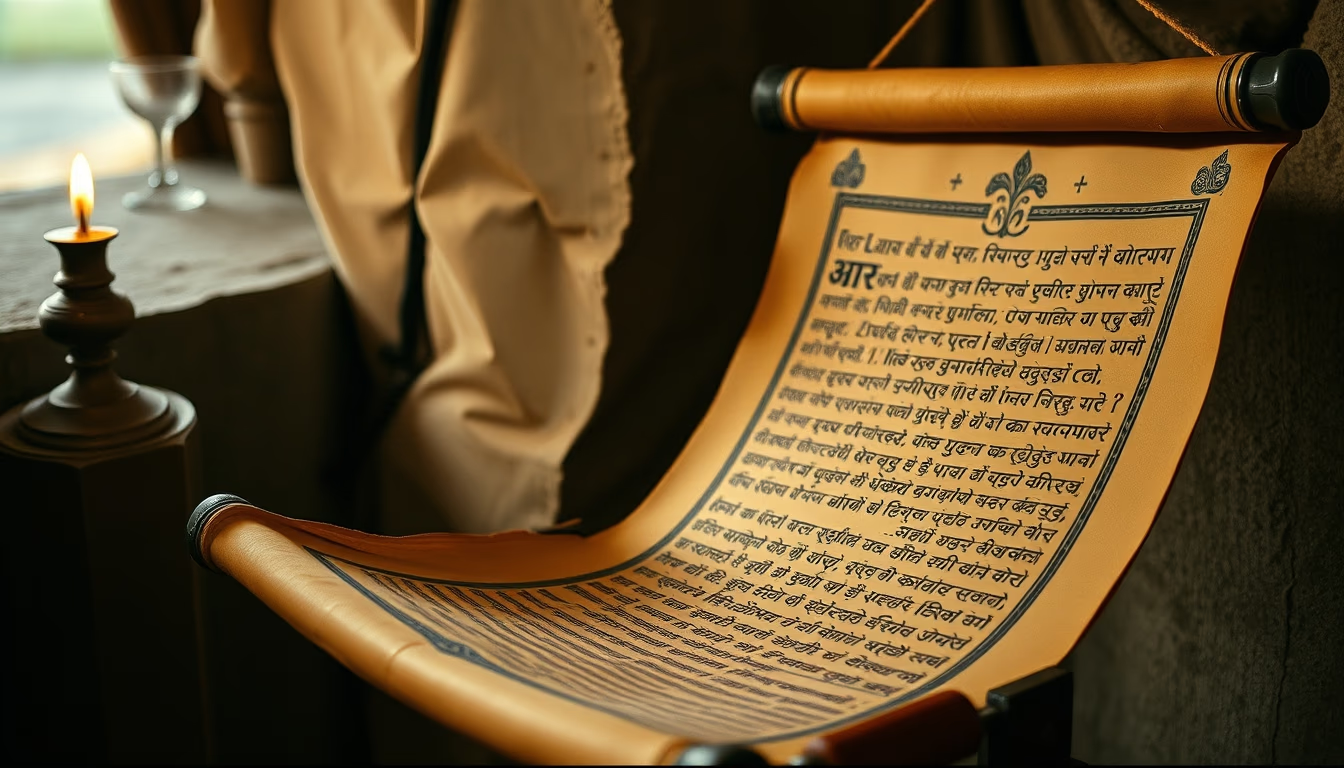
Beyond its functionality, Hangul holds immense aesthetic and cultural value. Korean calligraphy (seoye) is a traditional art that explores the beauty of letterforms. The alphabet has also influenced digital font design and is a source of national pride. UNESCO included the original manuscripts of Hunminjeongeum in the Memory of the World Register in 1997, recognizing its historical significance.
Frequently Asked Questions
Who created Hangul and why?
Hangul was created by King Sejong the Great of the Joseon dynasty in 1443 to allow common Koreans to read and write easily, as Chinese characters were too complex.
How many letters does Hangul have?
Hangul has 24 basic letters (14 consonants and 10 vowels), plus 27 compound letters, for a total of 51 possible characters.
Is Hangul used only in South Korea?
No, Hangul is the official writing system in both South Korea and North Korea, though there are minor differences in spelling and usage of some letters.
Direct URL
https://pub-c7d6a6ea828543ac903a74a341ccb2e1.r2.dev/imagens/hangul-korean-ancient-studio-editorial-portrait-fresh2.avifHow to credit
Include a visible link back to UtilizAí. Copy one of the snippets below:
<a href="https://xn--utiliza-eza.com/en/midia/imagens/hangul-korean-ancient-studio-editorial-portrait-fresh2">Hangul korean ancient</a> by <a href="https://xn--utiliza-eza.com">UtilizAí</a>, licensed under <a href="https://creativecommons.org/licenses/by/4.0/">CC BY 4.0</a>.
[Hangul korean ancient](https://xn--utiliza-eza.com/en/midia/imagens/hangul-korean-ancient-studio-editorial-portrait-fresh2) by [UtilizAí](https://xn--utiliza-eza.com), CC BY 4.0
License: CC-BY-4.0