Crystal salt macro
1344×768 · AVIF · CC BY 4.0
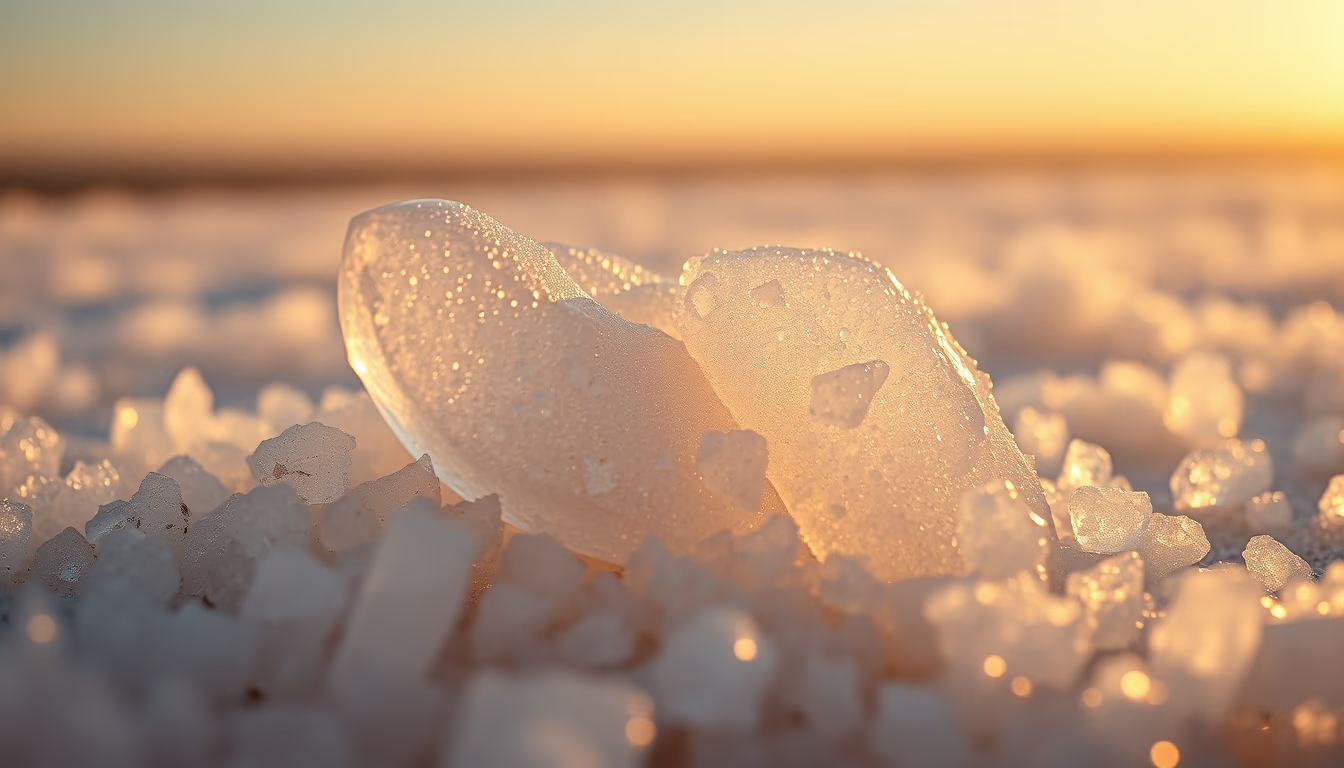
Salt crystals at macro scale reveal the natural geometry and mineral purity of sodium chloride, with cubic faces and characteristic liquid inclusions.
About this subject
Table salt, or sodium chloride (NaCl), crystallizes in the cubic system, forming perfect crystals when evaporation conditions are slow and controlled. At macro scale, smooth faces and right angles that define its crystal structure become visible. Each crystal is a transparent rectangular prism, often exhibiting fluid inclusions, tiny brine bubbles trapped during growth.
Natural salt crystal formation occurs in salt pans or evaporites, such as the Salar de Uyuni desert in Bolivia or the Cabo Frio salt flats in Brazil. The crystallization process depends on solution saturation: as water evaporates, Na+ and Cl- ions arrange into a face-centered cubic lattice. Crystal purity can be assessed by transparency and absence of impurities.
Interestingly, halite (rock salt) can exhibit colors due to impurities: blue tones from structural defects, or reddish hues from iron oxide inclusions. In gastronomy, large crystals are used as finishing salt, fleur de sel, for example, valued for their crunchy texture and milder flavor due to slow dissolution on the tongue.
Beyond culinary use, salt is essential for the chemical industry, production of chlorine and caustic soda, and food preservation. Macrophotography of salt crystals not only reveals the beauty of mineralogy but also documents purity and quality, useful for geologists and chefs.
Frequently Asked Questions
Why do salt crystals have a cubic shape?
Sodium chloride crystallizes in the cubic system because Na+ and Cl- ions arrange into a three-dimensional lattice with perpendicular faces. This arrangement minimizes the crystal's total energy, resulting in the characteristic cubic form.
What are the liquid inclusions inside salt crystals?
They are tiny brine bubbles trapped during rapid crystal growth. They indicate formation conditions and can contain information about the original water composition.
Is there a difference between sea salt and rock salt in terms of crystallization?
Yes. Sea salt crystallizes from evaporated seawater, usually forming smaller, irregular crystals. Rock salt is mined from underground deposits and can form larger, purer crystals because it crystallized slowly over millions of years.
Direct URL
https://pub-c7d6a6ea828543ac903a74a341ccb2e1.r2.dev/imagens/crystal-salt-macro-cinematic-wide-shot-p3.avifHow to credit
Include a visible link back to UtilizAí. Copy one of the snippets below:
<a href="https://xn--utiliza-eza.com/en/midia/imagens/crystal-salt-macro-cinematic-wide-shot-p3">Crystal salt macro</a> by <a href="https://xn--utiliza-eza.com">UtilizAí</a>, licensed under <a href="https://creativecommons.org/licenses/by/4.0/">CC BY 4.0</a>.
[Crystal salt macro](https://xn--utiliza-eza.com/en/midia/imagens/crystal-salt-macro-cinematic-wide-shot-p3) by [UtilizAí](https://xn--utiliza-eza.com), CC BY 4.0
License: CC-BY-4.0