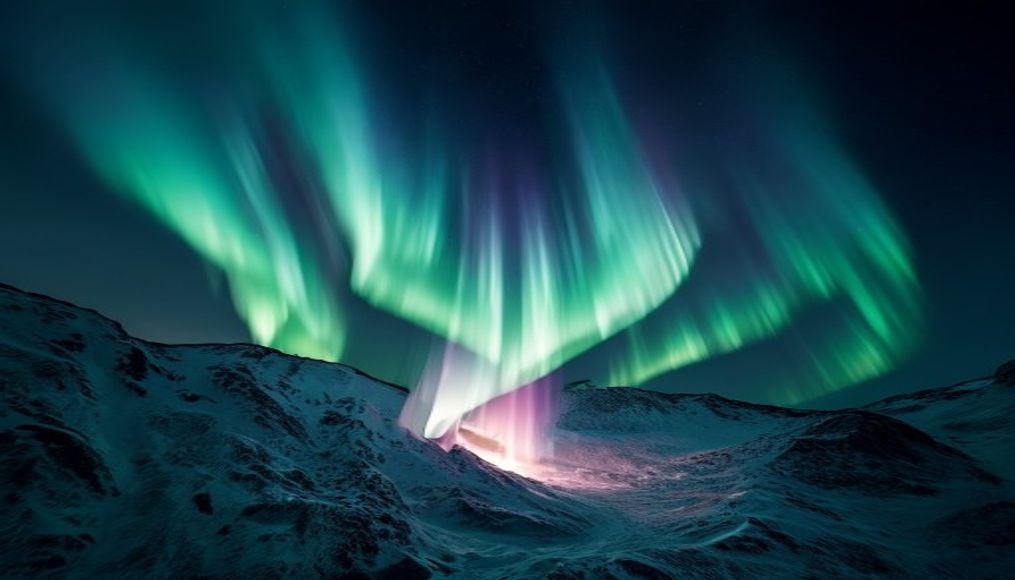
Aurora pillar dance
1344×768 · AVIF · CC BY 4.0
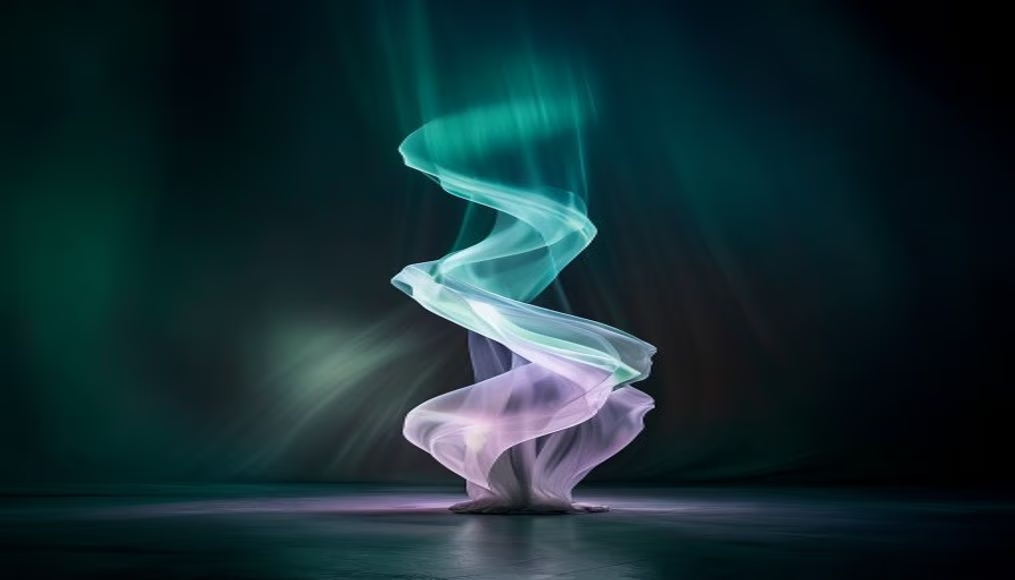
Auroras polares, como os pilares dançantes, são fenômenos atmosféricos causados pela interação do vento solar com o campo magnético terrestre, formando cortinas coloridas no céu noturno de altas latitudes.
Sobre o tema
As auroras boreais e austrais são exibições luminosas que ocorrem nas regiões polares, tipicamente entre 65° e 72° de latitude. O fenômeno acontece quando partículas carregadas do vento solar colidem com gases na atmosfera superior, excitando moléculas de oxigênio e nitrogênio. Essa excitação libera luz visível nas cores verde, vermelha e roxa, criando formas como cortinas, arcos e, ocasionalmente, pilares verticais que parecem dançar no céu. O formato de pilar ocorre quando a linha do campo magnético está alinhada com a linha de visão do observador, dando a impressão de feixes alongados.
A intensidade e frequência das auroras variam com o ciclo solar de 11 anos, sendo mais ativas durante o máximo solar. Regiões como Tromsø na Noruega, Yellowknife no Canadá e a Antártida são destinos populares para observação. No Brasil, auroras são extremamente raras, mas já foram registradas em eventos de tempestades geomagnéticas intensas, como em 1859 e 2024, quando colorações avermelhadas foram vistas em baixas latitudes. Culturalmente, auroras inspiram mitologias: para os inuítes, representam almas dos mortos brincando; na mitologia nórdica, eram reflexos dos escudos das Valquírias.
Além do valor estético, auroras têm implicações científicas. Elas ajudam a estudar a magnetosfera terrestre e fenômenos de clima espacial, que podem afetar satélites e redes elétricas. O termo 'aurora' foi cunhado por Galileu Galilei em 1619, em homenagem à deusa romana do amanhecer, e 'boreal' remete ao vento norte. Embora a imagem em questão seja uma natureza-morta em estúdio, seu título evoca a dinâmica e a beleza desses pilares de luz naturais.
Perguntas frequentes
O que causa as diferentes cores nas auroras?
As cores dependem do tipo de gás excitado e da altitude. O oxigênio emite luz verde (até 240 km) e vermelha (acima de 240 km). O nitrogênio produz azul e roxo. A cor verde é a mais comum.
É possível ver auroras no Brasil?
Sim, mas extremamente raro. Em eventos de tempestades geomagnéticas muito fortes, como em maio de 2024, auroras avermelhadas foram registradas em estados do sul e sudeste, embora breves e de baixa intensidade.
Qual a melhor época para observar auroras?
Entre setembro e março no hemisfério norte (aurora boreal) e entre março e setembro no hemisfério sul (aurora austral). A noite precisa estar escura e sem nuvens, e a atividade solar elevada.
URL direta
https://pub-c7d6a6ea828543ac903a74a341ccb2e1.r2.dev/imagens/aurora-pillar-dance-studio-still-life-p2.avifComo creditar
Inclua um link visível de volta pro UtilizAí. Copie um dos snippets abaixo:
<a href="https://xn--utiliza-eza.com/midia/imagens/aurora-pillar-dance-studio-still-life-p2">Aurora pillar dance</a> by <a href="https://xn--utiliza-eza.com">UtilizAí</a>, licensed under <a href="https://creativecommons.org/licenses/by/4.0/">CC BY 4.0</a>.
[Aurora pillar dance](https://xn--utiliza-eza.com/midia/imagens/aurora-pillar-dance-studio-still-life-p2) by [UtilizAí](https://xn--utiliza-eza.com), CC BY 4.0
Licença: CC-BY-4.0