Astrolabe ancient
1344×768 · AVIF · CC BY 4.0
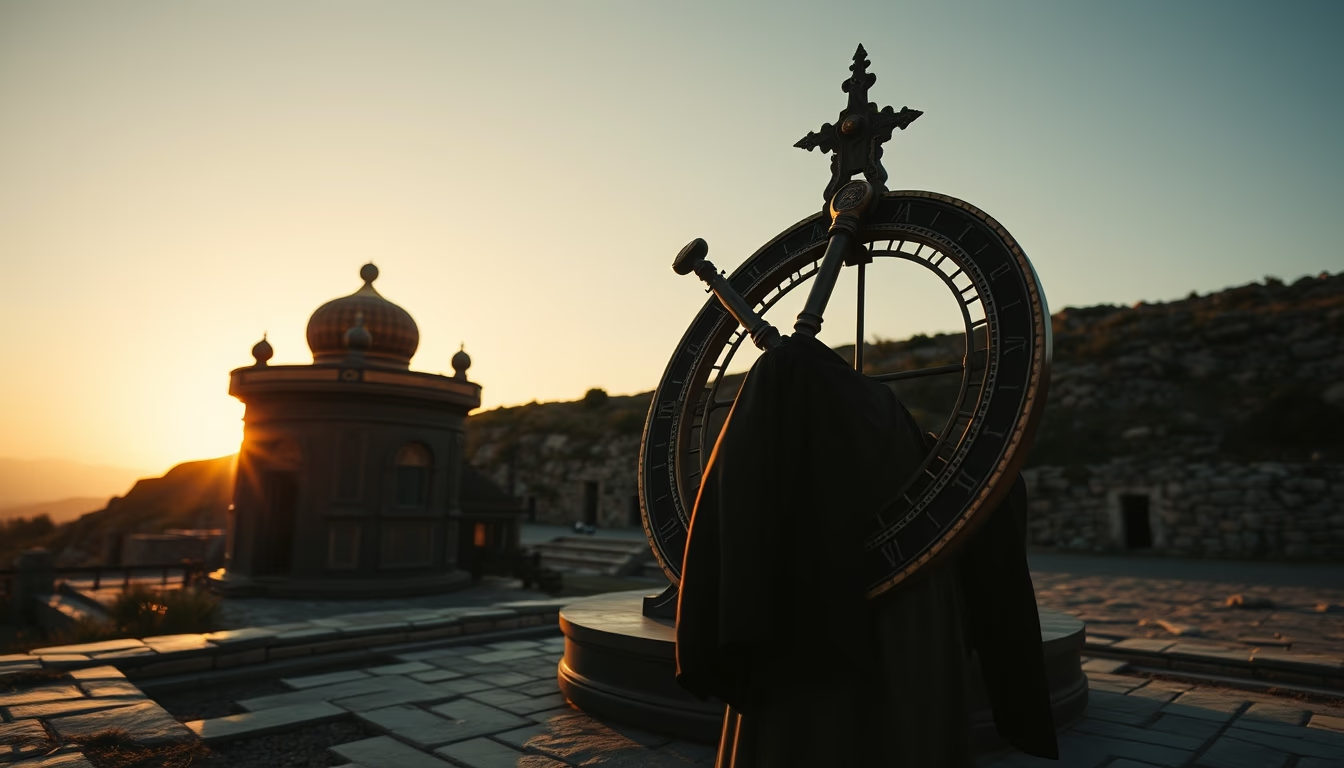
The ancient astrolabe, an astronomical instrument used by navigators and astronomers since Ancient Greece, revolutionized maritime positioning.
About this subject
The astrolabe is one of the oldest scientific instruments in human history, with origins dating back to Ancient Greece around the 2nd century BCE. Attributed to Hipparchus of Nicaea and refined by Ptolemy, the device measured the altitude of celestial bodies above the horizon, enabling calculation of latitude and local time. Its construction, typically in metal or wood, featured a circular plate (mater) with a rotating lattice (rete) depicting the starry sky, along with an alidade for alignment.
During the Middle Ages, the astrolabe flourished in the Islamic world, used for navigation as well as astronomical and astrological calculations. Scholars such as Al-Farghani and Al-Zarqali created sophisticated versions, and the instrument reached Europe via the Iberian Peninsula. In the 15th century, during the Age of Discovery, the nautical astrolabe became essential for Portuguese and Spanish explorers, enabling safer ocean voyages.
A notable fact is that the planispheric astrolabe, the most common type, could solve spherical trigonometry problems, functioning as an analog computer. Rare surviving examples, such as the astrolabe of Al-Sahl al-Tustari (10th century), are now museum treasures. The instrument fell out of use with the development of the sextant in the 18th century but remains a symbol of ancient scientific ingenuity.
Frequently Asked Questions
What is the difference between a nautical and a planispheric astrolabe?
The nautical astrolabe is a simplified, sturdy version used on ships to measure the altitude of the Sun or stars. The planispheric astrolabe is more complex, with rotating celestial maps, ideal for astronomical and astrological calculations.
How was the astrolabe used in navigation?
Navigators measured the altitude of the Sun at noon or of stars like Polaris. From this measurement, they calculated latitude, essential for ocean navigation before GPS.
Are there original astrolabes preserved?
Yes, rare examples survive in museums such as the Museum of the History of Science in Oxford and the Louvre. The oldest known is a 10th-century Persian astrolabe.
Direct URL
https://pub-c7d6a6ea828543ac903a74a341ccb2e1.r2.dev/imagens/astrolabe-ancient-cinematic-wide-shot-p9.avifHow to credit
Include a visible link back to UtilizAí. Copy one of the snippets below:
<a href="https://xn--utiliza-eza.com/en/midia/imagens/astrolabe-ancient-cinematic-wide-shot-p9">Astrolabe ancient</a> by <a href="https://xn--utiliza-eza.com">UtilizAí</a>, licensed under <a href="https://creativecommons.org/licenses/by/4.0/">CC BY 4.0</a>.
[Astrolabe ancient](https://xn--utiliza-eza.com/en/midia/imagens/astrolabe-ancient-cinematic-wide-shot-p9) by [UtilizAí](https://xn--utiliza-eza.com), CC BY 4.0
License: CC-BY-4.0