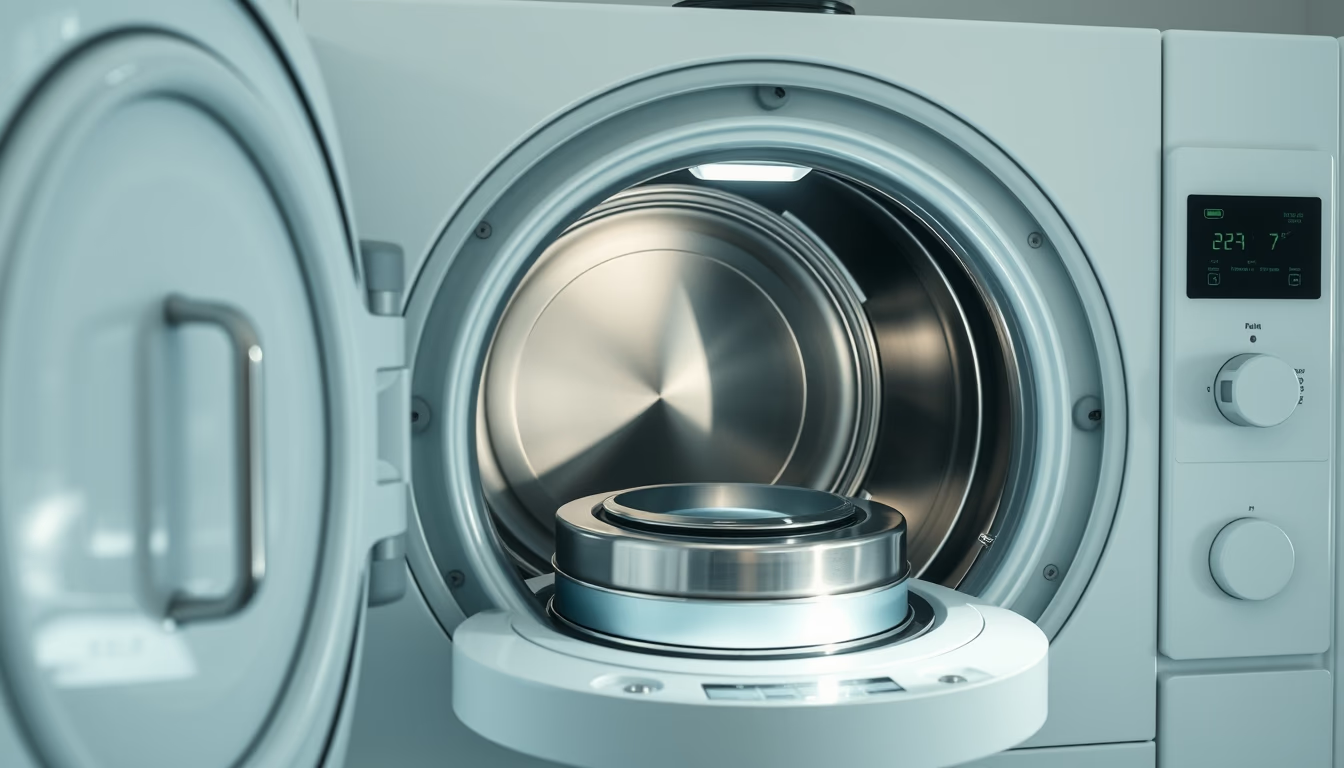
Rotovap evaporator
1344×768 · AVIF · CC BY 4.0

The rotary evaporator, or rotovap, is an essential laboratory device for removing solvents via evaporation under reduced pressure, widely used in organic chemistry and pharmaceuticals.
About this subject
The rotary evaporator, commonly called rotovap, operates by reducing the internal pressure of the system, which lowers the boiling point of the solvent and allows it to evaporate at lower temperatures. The round-bottom flask rotates continuously, creating a thin liquid film on its inner surface, increasing the evaporation area and preventing localized overheating. This principle makes the process fast and gentle, preserving heat-sensitive compounds.
Its main components include a heated water bath that warms the flask; a condenser, usually made of glass, that cools and condenses solvent vapors; and a collection flask where the condensed solvent is collected. A vacuum pump connected to the system maintains reduced pressure, and the equipment can be adjusted to control rotation speed and bath temperature. Modern models often incorporate pressure sensors and digital controls.
The rotovap is indispensable in organic synthesis, natural product purification, and pharmaceutical formulation. It is used to concentrate samples, dry extracts, exchange solvents, or remove volatile solvents after reactions. In biochemistry labs, it is also employed to concentrate proteins or nucleic acids from dilute solutions, ensuring that thermolabile compounds remain intact.
Operational care is crucial to avoid accidents. Bumping, or violent boiling, can occur if pressure is reduced too quickly, projecting the sample into the condenser. Using an antifoaming agent or a foam adapter helps control this. Additionally, the type of condenser (straight, spherical, or cold finger) should be chosen based on the solvent. The rotovap requires constant monitoring and proper sealing of all joints to maintain vacuum.
Frequently Asked Questions
What is the difference between a rotary evaporator and simple distillation?
In a rotary evaporator, reduced pressure allows solvents to evaporate at lower temperatures, protecting heat-sensitive compounds. Additionally, the rotation of the flask increases the evaporation area, making the process faster and more efficient than simple distillation at atmospheric pressure.
How can I prevent sample from entering the condenser during evaporation?
To avoid sample carryover, reduce pressure gradually, do not fill the flask beyond half its capacity, and consider using a foam adapter or an antifoaming agent. Maintaining moderate rotation also helps.
What is the ideal pressure for operating a rotovap?
The ideal pressure depends on the solvent. Typically, it ranges from 10 to 100 mbar, adjusted so that the solvent boils gently. Consult vapor pressure tables specific to each solvent.
Direct URL
https://pub-c7d6a6ea828543ac903a74a341ccb2e1.r2.dev/imagens/rotovap-evaporator-studio-editorial-portrait-fresh11.avifHow to credit
Include a visible link back to UtilizAí. Copy one of the snippets below:
<a href="https://xn--utiliza-eza.com/en/midia/imagens/rotovap-evaporator-studio-editorial-portrait-fresh11">Rotovap evaporator</a> by <a href="https://xn--utiliza-eza.com">UtilizAí</a>, licensed under <a href="https://creativecommons.org/licenses/by/4.0/">CC BY 4.0</a>.
[Rotovap evaporator](https://xn--utiliza-eza.com/en/midia/imagens/rotovap-evaporator-studio-editorial-portrait-fresh11) by [UtilizAí](https://xn--utiliza-eza.com), CC BY 4.0
License: CC-BY-4.0