Modular synthesizer rack
1344×768 · AVIF · CC BY 4.0
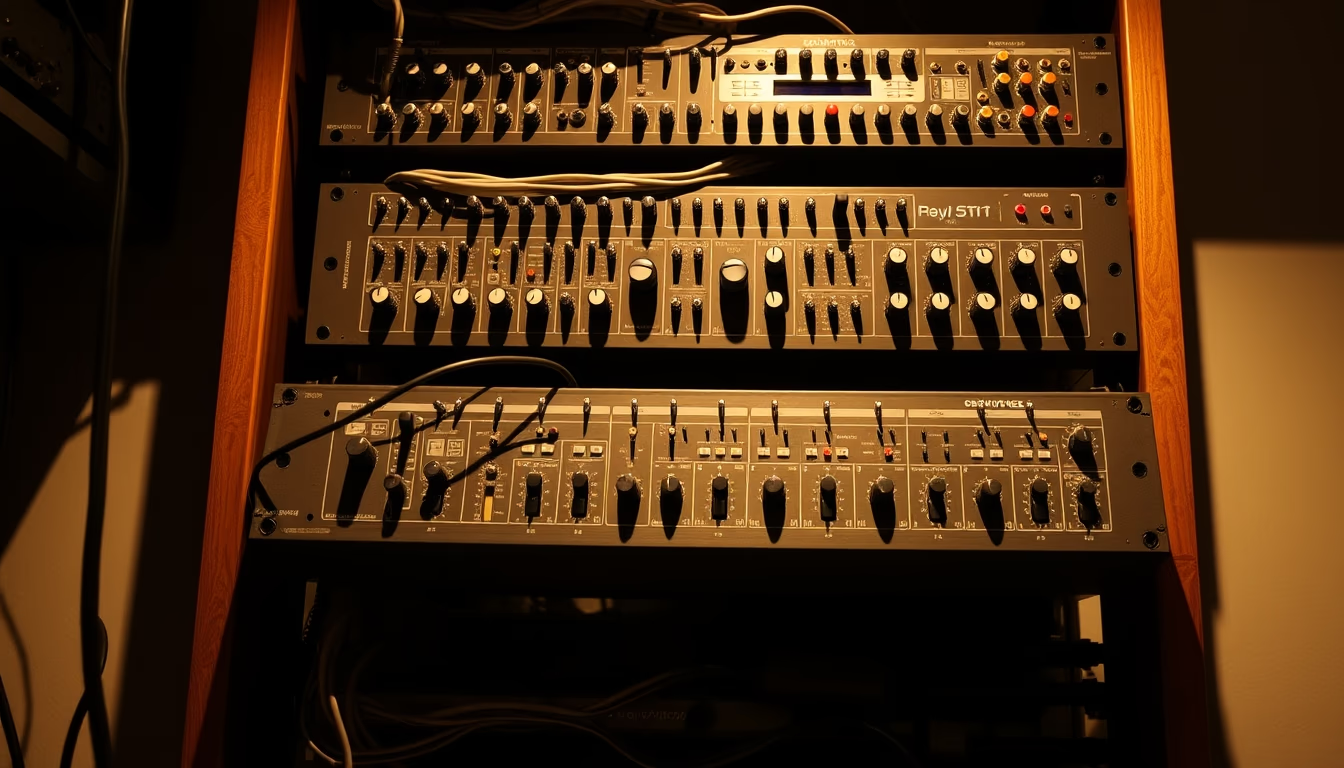
A modular synthesizer rack filled with Eurorack modules, used by electronic musicians to create unique and experimental sounds.
About this subject
Modular synthesizers are electronic musical instruments composed of independent modules that perform specific functions, such as oscillators, filters, amplifiers, and sequencers. Unlike traditional synthesizers, which have a fixed signal path, modulars allow the musician to manually connect modules with patch cables, creating customized signal chains and endless sonic possibilities. The Eurorack format, created by the German company Doepfer in the mid-1990s, became the most popular standard for modular synthesizers due to its compact size and vast ecosystem of manufacturers.
The history of modular synthesizers dates back to the 1960s and 1970s, with systems like the Moog Modular and Buchla. These early instruments were large, expensive, and primarily used in studios and by avant-garde artists. With the resurgence of interest in analog music in the 2000s, the Eurorack format experienced a renaissance, driven by online communities and independent manufacturers. Today, thousands of modules are available, ranging from clones of classic designs to hybrid digital innovations.
A typical modular rack consists of a power supply and rails where modules are mounted. Users can choose modules from different manufacturers, combining them to create a unique instrument. The flexibility is such that the same rack can be used to synthesize lead sounds, pads, percussion, or even as an effects processor. Artists like Trent Reznor, Aphex Twin, and Suzanne Ciani are known for extensively using modulars in their productions.
Modular culture is marked by experimentation and knowledge exchange. Events like Knobcon and SynthFest promote demonstrations and module sales. Additionally, platforms like ModularGrid allow users to plan virtual racks and share configurations. For beginners, it is recommended to start with a small system based on a semi-modular synthesizer or a set of essential modules, such as VCO, VCF, VCA, and envelope.
Frequently Asked Questions
What is a modular synthesizer?
It is an electronic musical instrument composed of independent modules that are manually connected with patch cables. Each module performs a specific function, such as generating or modifying sound, allowing full customization of the signal flow.
What is the difference between a modular synthesizer and a regular synthesizer?
Regular synthesizers have a fixed, pre-configured signal path, while modulars allow the user to connect modules in any desired way, offering much more flexibility and sonic possibilities.
How to start with modular synthesizers?
It is recommended to start with a small system, such as a semi-modular synthesizer (e.g., Moog Mother-32) or a set of essential modules: an oscillator (VCO), a filter (VCF), an amplifier (VCA), and an envelope. Using tools like ModularGrid to plan the rack is also helpful.
Direct URL
https://pub-c7d6a6ea828543ac903a74a341ccb2e1.r2.dev/imagens/modular-synthesizer-rack-fine-art-photography-p12.avifHow to credit
Include a visible link back to UtilizAí. Copy one of the snippets below:
<a href="https://xn--utiliza-eza.com/en/midia/imagens/modular-synthesizer-rack-fine-art-photography-p12">Modular synthesizer rack</a> by <a href="https://xn--utiliza-eza.com">UtilizAí</a>, licensed under <a href="https://creativecommons.org/licenses/by/4.0/">CC BY 4.0</a>.
[Modular synthesizer rack](https://xn--utiliza-eza.com/en/midia/imagens/modular-synthesizer-rack-fine-art-photography-p12) by [UtilizAí](https://xn--utiliza-eza.com), CC BY 4.0
License: CC-BY-4.0