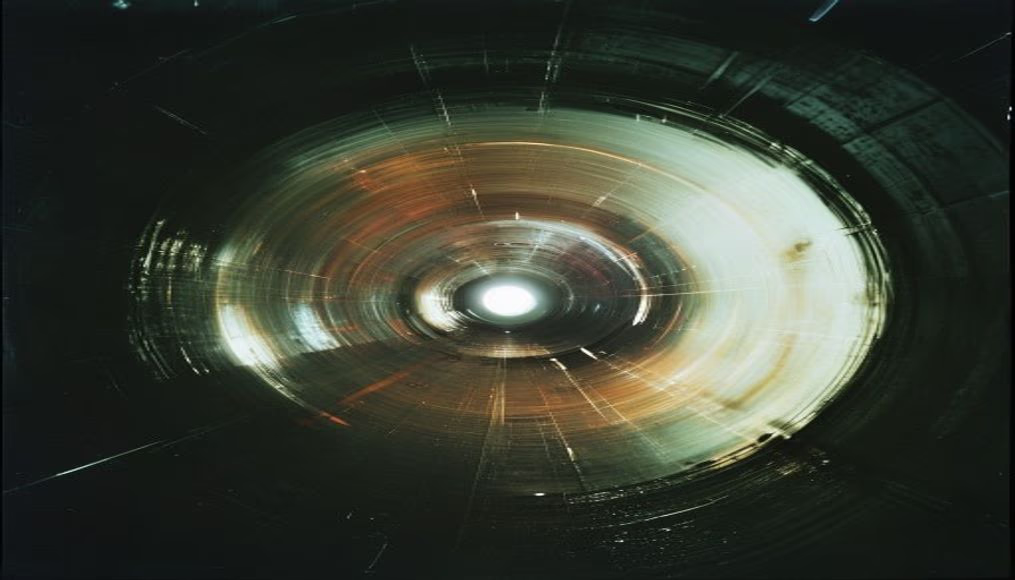
Sun corona eclipse
1344×768 · AVIF · CC BY 4.0

The solar corona, visible only during total solar eclipses, reveals the Sun's outer atmospheric layer with plasma at millions of degrees Celsius.
About this subject
The solar corona is the outermost layer of the Sun's atmosphere, extending millions of kilometers into space. During a total solar eclipse, when the Moon completely blocks the solar disk, the corona becomes visible to the naked eye as a white, iridescent halo. This phenomenon occurs, on average, every 18 months somewhere on Earth, but each specific location may wait centuries for a total eclipse. The temperature of the corona surprises scientists: while the Sun's surface (photosphere) reaches about 5,500°C, the corona reaches 1 to 3 million degrees Celsius. This paradox, known as the coronal heating problem, is not yet fully understood, but magnetic fields and plasma waves are believed to play crucial roles.
Visible structures in the corona include magnetic loops, plumes, and darker regions called coronal holes, where the solar wind escapes at high speeds. Studying the corona is fundamental for predicting space weather, as coronal mass ejections can impact satellites and power grids on Earth. During eclipses, scientists conduct special observations to measure the coronal light spectrum, revealing elements like highly ionized iron, which only exists at extreme temperatures. The corona is also continuously observed by coronagraphs on space telescopes such as SOHO, which create artificial eclipses by blocking the solar disk.
Historically, the first recorded observation of the corona dates back to 968 BC in Assyria, but it was during the 1868 eclipse that the element helium was discovered in the corona's spectrum, before being found on Earth. The shape of the corona varies with the 11-year solar cycle: during solar maximum, the corona is more uniform and symmetric; at minimum, it features long jets at the poles. Photographing the corona requires special equipment and technique, making it one of the most anticipated moments for amateur and professional astronomers on eclipse expeditions.
Frequently Asked Questions
Why is the solar corona hotter than the Sun's surface?
This is the coronal heating problem. It is believed that plasma waves and magnetic field dynamics transport energy from lower layers to the corona, but the exact mechanism is still debated.
How do scientists study the corona outside of eclipses?
They use coronagraphs, which artificially block the solar disk light, installed on space telescopes like SOHO and STEREO. They also make observations in radio and X-rays.
What is the significance of the corona for space weather?
Coronal mass ejections originating in the corona can send charged particles toward Earth, causing geomagnetic storms that affect satellites, communications, and power grids.
Direct URL
https://pub-c7d6a6ea828543ac903a74a341ccb2e1.r2.dev/imagens/sun-corona-eclipse-studio-editorial-portrait-p2.avifHow to credit
Include a visible link back to UtilizAí. Copy one of the snippets below:
<a href="https://xn--utiliza-eza.com/en/midia/imagens/sun-corona-eclipse-studio-editorial-portrait-p2">Sun corona eclipse</a> by <a href="https://xn--utiliza-eza.com">UtilizAí</a>, licensed under <a href="https://creativecommons.org/licenses/by/4.0/">CC BY 4.0</a>.
[Sun corona eclipse](https://xn--utiliza-eza.com/en/midia/imagens/sun-corona-eclipse-studio-editorial-portrait-p2) by [UtilizAí](https://xn--utiliza-eza.com), CC BY 4.0
License: CC-BY-4.0