Sun corona eclipse
1344×768 · AVIF · CC BY 4.0
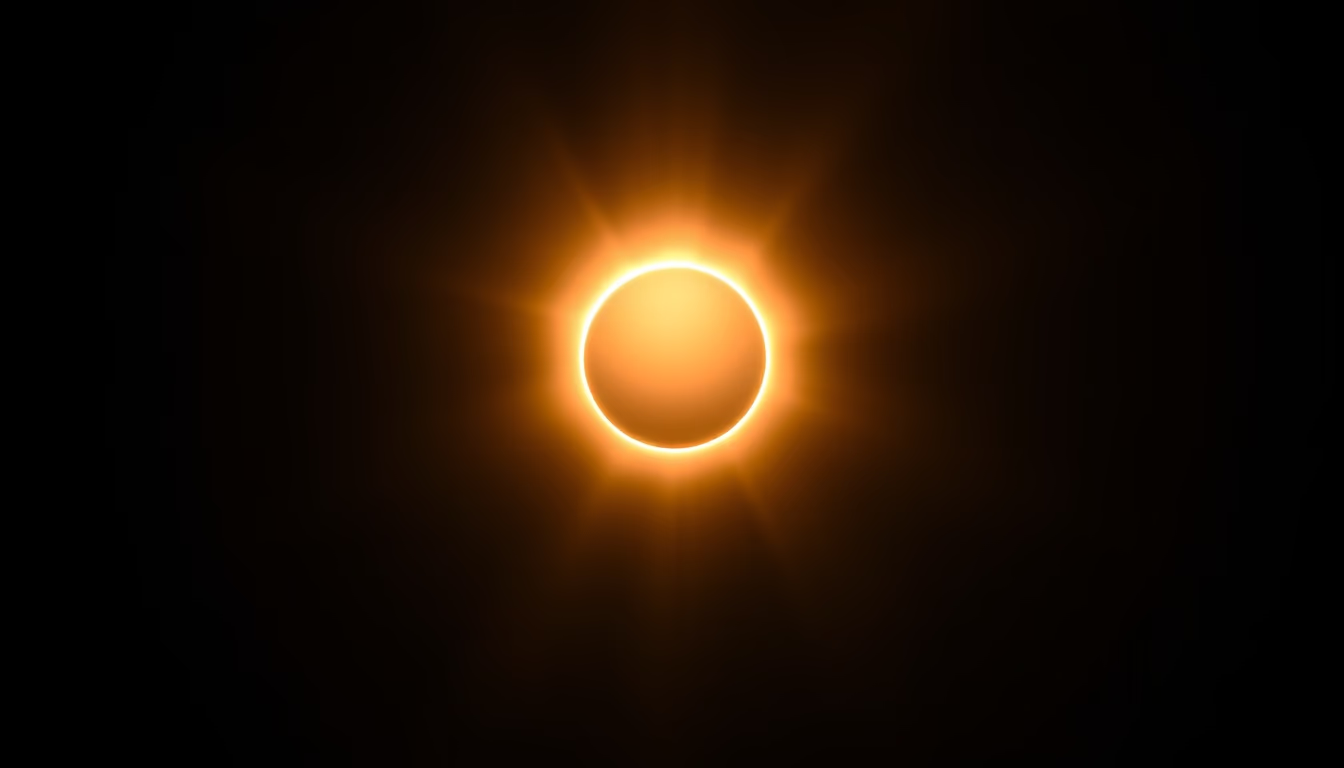
The solar corona, visible only during a total solar eclipse, reveals the star's outer atmosphere and extreme magnetic phenomena.
About this subject
The solar corona is the outermost layer of the Sun's atmosphere, extending millions of kilometers into space. During a total solar eclipse, when the Moon completely covers the solar disk, the corona becomes visible to the naked eye as a faint white halo. This region is extremely hot, with temperatures exceeding 1 million degrees Celsius, while the visible surface (photosphere) is about 5,500°C. This thermal paradox remains a key topic in solar physics.
Observations of the corona led to the discovery of helium. In 1868, during a total eclipse, astronomer Pierre Janssen detected an unknown yellow spectral line, later identified as a new element, named helium (from Greek helios, Sun). Additionally, total eclipses enabled studies of light bending by stars, confirming Einstein's general relativity in 1919.
Culturally, total solar eclipses have always fascinated humanity. Ancient civilizations interpreted them as omens or moments of renewal. Today, events like the 2026 total eclipse (predicted to be visible in several regions) attract thousands of observers worldwide. The corona, with its feathery structures and magnetic loops, is one of nature's most stunning spectacles.
Scientifically, the corona is where coronal mass ejections (CMEs) originate, explosions that release charged particles and affect Earth's space weather. Missions like the Parker Solar Probe and Solar Orbiter study this region up close, but natural eclipses still provide unique, low-cost observation opportunities.
Frequently Asked Questions
Why is the solar corona hotter than the Sun's surface?
This phenomenon, known as the coronal heating paradox, is not fully understood. It is believed that magnetic waves and tiny explosions called nanoflares transfer energy to the corona, heating it to millions of degrees.
When is the next total solar eclipse visible from Brazil?
The next total solar eclipse visible from Brazil will occur on August 12, 2045, but only in the northern region. In 2026, a total eclipse will be visible in parts of Europe, Asia, and Africa, not Brazil.
Is it safe to look directly at the solar corona during an eclipse?
During totality, when the Moon fully covers the Sun, it is safe to observe the corona with the naked eye. However, before and after totality, certified solar filters are essential to avoid eye damage.
Direct URL
https://pub-c7d6a6ea828543ac903a74a341ccb2e1.r2.dev/imagens/sun-corona-eclipse-minimalist-composition-p5.avifHow to credit
Include a visible link back to UtilizAí. Copy one of the snippets below:
<a href="https://xn--utiliza-eza.com/en/midia/imagens/sun-corona-eclipse-minimalist-composition-p5">Sun corona eclipse</a> by <a href="https://xn--utiliza-eza.com">UtilizAí</a>, licensed under <a href="https://creativecommons.org/licenses/by/4.0/">CC BY 4.0</a>.
[Sun corona eclipse](https://xn--utiliza-eza.com/en/midia/imagens/sun-corona-eclipse-minimalist-composition-p5) by [UtilizAí](https://xn--utiliza-eza.com), CC BY 4.0
License: CC-BY-4.0