Solar prominence eruption
1344×768 · AVIF · CC BY 4.0
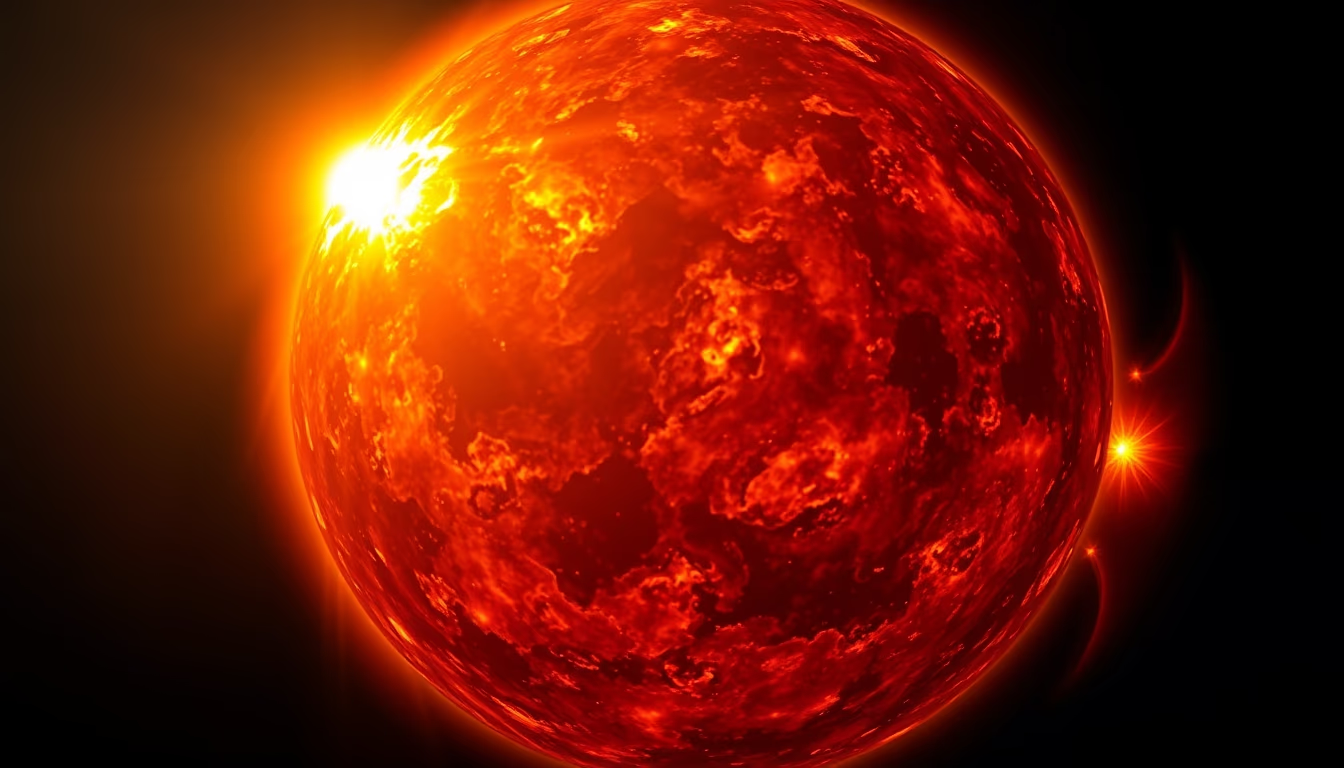
Solar prominence eruptions are intense magnetic phenomena in the Sun's atmosphere, releasing vast amounts of plasma and energy.
About this subject
Solar prominences are magnetized plasma structures that extend from the Sun's surface into the corona, often taking the shape of arcs or loops. When these structures become unstable, they can erupt, ejecting matter into interplanetary space. These eruptions are associated with coronal mass ejections (CMEs), which can impact Earth's magnetic field and cause geomagnetic storms, affecting satellites, communication systems, and power grids.
The Sun undergoes an approximately 11-year activity cycle, during which the number and intensity of prominences vary. During solar maximum, eruptions are more frequent. Prominences can reach heights of hundreds of thousands of kilometers, and their temperatures are much lower than the surrounding corona, around 10,000 K compared to 1 million K. This temperature difference makes prominences visible as dark structures against the solar disk at specific wavelengths, such as H-alpha.
Studying these phenomena is crucial for space weather forecasting. Observatories like NASA's Solar Dynamics Observatory (SDO) constantly monitor the Sun to detect prominences and eruptions. Understanding the magnetic mechanisms behind eruptions helps protect technological infrastructure on Earth and in space. In addition, prominences are the subject of theoretical studies and numerical simulations that aim to unravel the processes of magnetic reconnection and plasma instabilities.
Frequently Asked Questions
What causes a solar prominence eruption?
The eruption occurs when the magnetic field supporting the prominence becomes unstable, often due to motions in the photosphere or interactions with other magnetic fields, leading to magnetic reconnection and energy release.
What is the difference between a prominence and a solar eruption?
A prominence is a stable plasma structure that can last days or months; an eruption is when that structure breaks apart and ejects material into space, often associated with a coronal mass ejection.
Do solar prominence eruptions affect Earth?
Yes, especially if they occur in Earth's direction. They can cause geomagnetic storms, disrupt radio communications, damage satellites, and trigger auroras at lower latitudes.
Direct URL
https://pub-c7d6a6ea828543ac903a74a341ccb2e1.r2.dev/imagens/solar-prominence-eruption-fish-eye-wide-angle-p11.avifHow to credit
Include a visible link back to UtilizAí. Copy one of the snippets below:
<a href="https://xn--utiliza-eza.com/en/midia/imagens/solar-prominence-eruption-fish-eye-wide-angle-p11">Solar prominence eruption</a> by <a href="https://xn--utiliza-eza.com">UtilizAí</a>, licensed under <a href="https://creativecommons.org/licenses/by/4.0/">CC BY 4.0</a>.
[Solar prominence eruption](https://xn--utiliza-eza.com/en/midia/imagens/solar-prominence-eruption-fish-eye-wide-angle-p11) by [UtilizAí](https://xn--utiliza-eza.com), CC BY 4.0
License: CC-BY-4.0