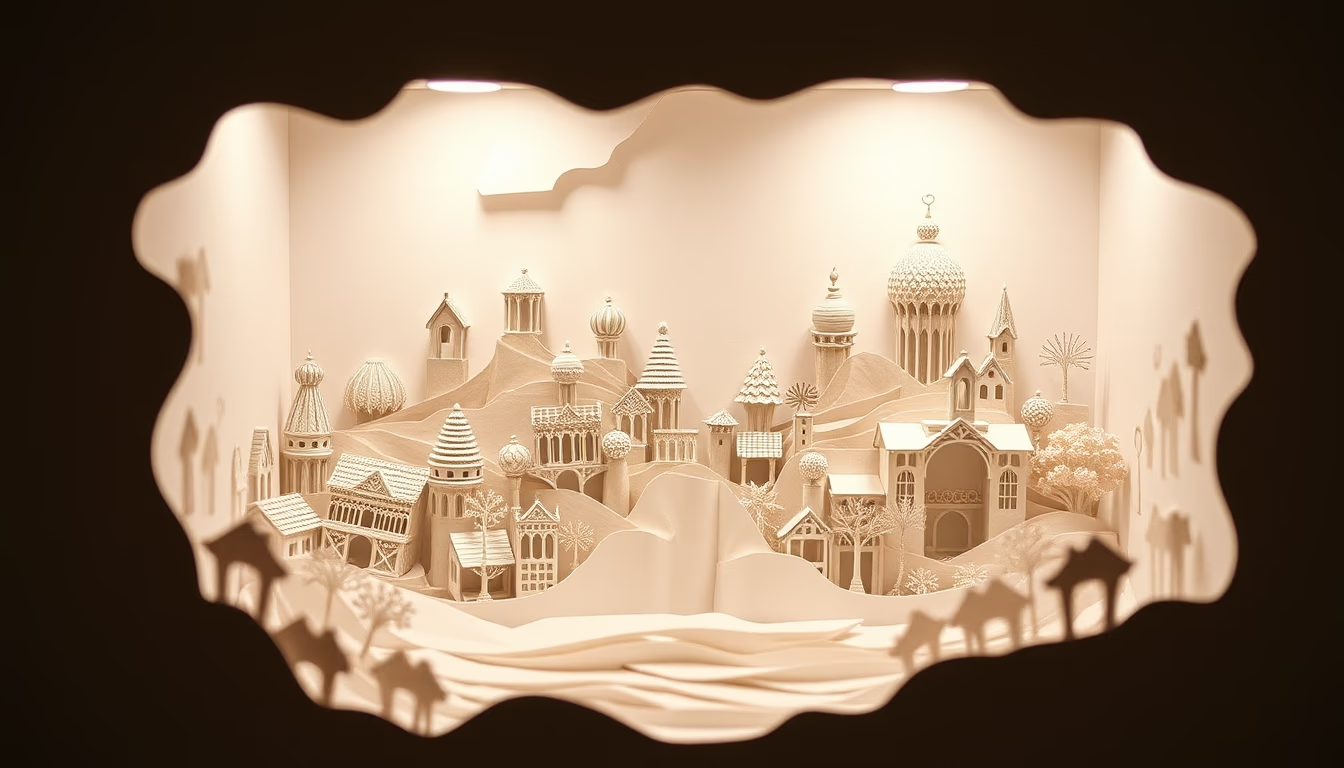
Pop-up book opened
1344×768 · AVIF · CC BY 4.0

Pop-up books blend paper engineering with visual storytelling, creating three-dimensional illusions that delight readers of all ages.
About this subject
Pop-up books are a paper art form that transforms flat pages into three-dimensional sculptures when opened. Their origins trace back to the 13th century, when English monk Matthew Paris created volvelles (rotating discs) in manuscripts. In the 18th century, early movable books with flaps and mechanisms emerged in Germany, primarily for teaching anatomy. The term "pop-up" became popular in the 20th century with publishers like Blue Ribbon Books, which produced animated versions of classic tales.
The technique involves precise cutting and strategic folding, such as V-fold and box fold mechanisms, which create structures that rise when the page is opened. Heavy-weight paper is essential for durability. Artists like Robert Sabuda, Matthew Reinhart, and David A. Carter have elevated paper engineering to high complexity, incorporating elements like levers, wheels, and layered scenes. Designing a single pop-up can take months of prototyping.
Culturally, pop-ups are celebrated for merging literature and design, used both in children's books and adult art pieces. They are collector's items, with limited editions fetching high prices at auctions. Beyond entertainment, they serve as educational tools in subjects like science and history, making abstract concepts visible and interactive. Festivals and exhibitions dedicated to this art form occur in museums worldwide, highlighting its aesthetic and educational significance.
Frequently Asked Questions
What was the first pop-up book in history?
The first movable element is credited to the Volvelles created by monk Matthew Paris in the 13th century. However, the first commercial pop-up book was Little Folks (1929) by Blue Ribbon Books.
What is the difference between a pop-up and a lift-the-flap book?
Pop-up books have structures that rise in 3D when opened, while lift-the-flap books have parts that can be lifted or pulled to reveal content, without necessarily creating volume.
What materials are used in paper engineering for pop-ups?
High-weight paper (150 to 300 gsm), cardstock, precision scissors, craft knife, white glue, and rulers. Advanced artists use design software and printers for prototyping.
Direct URL
https://pub-c7d6a6ea828543ac903a74a341ccb2e1.r2.dev/imagens/pop-up-book-opened-fine-art-photography-fresh11.avifHow to credit
Include a visible link back to UtilizAí. Copy one of the snippets below:
<a href="https://xn--utiliza-eza.com/en/midia/imagens/pop-up-book-opened-fine-art-photography-fresh11">Pop-up book opened</a> by <a href="https://xn--utiliza-eza.com">UtilizAí</a>, licensed under <a href="https://creativecommons.org/licenses/by/4.0/">CC BY 4.0</a>.
[Pop-up book opened](https://xn--utiliza-eza.com/en/midia/imagens/pop-up-book-opened-fine-art-photography-fresh11) by [UtilizAí](https://xn--utiliza-eza.com), CC BY 4.0
License: CC-BY-4.0