Origami crane delicate
1344×768 · AVIF · CC BY 4.0
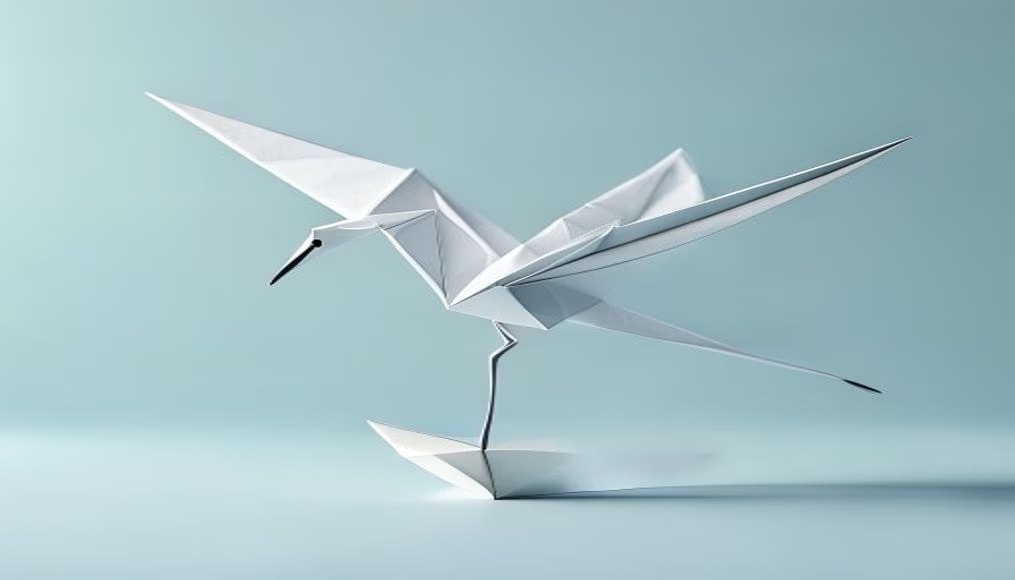
The origami crane, a paper bird symbolizing peace and hope, demands precise folds and carries centuries of Japanese tradition.
About this subject
The origami crane, or tsuru, is one of the most iconic figures in the ancient art of origami, which emerged in Japan around the 6th century with the introduction of paper. The first documented representation of an origami crane dates to the Edo period (1603, 1868), in books such as Hiden Senbazuru Orikata. Traditionally, the crane is folded from a single square of paper without cuts or glue, using about 20 precise folds that transform the sheet into a three-dimensional bird.
The crane gained special significance after the story of Sadako Sasaki, a Japanese girl who lived near Hiroshima and developed leukemia from the atomic bomb. Inspired by the legend that folding a thousand cranes grants a wish, she devoted herself to folding them in hopes of recovery. Sadako died in 1955, but her legacy turned the crane into a universal symbol of peace and the fight against nuclear weapons. A thousand cranes strung together, called senbazuru, are often sent to the Hiroshima Peace Memorial.
In practice, the crane is considered an intermediate origami model, suitable for those who master basic folds. The most common paper is kami, a thin square sheet usually 15 cm per side, but larger or smaller versions are used depending on skill. Variations include the flapping-wing crane or the double-headed crane. Folding requires precision: each crease must be sharply defined with a fingernail to ensure symmetry and stability.
Today, the crane transcends traditional origami, appearing in logos, tattoos, and decorations. It is also used in solidarity campaigns: after natural disasters, senbazuru are sent to affected communities as a gesture of support. The simplicity of the form contrasts with the depth of its symbolism, making the crane not just an exercise in patience but a bridge between cultures.
Frequently Asked Questions
How many folds are needed to make an origami crane?
A traditional origami crane requires about 20 folds, all made from a single square of paper without cuts or glue.
What does a senbazuru (thousand cranes) symbolize?
According to legend, folding a thousand origami cranes grants a wish. Today, senbazuru symbolize peace, hope, and solidarity, especially linked to the story of Sadako Sasaki.
What is the best paper for folding an origami crane?
The best paper is kami, thin and square, usually 15 cm per side. Thicker papers can make precise folding more difficult.
Direct URL
https://pub-c7d6a6ea828543ac903a74a341ccb2e1.r2.dev/imagens/origami-crane-delicate-commercial-product-photography-v9.avifHow to credit
Include a visible link back to UtilizAí. Copy one of the snippets below:
<a href="https://xn--utiliza-eza.com/en/midia/imagens/origami-crane-delicate-commercial-product-photography-v9">Origami crane delicate</a> by <a href="https://xn--utiliza-eza.com">UtilizAí</a>, licensed under <a href="https://creativecommons.org/licenses/by/4.0/">CC BY 4.0</a>.
[Origami crane delicate](https://xn--utiliza-eza.com/en/midia/imagens/origami-crane-delicate-commercial-product-photography-v9) by [UtilizAí](https://xn--utiliza-eza.com), CC BY 4.0
License: CC-BY-4.0